
The planned “Arc de Trump” is less Paris and more Ashgabat. Perhaps the US president was inspired by Turkmenbashi, the founding dictator of post-Soviet Turkmenistan and a man in love with Guinness records, shiny stone and bling.

Thanks to him, the country’s architectural legacy includes the world’s highest density of white marble buildings, the largest “indoor” Ferris wheel and the largest architectural star. But there is fierce rivalry around the world when it comes to other outsize constructions.
Tallest skyscraper: Burj Khalifa

Scraping the sky has been a key part of Dubai’s rise to global prominence, greatness and bigness. “Bold, bonkers and almost unbelievable,” is how one Telegraph writer describes the city’s architecture. Amid Downtown’s cluster of skyscrapers, the Burj Khalifa rises head and shoulders above the rest: the 124th-floor observation deck is at the top of most tourists’ hit-list.
Sign up for the Traveller Deals newsletter
Get exclusive travel deals delivered straight to your inbox. Sign up now.
Hotel with the most rooms: First World Hotel & Plaza

There’s something intriguing about humongous hotels. In the days of the USSR, people were fascinated by the Rossiya, the 3182-room gargantuan that held the world record for biggest hotel from 1967-1980. It was as if the regularly spaced, identical windows and cell-like rooms reflected something about Soviet conformity. Cut to today and the First World Hotel & Plaza, with 7351 rooms reflects back our era of mass tourism, multiple dining outlets and in-house theme parks and casinos.
Tallest hotel: Ciel Dubai Marina

Opened at the end of November, this 377-metre tower (“ciel” means sky) is officially the tallest hotel building. It has 1004 rooms and suites, all with floor-to-ceiling glass windows. Rooms on the hotel’s higher levels have views over the Dubai skyline and the Persian Gulf. The former record holder, the Gevora Hotel, is also in Dubai.
Highest observatory: University of Tokyo Atacama Observatory, Chile

The relative height gain from sea level to a mountaintop is pretty negligible when you’re looking at objects that are light years away. But astronomers like the Atacama’s high places because of the clear skies. The University of Tokyo’s Atacama Observatory is sited at 5640 metres above sea level on the top of Cerro Chajnantor.
Heaviest building: Palace of the Parliament, Bucharest

Nicolae Ceaușescu, Romania’s president from 1974-1989, liked buildings that embodied his authoritarian zeal. The Palace of the Parliament is all about volume, hardness and weight. It has a floor area of 365,000 square metres, occupies 2.55 million cubic metres of sky, and weighs about 4,098,500 tonnes, making it the heaviest building in the world and largest civilian administrative building in the world.
It was designed by 700 architects, and constructed over a period of 13 years, has 23 sections and was valued in 2020 at €4 billion ($6.7 billion), making it the most expensive administrative building in the world. The heating and electricity bill is in the millions per year.
Widest avenue: Avenida 9 de Julio, Buenos Aires

This 16-lane concrete canyon in the heart of Buenos Aires is named for the July 9, 1816 Declaration of Independence. It was planned in 1888 and originally intended to open for the bicentennial. Expropriation and construction issues led to its being delayed until 1926 and work was only fully completed by the 1960s.
The avenue runs for three kilometres from Retiro to Constitución, two neighbourhoods known for their rail termini. As well as the traffic lanes, there are two median strips and the official width is 110 metres, making it the widest avenue in the world. Envisioned in the days of Model T Fords it was expected to be a leafy and airy promenade, but is a hellish highway for the modern flaneur. Crossing it in one go is possible if you’re Usain Bolt and the flashing green men are playing fair.
Longest highway: Asian Highway No 1, Kapikule to Tokyo

When is a street a road? When is a road a highway? There’ll always be debate about definitions. For years the Guinness Book of World Records erroneously conflated Yonge Street in Ontario with Highway 11 to create the “world’s longest street”. Numbering is one way to determine a road, and the AH1 – a UN-recognised denomination – runs from Kapikule on the Turkey/Bulgaria border to Tokyo in Japan – a distance of 20,557 kilometres, passing through 12 other countries en route.
Longest bar in the world: Humble Baron, US
In the UK, a bar is where you order, hustle, queue and block other people’s view. On dead nights, in one-horse towns, a punter might take a stool at one end. In the US, the bar is the main point of a bar, so that bartenders can slide glass down like tenpin bowls and tired cowboys can demand a whole bottle of moonshine to help them forget the last hanging. The Humble Baron in Shelbyville, Tennessee, advertises itself as “premier bar, restaurant and entertainment venue”. Its 158-metre counter is an official record. Years ago, Doncaster’s White Swan claimed to have the world’s tallest bar; but it was closed, perhaps following anti-heightist outrage.
Biggest public square: Xinghai Square, Dalian, China

In an ideal Chinese world, China would own all 20 of these records. Part of the renascent superpower’s brand is to build massive towers, bridges, factories and dams. Xinghai Square in the “major sub-provincial city” of Dalian, in the coastal province of Liaoning, is a 109-hectare emptyish space near the shore; the largest city square in the world, its name means “Sea of Stars”. It was commissioned by disgraced former politician Bo Xilai, who is serving a life sentence for embezzlement and bribery.
Biggest airport: King Fahd International Airport, Saudi Arabia

No big hitter for traffic and with only two runways, this airport covers a whopping 770 square kilometres, making it bigger than Singapore and the Maldives.
Tallest statue: Statue of Unity, Narmada Valley, Gujarat

Several of the world’s tallest statues are Buddhas, but Gujarat’s Statue of Unity is a 182-metre depiction of Sardar Patel, making it almost certainly the most obscure massive statue on earth, too. He was the first deputy prime minister of independent India, and the construction took place between 2013-18, supported by then chief minister of Gujarat, Narendra Modi. The total height of the structure, with its mega-plinth, is 240 metres.
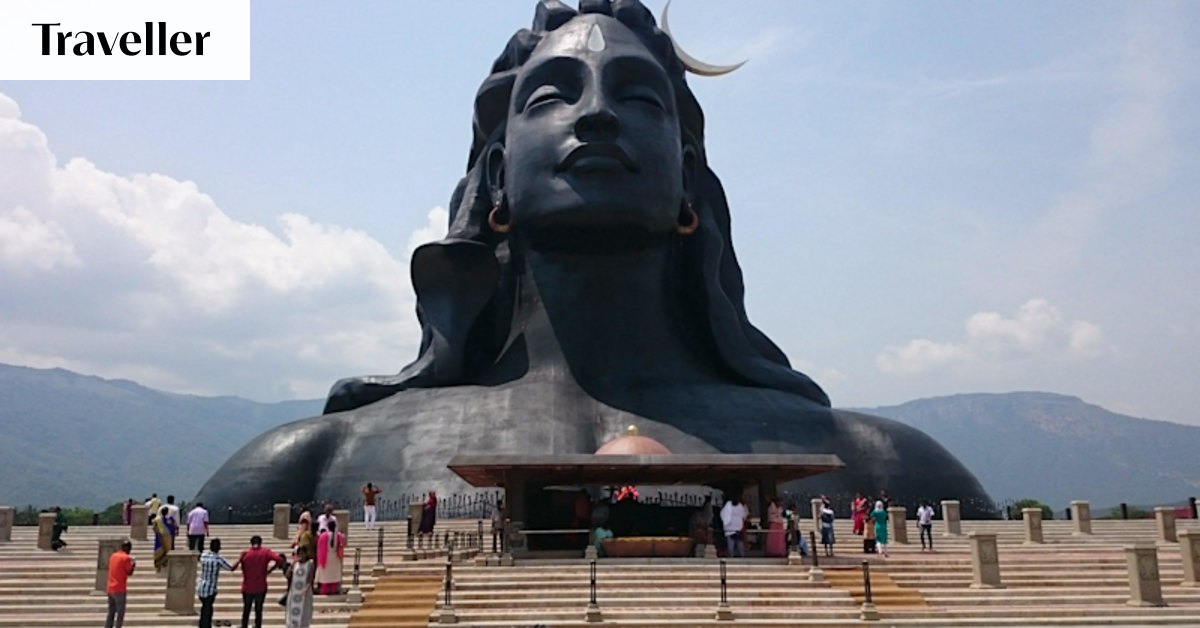
Biggest bust: Adiyogi Shiva, Tamil Nadu

This 34-metre-high head refers to the first yogi and is intended to draw people to the practice of yoga. In imperial measure, it’s 112 feet – 112 alludes to the number of chakras or meditation aids.
Tallest flagpole: Cairo
This 202-metre pole looms above the satellite city of New Capital, New Cairo, Egypt, with special dampers inside to offset wind vibration. Dushanbe, the capital of Tajikistan, Baku in Azerbaijan, and Asgabat, Turkmenistan have all gone in for lofty patriotic poles, and North Korea used to appear in Guinness as a record-breaker – though the pole was on top of a radio tower. Cairo’s is currently the tallest free-standing flagpole.
Biggest flag: State Flag Square, Baku

If a flagpole is phallic, what is the flag at the top of it? Baku’s flapping pendant is 36 metres by 72 metres, its total weight exceeding 500 kilograms. US States go in for massive national flags too – surprise, surprise – while Toronto is said to be the home of the world’s largest Lego flag, made from nearly 250,000 bricks.
Biggest clocktower: Abraj Al Bait, Mecca

You’d have thought Switzerland might have nailed this or even the famously “punctual” UK. But times matter hugely for the praying pilgrims of Mecca. At 601 metres, this is the tallest clock tower in the world, and the complex of seven buildings comprises the world’s second most expensive building.
Biggest roundabout: Putrajaya, Malaysia

This circle of endless indicating is to members of the Roundabout Appreciation Society what Concorde is to plane-watchers or the Mallard to rail-fans. From the air it’s quite beautiful and is the sort of humdrum wonder future developments would be wise to include as a tourist attraction.
Located in Putrajaya, Malaysia, the world’s largest roundabout has a circumference of 3.5 kilometres and 15 entry/exit points. Three turn inwards towards monuments and a five-star hotel, the Pulse Grand Hotel (formerly the Putrajaya Shangri-La). Darling, I’m taking you to an island this year…
Most expensive public building: Great Mosque, Mecca

The Great Mosque or Masjid al-Haram, expansion of which was completed for Ramadan last year, is the largest mosque in the world and cost a reported $145 billion. The UK’s overbudget, delayed nuclear facility Hinckley Point C could cost $96 billion, which would make it number two in this category…
Highest density of white marble buildings: Ashgabat, Turkmenistan

Following Independence, the first president of Turkmenistan, Saparmurat Niyazov, who styled himself Turkmenbashi, founded new Ashgabat. He decreed buildings should be constructed from white marble that would reflect the sun in summer and cheer up the population in winter. The capital of Turkmenistan looks in some places like a massive mausoleum. Ashgabat also boasts the world’s largest enclosed Ferris wheel and largest architectural star.
Largest horse-shaped structure: The Kelpies, Scotland

Beside the M9 between Falkirk and Grangemouth, this pair of monumental steel horse-heads by sculptor Andy Scott represent kelpies: mythical shape-shifting spirits that inhabit Scottish lochs. Each head is 30 metres high. They are possibly the biggest in the world – though Turkmenistan says its horse’s head on a sports stadium is 40 metres high. Guinness agrees, but it can be contended that part of that height is actually a base.
Biggest restaurant in the world: Bawabet Dimashq, Syria

Bawabet Dimashq Restaurant (Damascus Gate Restaurant) has 6014 seats and covers a floor area of 20,000 square metres. The outdoor seating area is available in summer only.
The Telegraph, London