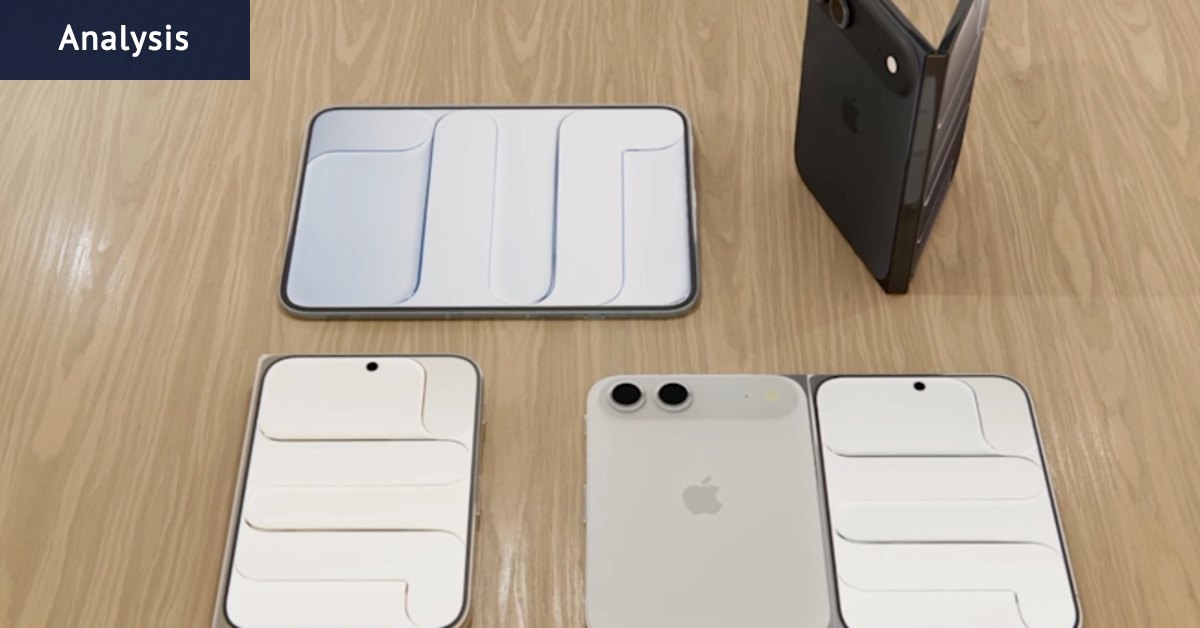


When Apple unveils its iPhone 18 models this September, it may also introduce an entirely new form factor for its smartphones, with rumours intensifying that a folding iPhone is finally ready for release.
Samsung has been releasing folding phones for more than six years, and although they got off to a rocky start, they’ve become a steadily growing product category. Could a folding iPhone tip the format into mainstream acceptance? Or will the majority stick with the standard models, leaving folding phones a niche concern?
Rumours and speculation about Apple’s folding iPhone have been ongoing for years, so at this point, it seems likely the company has tested multiple designs.
In 2024, a report in The Information cited people directly involved in the project as saying Apple would release a flip-style phone, sized like a regular iPhone but with a horizontal crease in the middle to fold into a small square, similar to Samsung’s Z Flip. But more recent reports point to something larger, with multiple analysts describing a passport-shaped device that opens up to become a small tablet.
This shape would differ from most book-style foldable devices on the market, including Samsung’s Z Fold and Google’s Pixel Pro Fold. While those models more or less resemble normal phones while folded, and become a square-ish tablet, Apple’s supposed device would be square-ish in both modes; a 2:3 ratio when folded and around a 4:3 ratio when opened. The advantage would be that both of those screen shapes are in use by iPads, so apps wouldn’t need to be adapted.
Longtime Apple analyst Ming-Chi Kuo described this format in a note last year, also saying that Apple had developed a hinge which eliminated the perceptible gap in the middle of the inner screen. Kuo said the company was prioritising thinness and sleek design even if it made for a notably expensive device, and that it would include a fingerprint sensor instead of Face ID. These details were backed up in a newsletter from Bloomberg’s Mark Gurman, who said the phone would cost more than $US2000 ($2840).
As for the size of the device, multiple rumours indicate an outer screen size of 5.5 inches which, given the 2:3 ratio, would make for a device approximately 8cm x 12cm when closed. Quite a different shape to the latest Z Fold, which is 7cm x 16cm. It would also be the shortest iPhone since 2010’s iPhone 4.
Last year, 3D design files appeared on the internet that had supposedly (but unverifiably) leaked from Apple’s production line. They matched the above measurements, and designers used them to create digital models and 3D-printed dummies, giving glimpses of a phone that resembles a small notepad. When opened, the tablet would have a screen size of 7.8 inches, making for a device smaller than the iPad Mini by just a few centimetres on either edge.
Analyst Jeff Pu has suggested there will be multiple size options for the device, but only the one size has appeared in most rumours.
Demand for iPhones has remained consistent despite each generation of device lasting longer than the last, and despite investor hand-wringing about Apple’s perceived lack of AI features. But the overwhelming bulk of that demand is for the standard iPhone, or the Pro model, with comparatively few users going for the outlier Mini, Plus or Air models.
In fact, some reports have indicated that last year’s Air underdelivered spectacularly, with Apple cutting production to just 10 per cent of its original estimates. The ultra-thin phone is very expensive, lacks features the standard iPhone has including multiple rear cameras, and is an unproven form factor despite Apple’s claims of extraordinary durability.
Bloomberg’s Gurman claims that the design of the folding iPhone will be similar to two Air models joined together, albeit in a different shape. Apple will need to hope there is enough pent-up demand for a non-Android folding phone to counter durability concerns, especially if it claims to have also developed a brand new hinge system that eliminates the foldable screen gap.
Of course, Apple has form with introducing its own takes on devices that other manufacturers have had for years. The iPad, Apple Watch and AirPods were all late to their respective categories, and while they may not have taken off immediately, they did eventually become the overall leading models.
If Apple introduces a $3000 folding iPhone this year, it may not be met with enough immediate demand for it to overtake the standard iPhone or even Samsung’s Galaxy Z Fold. But it could win users over time, especially if Apple markets to its base of creatives who would otherwise have a phone and an iPad Mini separately.
Gurman has reported that Apple is so confident in the folding iPhone that it is already planning a follow-up that would give users the choice between the notepad style and a smaller Z Flip style device.
Get news and reviews on technology, gadgets and gaming in our Technology newsletter every Friday. Sign up here.
 Tim Biggs is a writer covering consumer technology, gadgets and video games.Connect via X or email.