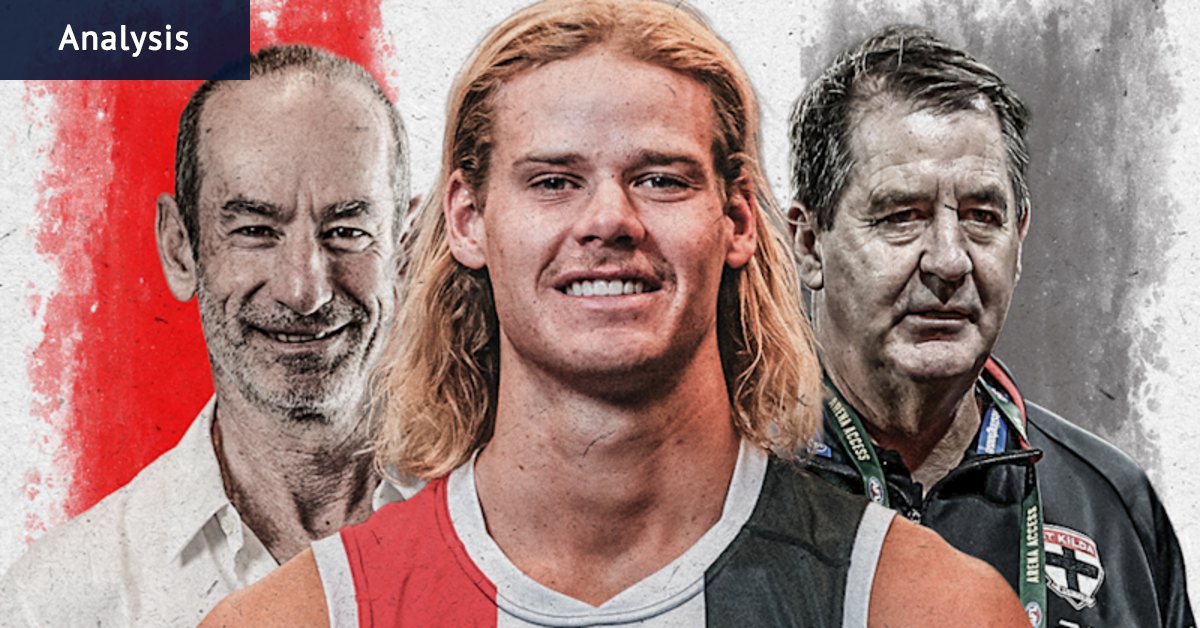

Irrespective of how 17 clubs saw it, St Kilda people endorsed the great trade raid of 2025. They’d had enough of muddling around the middle and lower middle, of meekly submitting to the draft’s slow burn for teams in the ladder’s eight-to-12 purgatory.
Andrew Thompson, St Kilda’s 200-game stalwart and ex-board member with strong links to the current crew (he converted close mate and former AFL chief executive Gillon McLachlan to the Saints too), is among those who viewed the massive splurge as timely and necessary. As a moment that the club stopped having sand kicked in its face.

Malcolm Blight and Ken Hinkley coaching St Kilda in 2001.Credit: Mark Dadswell
“At last, they’re not going to be pushed around,” said Thompson, who summed up the club’s new attitude thus: “The belief feels genuine, as opposed to [just] hope.”
It’s not the first time St Kilda have acted as a disrupter in the marketplace, making offers that were deemed irresponsible.
A quarter-century earlier, Thompson was among a posse of players and officials who went up to Jupiter’s Casino on the Gold Coast to importune Malcolm Blight, in the hope of persuading the eccentric ex-champion and coaching great to sign on.
Rod Butters, St Kilda’s maverick president, passed a napkin to Blight with an offer scribbled on it – $1 million a year, lunatic lucre in that era. Blight, who had been reluctant, was thus persuaded to coach the club, in a union that lasted 15 games.

Andrew Thompson and Fraser Gehrig chaired off the ground by Saints teammates in 2007.Credit: John Donegan
The mercurial coach’s presence gave the bottom-of-ladder Saints the pheromone scent that out-of-contract players couldn’t withstand. Fraser Gehrig, the prodigiously gifted spearhead who had been in the bag for Collingwood, switched to the Saints, while Aaron Hamill, an emerging gun forward at Carlton, signed on for five years; both deals were considered exorbitant.
The Blues were filthy at losing a good player to the Saints, the club that Carlton had treated as a dumping ground for cast-off players back in the ’80s.
Steven Lawrence, a Brisbane Lion with Saints heritage via his father Barry, also jumped on the St Kilda train, as did Brett Voss (Lions), North’s Matthew Capuano and Docker Craig Callaghan. Player agent and ex-North Melbourne powerbroker Ron Joseph, who managed Gehrig and knew Blight well from Arden Street, was a key orchestrator of the dealings, as was football manager and later chief executive Brian Waldron.

Nasiah Wanganeen-Milera has emerged as one of the competition’s best players.Credit: AFL Photos
More crucially, the Saints had a priority draft pick, and used picks one and two to draft teenage key forwards Nick Riewoldt and Justin Koschitzke.
Thompson sees parallels between the revolution of 2000, which continued under Grant Thomas, Blight’s forceful, unorthodox replacement, into the early 2000s, when Nick Dal Santo, Leigh Montagna, Luke Ball, Brendon Goddard and others arrived as teens.
The 2026 Saints, though, have assembled the young talent first, then embarked on the splurge, having drafted Darcy Wilson, Alix Tauru, Mitch Owens, Mattaes Phillipou, Marcus Windhager and their new messiah, Nasiah Wanganeen-Milera, who enters 2026 as the AFL’s highest-paid player after he spurned a leviathan offer from Port Adelaide.
The revolution of 2000 succeeded, in the sense that the Saints did garner sex appeal and a more tenacious culture, becoming a top-four team five times from 2004 until 2010. They might have won the flag three times – in 2004 (they lost the preliminary final by a kick to eventual premiers Port Adelaide), then the grand final near misses of 2009 and 2010 under Lyon.
Gehrig booted more than 100 goals in 2004, and won Coleman Medals in ’04 and ’05. Hamill, whose body did not hold up over his five-year deal, was nonetheless, an important influence in the locker room and as leader.
The four horsemen of 2025’s post-season have created a similar buzz to the millennial version. The nature of their deployment – and output – will be followed intensely.

Sam Flanders (right) played 89 games for Gold Coast.Credit: AFL Photos
The Suns rated Flanders as a quality player, whom they couldn’t accommodate in that loaded midfield, and his former club expects that he will perform well as a mid for the Saints.
Loading
De Koning shapes a ruckman whose prospects have been assisted by the new ruck rule favouring jumpers over wrestlers. The converse, however, might be true of Rowan Marshall, whom the Saints stubbornly held on to despite his request for a trade to Geelong.
Marshall, in the absence of Max King, has the capacity to play forward, as he surely will this weekend.
For Silvagni, who improved markedly when shifted to key defender at Carlton last year, the question will be whether he can avoid the injuries that beset him lately with the family firm. Ryan has less career runway remaining. Can he regain the lustre lost in a dismal West Coast team?
Whatever unfolds in 2026, the Saints have moved from off-Broadway to Times Square. They’ve raised the stakes dramatically.
If the stairway can’t lift the Saints to the clouds, their chequebook recruiting may go down like a lead zeppelin.
Keep up to date with the best AFL coverage in the country. Sign up for the Real Footy newsletter.