
What makes a work of art scandalous changes with time. Jackson Pollock’s Blue Poles caused an outcry when it was purchased by the National Gallery Australia for $1.3 million back in 1973, the most ever paid at that time for an American painting. In 2023, the NGA valued it at more than $500 million, but to Australia it is a priceless treasure.
For our summer series, we asked galleries around the state to nominate the most controversial items in their holdings, unearthing an array of the weird and wonderful.
Lauren Ellis, curatorial manager, Bendigo Art Gallery
The Young Family (2002-03) was created by Patricia Piccinini for her solo presentation in the Australian Pavilion at the 50th Venice Biennale in 2003. The work represents an exhausted human-pig chimera mother suckling her playful babies, creatures engineered by humans to grow organs for human transplants. It was the work that elevated Piccinini’s international profile, as audiences grappled not only with the ethical questions it raised, but the visceral reactions it triggered.

Patricia Piccinini’s The Young Family (2002-03).Credit: Bendigo Art Gallery
When it was acquired by Bendigo Art Gallery, a letter of complaint to then-director Karen Quinlan described it as a “monstrosity”. The uncanny creatures are certainly divisive: disconcerting to some, adorable and relatable to others. Social attitudes to the body have shifted dramatically since the work was created. Various activist movements have challenged the vilification of non-normative bodies. On the other hand, the lifelike details of freckles, wrinkles, pores and hairs elicit even stronger physical reactions in today’s world of botox and dermaplaning.
At the time it was created, many relegated The Young Family to the realm of science-fiction. Less than two decades later, in 2017, the first human-pig embryos were created in California, making the moral dilemma at the heart of this work more relevant than ever.
Suzette Wearne, senior curator, McClelland Sculpture Park + Gallery
In 2015, an enormous, shimmering stainless-steel gnome was installed on a prominent site beside the Peninsula Link freeway in Frankston, in Melbourne’s outer south-east.
The community’s early response ran the gamut from admiration and wonderment to confusion and intense dislike. Public Facebook pages covering all things Frankston became a safe space for residents to make curiously mean-spirited comments about the work. Many were aggravated by what they perceived as an extravagant and unnecessary expense.

Reflective Lullaby by Gregor Kregar.Credit: Mark Ashkanasy
Reflective Lullaby by Slovenian-born, New-Zealand-based artist Gregor Kregar was the first of the Southern Way McClelland Commissions, a program which has positioned the Mornington Peninsula on the map of public art and contemporary sculpture internationally. McClelland has been able to commission six landmark sculptures through the program, which will continue until 2037.
By the time Kregar’s work was relocated to its forever home in McClelland’s sculpture park in 2023, it had forged an indelible place in the hearts and minds of the local community and went by the nickname “Frankie”. Facebook pages became a safe space for people together to mourn the loss of a figure that had become a landmark on their commute, and, for some, synonymous with home. Some were outraged by McClelland’s brazen “theft” of the popular icon.
At McClelland, when the weather is just right, Frankie becomes paradoxically camouflaged – his mirror-like surface reflecting only the eucalypts that surround him. It is, as the artist intended, at once ridiculous and sublime.
Danny Lacy, artistic director, Shepparton Art Museum
There is some mystique about John Perceval’s angels, including my pick, Delinquent Angel. We have three in the collection and they’re sort of quite ugly little creatures in a way, almost an acquired taste because they are amazingly raw, each with their own personality; all are quite different and odd and obscure. I actually love them but everyone has a different reaction – our exhibitions manager dislikes one of them intensely, so even within the gallery staff we all respond to them quite differently.

Detail of Delinquent Angel (1961) by John Perceval. Credit: Shepparton Art Museum
We had Delinquent Angel out on display again recently and people were quite fascinated by it. It was made in the early ’60s, so a lot of time has passed since then. They are quite lovely objects with this mystique about them.
That’s the beauty of the sculptures, they are quite devilish in a way – especially Delinquent Angel, it has that amazing red and copper glaze, it’s not your traditional vision of what an angel might be. I think anyone who has little kids probably responds to it quite well! They have a real personality, even though they are modest in size, and take up more visual space and headspace than their size. We always show them with a lot of physical space around them.
These pieces raise questions about what is good art, what value do you put on it? Delinquent Angel is one of the more treasured works in the collection, so much so that it was the gallery’s logo for a while. There were mixed reactions to the piece when it was acquired back in 1976 by then-director Peter Timms. Media clippings show there was outrage from one councillor that the gallery had spent $2700 on “a 10-inch bit of stuff”.
It’s an interesting sign of the times. Timms was hugely well respected and had great connections with artists and galleries. There was a bit of pushback from the community supporting the acquisition.
Stephanie Sacco, curator collections, Mornington Peninsula Regional Gallery
(Potentially) enough bodypaint for three dancers by d harding, a Bidjara, Ghungalu and Garingbal artist, won the Mornington Peninsula Regional Gallery’s biennial award, National Works on Paper, in 2024.
One of the leading art awards in the country, and one of the most popular exhibitions on the gallery’s calendar, National Works on Paper celebrates the dynamism of Australian contemporary artists working with paper as their chosen medium.

(Potentially) enough bodypaint for three dancers, by d harding, won the National Works on Paper award in 2024.Credit: MPRG
The winning work sparked debate among visitors to the gallery. It can easily be perceived as simply white paint on a large sheet of once-folded paper. However, its power is in its simplicity.
As the title suggests, the paper carries the artist’s approximation of enough bodypaint that three dancers could re-wet and use it to paint their bodies.
When selecting the winner, the judges applauded harding’s clever use of paper, making it active, a carrier of Country, culture, ritual and people. (Potentially) enough bodypaint for three dancers is a masterful intersection of the richness and depth of the world’s oldest continuous culture, and the relative newness of the contemporary.
(Potentially) enough bodypaint for three dancers is part of Unfolding: First Nations Works on Paper at Mornington Peninsula Regional Gallery until February 15. Applications for National Works on Paper 2026 open on February 2.
Lisa Sullivan, assistant director (curatorial), Geelong Gallery
“I really hate Collingwood.” “I would vote for Trump.”
Controversial? Scandalous? Heartfelt? Or humorous? Whatever your position, these are just a few of the 106 revelations that inform Richard Lewer’s Confessions (2024): a multi-panel installation that was recently acquired by Geelong Gallery and is currently on display in the artist’s solo exhibition, I Only Talk to God When I Want Something. The exhibition title is Lewer’s own confession.

Confessions (2024) by Richard Lewer.Credit: Andrew Curtis
The work was created through a participatory project at the National Gallery of Victoria’s Triennial in early 2024, where visitors’ personal confessions were heard by Lewer and then painted onto pegboard panels: a material nod to the confessional booth of his childhood church in Hamilton, New Zealand.
The additional 104 confessions can be viewed alongside other works that reveal Lewer’s interest in religion including interpretations of Stations of the Cross, Seven Deadly Sins and The Last Judgment.
And while the Catholic Church has been plagued by controversy and scandal, this isn’t the focus of Lewer’s creative response to the faith system under which he was raised. As he has said: “Religion, with all its stories and rituals, has always intrigued me. Not so much for the doctrine, but its potential to shape human behaviour, offering a kind of moral guidance, a set of rules for how we might live more consciously.”
I Only Talk to God When I Want Something – Richard Lewer is at Geelong Gallery until March 1.
Cressida Goddard, registrar, City of Melbourne Art & Heritage Collection
In World War II, huge numbers of US soldiers came to Melbourne and so there was (presumably) a lot of naughtiness going on. In early 1942, Melbourne was the initial headquarters for the allied military effort in the south-west Pacific and hosted more than 30,000 American soldiers.
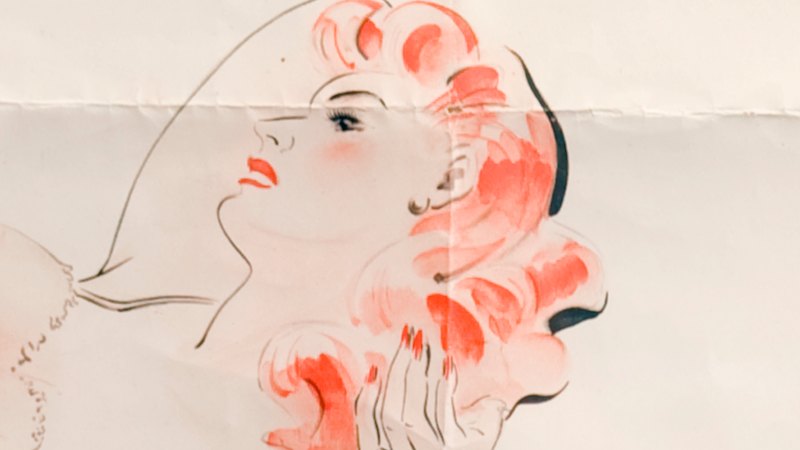
This poster has a little note on the top saying, “For exhibition in brothels only”, and was an attempt to reduce venereal disease. The woman’s face looks very much like the woman on the Redheads matches.

The “Don’t risk it feller” poster, from the early 1940s, is part of the City of Melbourne Art and Heritage Collection.Credit: City of Melbourne
We don’t know anything about the artist. Normally the printer’s name would be included at the bottom of the poster, but there’s nothing there. Maybe they didn’t want to be associated with this sort of content.
In 2010, there was a show at the City Gallery at Melbourne Town Hall, called Overpaid, oversexed and over here: US Marines in Wartime Melbourne 1943 and the poster featured in that exhibition.
Loading
There are 16 rooms in the City of Melbourne collection – including Moomba, Street Art, Public Art, Photography, Contemporary art, Artworks by Aboriginal artists – and then we have a room of misfits, which includes miscellaneous items relating to Melbourne and that where the poster sits, behind the door. It’s like it’s in the naughty corner.
If you look closely you can see the fold creases, as though someone has folded it up and maybe hidden it away.
Guided tours of the Art and Heritage Collection store at Melbourne Town Hall run at 2.30pm on Mondays and Wednesday to Friday (excluding public holidays). Free entry but bookings essential. See citycollection.melbourne.vic.gov.au
The Booklist is a weekly newsletter for book lovers from Jason Steger. Get it delivered every Friday.