Israel vows to kill next supreme leader, Starmer-Trump feud widens, oil prices rise


Updated ,first published
London: Israel has vowed to eliminate the next supreme leader of Iran as it launched another wave of “broadscale strikes” at Tehran and intensified attacks on targets in Lebanon on the fifth day of the war.
Iran is preparing for a long campaign against the United States and Israel, despite its losses in the air war so far, as senior clerics are tipped to name the hardline Mojtaba Khamenei, son of slain Ayatollah Ali Khamenei, as the nation’s new supreme leader.
Israeli Defence Minister Israel Katz declared that Iran’s next leader, whoever it is, would be a target.
“Every leader appointed by the Iranian terror regime to continue and lead the plan to destroy Israel, to threaten the United States and the free world and the countries of the region, and to suppress the Iranian people – will be a target for elimination,” Katz wrote on social media.
Israeli forces targeted the clerics at the symbolic heart of their power on Tuesday by striking the building in Qom where the Assembly of Experts would normally select a supreme leader, but the Iranian decision appears likely to be made in an online meeting.
Khamenei, 86, who was killed along with other senior leaders in strikes on Saturday that began the war, will be farewelled at a ceremony late on Wednesday, Tehran time, a possible factor in the timing of Israel’s new “wave of extensive strikes” on the capital.
The US is claiming success in curbing Iran’s ability to launch missiles and drones across the Middle East after striking nearly 2000 Iranian targets.
The mammoth bombing campaign, supported by 50,000 US personnel, aims to end the chaos across the region as a shipping crisis deepens fears of rising oil prices, and airlines cancel flights and nations try to intercept Iranian drones and ballistic missiles.
Israel said one of its F-35 fighter jets had shot down an Iranian Yak-130 jet over Tehran, and it warned Israeli citizens to prepare for ballistic missiles being fired from Iran.
“A short while ago, missiles were launched from Iran toward the territory of the State of Israel,” the Israel Defence Forces said on Wednesday afternoon, local time (10.49pm, AEDT).
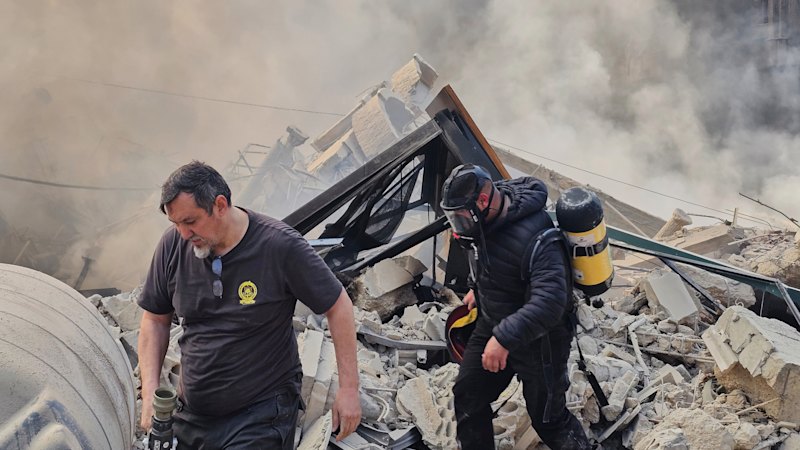
The war is estimated to have killed at least 1000 civilians in Iran since Saturday, according to the Human Rights Activists News Agency in the US, as thousands attended a funeral for students who died in a strike on the Shajareh Tayyebeh girls’ school in Minab, in southern Iran.
The death toll at the school is now 108 students, according to the Iranian Red Crescent Society, although access to the site to confirm the estimates has been limited.
US President Donald Trump expressed confidence about winning the war but sent further conflicting messages about its goal and duration, saying one option was to accept a different leader at the top of the Iranian government.
“I guess the worst case would be we do this, and then somebody takes over who’s as bad as the previous person, right? That could happen,” he told reporters at the White House.
“So we’d like to see somebody in there that’s going to bring it back for the people.”
Trump turned on a key ally, UK Prime Minister Keir Starmer, in an extraordinary rift between the two governments over the cause and timing of the war, after the British leader refused to allow US forces to use the Diego Garcia base in the Indian Ocean and the Fairford airfield in England.
“This is not Winston Churchill we are dealing with,” Trump said of Starmer, dismissing the prime minister with the comparison to Britain’s wartime champion.
The remark followed Starmer’s declaration in the UK parliament on Monday that he could not support military action that did not have a “viable, thought-through plan”.
Trump also threatened to halt trade with Spain after its Prime Minister, Pedro Sanchez, condemned the “unjustified, dangerous military intervention” in Iran and said it was a violation of international law.
Despite the economic risk of a rift with Trump, French President Emmanuel Macron also said the strikes against Iran were “outside of international law” – at the same time as he ordered French forces to take out Iranian threats as missile and drone strikes increased around the region.
German Chancellor Friedrich Merz, who met Trump at the White House on Tuesday (early Wednesday AEDT), took a more diplomatic approach by saying the strikes were “not without risk” but that political change in Iran would be positive for the Iranian people.
Lebanon’s Health Ministry said on Tuesday (Beirut time) that Israeli strikes had killed at least 50 people and wounded 335 since the latest escalation began.
Israel has suffered 10 deaths from attacks on its civilians, including nine people in an Iranian missile strike on a synagogue at Beit Shemesh near Jerusalem on March 1. The US has confirmed six casualties from its military forces.
United Nations Secretary-General António Guterres is pushing for a halt to the conflict after his office warned of the “multiplication of new fronts” across the Middle East.
“We are also witnessing an increasing number of civilian casualties and a severe humanitarian impact on the wellbeing of people throughout the region,” a spokesperson for Guterres said.
While Trump and his senior leaders said they launched the strikes on Saturday because Iran presented a nuclear threat and therefore justified self-defence by the United States, the head of the UN’s nuclear watchdog, Rafael Grossi, told CNN that Iran was not days or weeks away from acquiring a nuclear weapon and did not pose an imminent threat.
The war remains clouded by the dispute over the justification for the US and Israel strikes as the best way to halt Iran’s nuclear ambitions and curb its support for terrorist groups around the region.
US admiral Brad Cooper, the commander of the Central Command leading the strikes, said Iran’s air defences had been badly degraded, its navy had no operational vessels on key waterways after 17 were sunk, and more than 2000 Iranian targets had been hit.
“My overall operational assessment is that we are ahead of our game plan,” he said in a video briefing. “In simple terms, we’re focused on shooting things that can shoot us.”
But Iran’s Islamic Revolutionary Guard Corps declared it had “full control” of the Strait of Hormuz and could halt ships seeking to move through the strategic waterway, continuing the supply shortages that have led to a surge in the price of oil.
Trump responded by saying the US Navy could escort oil tankers through the Strait.
Airlines have struggled to deal with the impact of the air war, cancelling more than 20,000 flights, while governments are seeking to bring citizens home on emergency flights.
With wires
Read more on the US-Israel-Iran war:
Get a note directly from our foreign correspondents on what’s making headlines around the world. Sign up for our weekly What in the World newsletter.
 David Crowe is Europe correspondent for The Sydney Morning Herald and The Age.Connect via X or email.
From our partners