US president orders restart to nuclear weapons testing

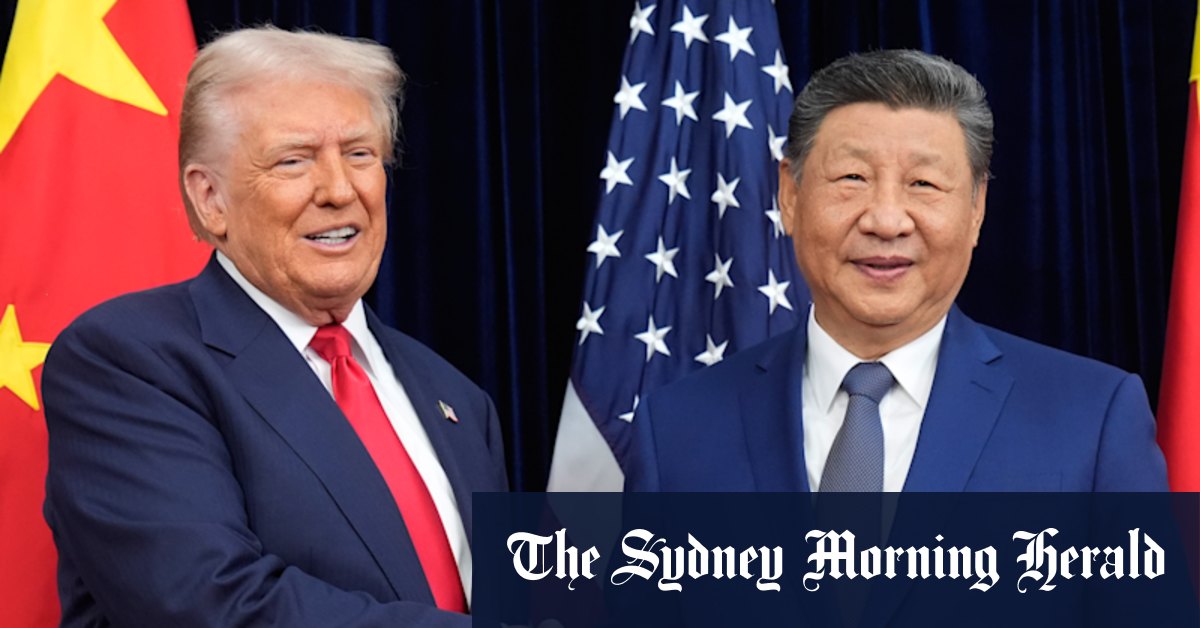
Trump also revealed that he would visit China in April, paving the way for a broader deal to be negotiated before then.
China’s foreign ministry confirmed the planned visit on Thursday, and said the two sides had agreed to extend for a year the tariff truce they struck in May, which wound back eye-watering triple-digit levies.
Xinhua reported that the foreign ministry said the two sides also reached a consensus on issues including anti-drug co-operation on fentanyl, expanding agricultural product trade, and rolling back their recent export curbs and trade restrictions.
In brief opening remarks before the press was asked to leave the meeting room, Xi told Trump via a translator that it was normal for the world’s two top economies to have frictions and noted their respective trade negotiators had achieved a “fundamental consensus” to address the primary concerns.
“In the face of wind, waves and challenges, you and I at the helm of China-US relations should stay the right course and ensure the steady sailing forward of the giant ship of China-US relations,” Xi said.
Just before Trump walked into the meeting in Busan, on the sidelines of the APEC summit in nearby Gyeongju, he declared on social media that he had ordered the US to restart nuclear weapons testing, after Russia announced trials of a nuclear-powered underwater drone and nuclear-capable cruise missile.

Donald Trump, Anthony Albanese and Singaporean Prime Minister Lawrence Wong arrive for dinner in Gyeongju on Wednesday.Credit: Getty Images
“Because of other countries’ testing programs, I have instructed the Department of War to start testing our Nuclear Weapons on an equal basis. That process will begin immediately,” Trump wrote on Truth Social.
Such a test would be seen in Russia and China as a deliberate assertion of US strategic power. The US’s last nuclear explosive test was in 1992. Russia has not conducted nuclear tests since 1990, while China’s last test was in 1996, according to the United Nations.
Russian President Vladimir Putin said on Wednesday that Russia had successfully tested a Poseidon nuclear-powered super torpedo that military analysts say is capable of devastating coastal regions by triggering vast radioactive ocean swells. But on Monday, Trump brushed off security concerns over Russia’s tests by noting the US had a nuclear submarine “right off their shores”.
Loading
Trump also said on Thursday morning that he had approved plans for South Korea to build a nuclear-powered submarine at a US shipyard, after a request a day earlier from South Korean President Lee Jae Myung. Lee argued that conventionally armed submarines would help his country better track North Korean and Chinese vessels and ease the operational burden on US forces.
Prime Minister Anthony Albanese dismissed concerns that the deal could make it difficult for the US to meet its obligations to Australia under the AUKUS defence pact and rejected the suggestion that South Korea would get greater access than Australia to secret US nuclear technology.
“These bilateral arrangements are a matter for the United States and Korea,” Albanese said in Gyeongju on Thursday morning, where he is attending the APEC summit.
“The arrangements that Australia has entered into with the United States and the United Kingdom are in our national interest, they will provide for Australia to have access to that technology. And that’s a very positive thing.
Loading
“President Trump has made very explicit his not just support for AUKUS, but indeed the bringing forward of the timetable, if that is possible.”
Albanese sat beside Trump at an intimate dinner in Gyeongju on Wednesday night attended by a select group of world leaders at the APEC summit.
Trump praised Albanese at the dinner for their “great meeting a week ago” at the White House, and said Albanese had “done a fantastic job”.
“We’re working together on rare earths, but we’re working on a lot of things together,” Trump said.
With Bloomberg, Reuters, AP
Get a note directly from our foreign correspondents on what’s making headlines around the world. Sign up for our weekly What in the World newsletter.