
THEATRE
THE ELOCUTION OF BENJAMIN FRANKLIN
Belvoir Downstairs Theatre, February 26
Until March 29
Reviewed by JOHN SHAND
★★★★
At the risk of revealing I’m over 21, I saw Gordon Chater’s unforgettable 1976 performance as Robert O’Brien in this one-actor play’s premiere season, in those heady days that confirmed Australian plays, acting and production could be world-class.
It toured Australia, had acclaimed West End and off-Broadway seasons, and was duly revived, but hasn’t received a professional production for 24 years. Until now.
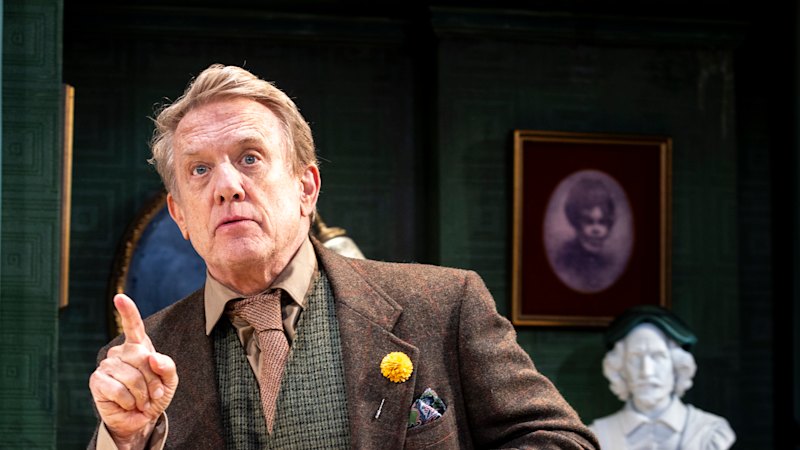
Make no mistake: this is among Australia’s greatest plays, containing one of the most enthralling characters and most challenging roles in our relatively brief theatrical history. To take it on, as Simon Burke does here, demands virtuosity of range and stage-craft as well as a preparedness to bare all.
I don’t just mean a man in his 60s being physically naked, as stipulated in the opening sequence – which requires its own courage in such a combustion chamber, with 80 people all within two metres of the stage. I mean the demands of letting us glimpse the soul of man who is an elocution teacher by day, a transvestite by night, and is wrongly confined to a psychiatric institution following accusations of child molestation.
O’Brien also has a wicked sense of humour. Did this aspect not stand the test of time, the play, itself, would not. While not all O’Brien’s quips will pass the newfangled puritanism in which we sometimes find ourselves, a diverse opening-night audience laughed at nearly all, aided by Burke’s delicious realisation of this endlessly multifaceted character, directed by Declan Greene for Griffin Theatre Company.
As well as being funny, O’Brien is intelligent, well read, hard-drinking and bawdy, and lusts after Mick Jagger, sometimes in the drag attire in which he shares dalliances with his married-with-children stockbroker friend, Bruce. He’s also warm, sincere and an expert, caring elocution teacher.
The wonder of Steve J Spears’ achievement is that he created such a complex, rounded man of 60 as a straight 23-year-old. The wonder of Burke’s achievement is making O’Brien glow with an inner warmth that jack-knifes to spitting rage. Moments of something close to acting genius (as when recreating a boorish talk-back radio discussion) alternate with moments where little cracks appear, which may well be papered over as the season advances.
Not only is it a monumental role in terms of range and density, but it’s as complex as Winnie’s in Beckett’s Happy Days in terms of the choreography of props, including bottles, smokes, a bra (which he steps into, rather than puts on), an endlessly ringing telephone and a bust of Shakespeare, which he addresses (possibly presumptuously) as his confidante.
Greene finely calibrates the gathering drama in Spears’ text, and the complexity of the play’s morality has only increased. If Burke doesn’t quite scale Chater’s heights (assuming vivid memories can be trusted), those heights are within his grasp, and others may well remember his own performance in 50 years’ time.
It’s a family affair for hip-hop veterans
THEATRE
Hilltop Hoods
Qudos Bank Arena, February 27
Reviewed by JAMES JENNINGS
★★★★
Hip-hop is one of the most unforgiving genres for artists, with rappers typically going from the hot new thing to being “old school” and out of style within about 10 years. This makes it an exceptional achievement that Hilltop Hoods, the Adelaide hip-hop group formed in 1994, are just as popular 30-plus years into their career, and capable of packing out Qudos Bank Arena over two nights – something most of their contemporaries from the US would have a hard time achieving.
That comes down to an extremely loyal fan base, that loyalty perhaps chiefly earned through Hilltop Hoods honing themselves into one of the country’s most electric live acts, crafting something far beyond a couple of guys on the mic – in this case, MCs Matthew “Suffa” Lambert and Daniel “Pressure” Smith – simply barking incoherent rhymes over a backing track.
Instead, you get a performance that begins with the high energy and fanfare of an encore, complete with confetti and pyrotechnics, that maintains that high bar throughout the show. Lambert and Smith, both entertaining and technically excellent rappers, tear through hits Leave Me Lonely, Chase That Feeling and The Nosebleed Section – the one Hoods song everybody knows – with the kind of cardio-raising gusto to put performers half their age to shame.
Although the group, backed by Barry “DJ Debris” Francis, has recorded and toured with the Adelaide Symphony Orchestra, tonight is a more stripped-back affair. Still, there’s no shortage of additional musicians, with the Hoods joined on stage by a drummer, sprightly three-piece brass section and Adelaide singer Nyassa, whose powerful voice lifts several songs, including the title track to last year’s Fall from the Light LP.
A succession of guests also keeps excitement levels raised, with surprise appearances from singers Montaigne, MARLON, SIX60’s Matiu Walters and Adrian Eagle, along with rappers Illy and trials (both of whom add verses to crowd favourite Cosby Sweater).
It’s that sense of inclusivity and everyone being invited to the party that makes this such a fun gig, with the feel-good vibes not even dampened by a pre-encore, turntables-related technical hiccup that temporarily puts a pause on proceedings. Whether it’s the love from the fans or the Hoods and assorted guests hugging it out at the end, there’s a heartwarming sense that it’s all one big family affair.
Better than ever at 77. What’s Grace Jones’ secret?
MUSIC
GRACE JONES
Sydney Opera House Forecourt, February 28
Reviewed by JOHN SHAND
★★★½
Grace Jones would still be startling were she 37 rather than 77. I’ve seen teens with less energy and less joie de vivre, and few people of any age can hold a candle to her charisma. The other improbability is that her voice is better now than it was in her ’80s heyday. It still has lapses of pitch (Amazing Grace is a bad idea), but it has darkened and deepened, sometimes almost sounding like a male baritone.
It was charming in an a cappella exchange with the crowd after a frantic Love is the Drug, and she used it with real commitment on Williams Blood from 2008’s Hurricane album, which remains her most recent release. (She did, however, give us a taste of a forthcoming album: a very funky song called The Key. Grace spreads her albums decades apart, these days.)
Alas, the same commitment was absent when she sang the finest song she’s ever covered, Astor Piazzolla’s Libertango, remade into I’ve Seen that Face Before. Perhaps 45 years of performing it has worn it thin, but it could still steal the show if she sang it as well as she did Williams Blood. Even her fabulous band sounded like it was just going through the motions here.
Were Grace not so funny, the lengthy breaks between songs – never filled instrumentally by the band – while she swaps between outlandish costumes, would be dead weights on the show. Instead, she’s busily quipping and teasing, sometimes from the wings while being wrangled out of and into her glam hats and fabled headdresses.
During the songs the comedy continues, whether she’s inverting herself on the golden upstage throne during My Jamaican Guy, thrashing two innocent crash cymbals into submission on Demolition Man, or, during Pull Up to the Bumper, riding into the area between stage and mosh-pit on a minder’s immense shoulders, scantily clad and smiling a smile that could be a source of renewable energy.
The hula-hoop still came out for Slave to the Rhythm, ending a 95-minute show that had started predictably late with another defining classic – Iggy Pop and David Bowie’s Nightclubbing. Grace’s version was always stronger than Iggy’s, and remains so: more relentless and more sinister, with that hint of automaton to her vocals.
Somehow she manages to sustain a career heavily reliant on 45-year-old material, yet it seems more a celebration than a nostalgia exercise. That’s partly down to Grace’s infectious pleasure in being on stage and in the moment, and partly to the expertise of the eight-piece Illustrious Blacks, led by keyboardist Charles Stuart, and containing such effective contributors as stinging guitarist Louis Eliot, understated bassist Malcolm Joseph and crisp drummer Andrew McLean.
At the end, she said she’d be back. Perhaps she will be. Perhaps she’s ageless. If there’s a secret, whisper it to me, Grace.
 John Shand has written about music and theatre since 1981 in more than 30 publications, including for Fairfax Media since 1993. He is also a playwright, author, poet, librettist, drummer and winner of the 2017 Walkley Arts Journalism AwardConnect via X.