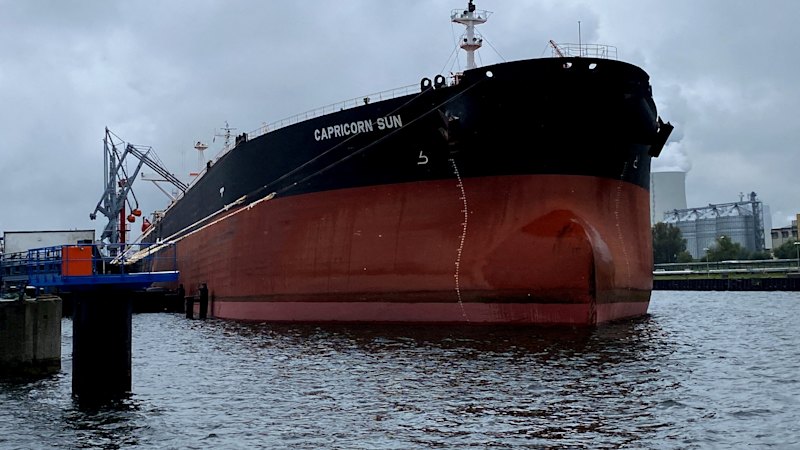


Fuel importers have been warned they could be breaching Australian sanctions law by importing Russian-origin oil processed in third countries, as the federal government comes under pressure to crack down on the revenue streams funding Vladimir Putin’s war against Ukraine.
The Department of Foreign Affairs and Trade sanctions office issued new advice last week to companies on how to ensure they were not contravening Australia’s sanctions regime on Russian-origin oil.
Unlike previous advice, the new guidance note stressed that oil imports do not evade Australian sanctions simply because Russian-origin oil has been blended with other petroleum products in third countries such as India or Singapore.
While not going as far as campaigners would like, the updated advice uses tougher language and includes significantly more detail than the previous official advice of June 2025.
Australia has imported about $24.7 billion worth of oil since 2022 from countries that refine Russian crude, delivering an estimated $2.5 billion in tax revenue to the Kremlin, according to the Centre for Research on Energy and Clean Air.
Mark Corrigan, a chemical engineer who has helped expose shipments of Russian-origin oil entering Australia through sanctions loopholes, said importers could face fines in the hundreds of millions of dollars if they breach the rules.
This masthead’s “Blood Oil” series, published last year, highlighted the vast quantities of Russian-origin oil that have flowed into Australia since the start of the war.
The new DFAT advice, issued on Tuesday, states that it is “prohibited to import Russian-origin oil and refined petroleum products into Australia, unless authorised by a permit issued by the minister for Foreign Affairs”.
The guidance states that blended oil or petroleum products that contain more than a small amount of Russian-origin oil or refined petroleum are prohibited under the law.
Only Russian oil imports that have been “substantially transformed” in third countries are allowed.
“The Australian Sanctions Office does not consider blending of oil products to constitute substantial transformation,” the note states.
“The process of blending does not cause the good to lose its identity – blended goods retain the same tariff code, use and character as an ‘import sanctioned good’ for Russia … Sanctions risk increases where a contracted supplier maintains supply arrangements with known producers of Russian oil products.”
The guidance contains a series of examples, including an Australian fuel retailer seeking to purchase and import a fuel consignment from Singapore. Through conversations with the exporter, the Australian company determines that there is a high risk that the fuel will have a non-trivial amount of Russian-origin fuel blended into it.
“As the product has not undergone substantial transformation, the portion of Russian-origin fuel cannot be considered to originate in the exporting country [and] the import of the fuel into Australia is prohibited without a permit,” the note states.
The note states it is the importer’s responsibility “to be aware of sanctions and to take steps to ensure that oil and refined petroleum products that they are importing, purchasing or transporting are not of Russian origin”.
The Ukrainian-Australian community wants the government to be more ambitious and match the European Union by changing the definition of sanctioned goods to include all petroleum products derived from Russian crude.
Corrigan said the new advice showed the government was listening to the community outrage over the issue, but it “still fails to close the valve on Russian oil entering the Australian fuel market”.
“While the EU requires importers to eliminate Russian petroleum from any supply route, Australia maintains a vague policy that allows the same material if it is ‘substantially transformed Russian oil’,” he said.
“Given that fines can be three times the value of imported sanctioned goods and a single tanker can be carrying $100 million worth of petroleum product, a successful prosecution would go a long way towards cleaning up Australia’s blood-tainted oil supply.”
He said the guidance suggested importers from Indian refiners may have been breaching Australian sanctions law because of rules embedded in the Australia-India free trade agreement.
Australian Institute of Petroleum chief executive Malcolm Roberts told a Senate hearing last week that stricter regulations would allow Australian importers to renegotiate contracts with overseas refineries handling Russian-origin oil.
“If the law changes materially, an importer will have the opportunity to trigger a review of a contract,” he said.
The government this week lowered the Russian oil price cap from $US47.60 a barrel to $US44.10, a move designed to drive down the market value of Russian crude oil.
Transparency International Australia chief executive Clancy Moore said: “Australia’s sanctions against Russian entities and individuals that prop up Putin’s corrupt regime send an important foreign policy signal and can help cut funding for Russia’s brutal war against the people of Ukraine.”
Cut through the noise of federal politics with news, views and expert analysis. Subscribers can sign up to our weekly Inside Politics newsletter.