
Menna Alaa El-Din
Updated ,first published
US President Donald Trump has announced the start of “major combat operations” in Iran, with Israel and the US launching multiple attacks on the nation.
“Our objective is to defend the American people by eliminating imminent threats from the Iranian regime,” Trump said in a video shared on social media,
He called the attacks “a noble mission”, saying they were necessary because of Iran’s pursuit of nuclear weapons and missile systems that could reach the US.
Trump also called on Iranian officials to “lay down your arms” or “you will face certain death”, and encouraged the Iranian people to “take over your government – it will be yours to take”.
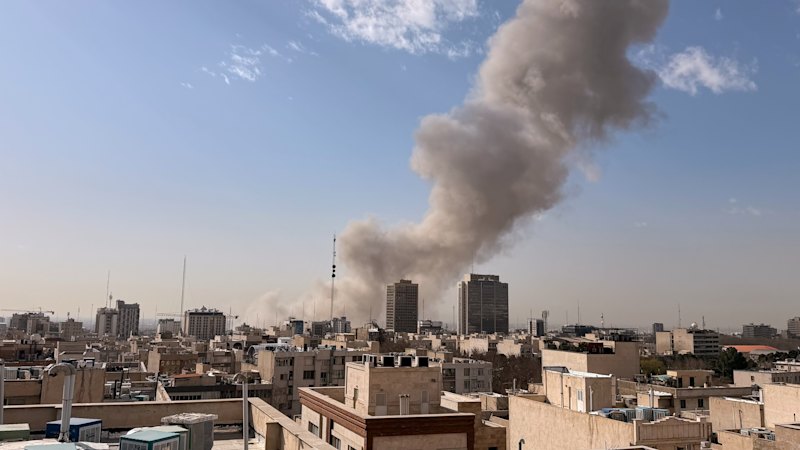
Israel along with the US launched a daylight attack on Iran’s capital, Tehran, on Saturday, with a cloud of smoke rising from the city’s downtown.
The first apparent strike happened near the offices of Supreme Leader Ayatollah Ali Khamenei. It wasn’t immediately clear whether the 86-year-old Khamenei had been in his offices at the time. He hasn’t been seen publicly in days as tensions with the US have grown. A regime official told Reuters that Khamenei was not in Tehran and had been transferred to a secure location.
Roads to Khamenei’s compound in downtown Tehran had been shut down by authorities as other blasts rang out across the capital. Neighbouring Iraq closed its airspace, the Ministry of Transport said.
Targets in the Israeli campaign included Iran’s military, symbols of government and intelligence targets, according to an official briefed on the operation, who spoke on the condition of anonymity to discuss non-public information about the attack.
Iranian authorities said Israeli-US airstrikes in southern Iran killed five students at a girls’ school, the first confirmed fatalities in the operation.
The state-run IRNA news agency reported the strike happened in Minab in Iran’s Hormozgan province. Iran’s paramilitary Revolutionary Guard has a base in the city.
Iran shut down its airspace after the attack. The warning to pilots came out as explosions rang out across Tehran. Sirens sounded across Israel at the same time. The Israeli military said that the “proactive alert [was] to prepare the public for the possibility of missiles being launched towards the state of Israel”.
Iran strikes back
Iran’s paramilitary Revolutionary Guard says it has launched its “first wave” of drones and missiles targeting Israel, suggesting it planned further attacks.
It had warned that US military personnel and bases spread across the region would be targets for any retaliation. It had also warned neighbouring countries hosting US troops that it would retaliate against US bases if Washington struck Iran.
Witnesses also heard sirens and explosions in Kuwait, home to US Army Central. There was no immediate word of any damage. Bahrain says the headquarters of the US Navy’s Fifth Fleet was targeted by a missile attack.
Bahrain’s state news agency said several facilities were hit inside the kingdom as a result of “an aggression” from outside the country.
The US embassy in Qatar posted on social media that it had told all personnel to shelter in place, adding that “we recommend all Americans do the same until further notice”.
Qatar hosts a major air base that is the forward headquarters of US Central Command and hosts thousands of American service members. The Al Udeid Air Base was targeted by Iran in June in retaliation for the US attacks on its nuclear facilities.
The Iranian-backed Houthis in Yemen have decided to resume missile and drone attacks on shipping routes and on Israel in support of Iran. That’s according to two senior Houthi officials, who spoke on the condition of anonymity because there was no official announcement from the Houthi leadership.
One of the officials said the rebels’ first attack could come “tonight”.
Trump conceded in his video message that “we may have casualties” as a result of the military operation.
The New York Times also reported that General Dan Caine, chairman of the Joint Chiefs of Staff and one of Trump’s most trusted advisers, warned the president that US troops could be killed if he attacked Iran.
Strikes in Iran by Israel and the US suggest “shaping actions” designed to degrade air defences in a pattern typical of a wider military campaign, a Dutch intelligence firm said.
“The broader pattern suggests preparatory shaping actions,” said Eric Schouten, chief executive of Dyami security intelligence firm in the Netherlands.
“This appears less like a symbolic strike and more like the opening phase of a co-ordinated campaign designed to establish air superiority and operational freedom of movement.
“Neutralising radar systems, surface-to-air missile batteries and command nodes would create more permissive conditions for sustained air operations over Iranian territory.”
Australia ‘stands with the brave people of Iran’: Albanese
Prime Minister Anthony Albanese has backed the US strikes on Iran, saying Australia “stands with the brave people of Iran in their struggle against oppression”.
“We support the United States acting to prevent Iran from obtaining a nuclear weapon and
to prevent Iran continuing to threaten international peace and security,” Albanese said.
“For decades, the Iranian regime has been a destabilising force, through its ballistic missile and nuclear programs, support for armed proxies, and brutal acts of violence and intimidation,” he said, noting the two attacks on Australia’s Jewish community in 2024.
Albanese said Iran had ignored calls from Australia and its international partners, including the US and G7 countries to uphold human rights and fundamental freedoms.
Australia has advised citizens still in Iran to be prepared to shelter in place for an extended period and prepare with supplies of water, food and medication.
“There have been air strikes on Iran, including in Tehran and other locations,” the government’s latest Smartraveller advice says.
“There is a risk of reprisal attacks and further escalation across the region … See our general advice on protecting your safety during an armed conflict.”
It said Australia’s ability to provide consular assistance was extremely limited, after the country closed its embassy following revelations that Iran was behind attacks on Australia’s Jewish community.
Foreign Minister Penny Wong shared the latest advice from Smartraveller on social media just before the strikes began, urging Australians to leave Iran if they could. Wong and the prime minister have been contacted for comment.
Israeli Defence Minister Israel Katz described the attack as being done “to remove threats”. He did not elaborate.
Several hospitals in Israel launched their emergency protocols, including moving patients and surgeries to underground facilities.
The attack comes amid high tensions between Iran and the United States over Tehran’s nuclear program.
The US and Iran renewed negotiations in February in a bid to resolve the decades-long dispute through diplomacy and avert the threat of a military confrontation that could destabilise the region.
Israel, however, insisted that any US deal with Iran must include the dismantling of Tehran’s nuclear infrastructure, not just stopping the enrichment process, and lobbied Washington to include restrictions on Iran’s missile program in the talks.
Israeli Prime Minister Benjamin Netanyahu repeated Trump’s regime change rhetoric in a statement on X, saying the Iranian regime must not be allowed to develop nuclear weapons and the time was ripe for Iranian people to topple the existing theocracy.
“This murderous terrorist regime must not be allowed to arm itself with nuclear weapons that would enable it to threaten all of humanity,” Netanyahu said.
“Our joint operation will create the conditions for the brave Iranian people to take their fate into their own hands.”
Iran said it was prepared to discuss curbs on its nuclear program in exchange for lifting sanctions but ruled out linking the issue to missiles.
In June, the US joined an Israeli military campaign against Iranian nuclear installations in the most direct American military action ever against the Islamic Republic.
Tehran retaliated by launching missiles towards the US.
Western powers have warned that Iran’s ballistic missile project threatens regional stability and could deliver nuclear weapons if developed. Tehran denies seeking atomic bombs.
Trump had wanted a deal to constrain Iran’s nuclear program, and he sees an opportunity while the country is struggling at home with growing dissent following nationwide protests.
Iran had hoped to avert a war, but maintains it has the right to enrich uranium and does not want to discuss other issues, such as its long-range missile program or support for armed groups such as Hamas and Hezbollah.
The world responds
The European Union’s first statement on the attacks avoided any criticism or support for Donald Trump and his military strikes against Iran. Instead, the EU said it was sympathetic to the situation faced by Iranian civilians and was talking to Israel to urge restraint to avoid civilian casualties.
“The latest developments across the Middle East are perilous,” said the European Commission’s foreign affairs chief, Kaja Kallas, a former prime minister of Estonia.
“Iran’s regime has killed thousands. Its ballistic missile and nuclear programs, along with support for terror groups, pose a serious threat to global security. The EU has adopted strong sanctions against Iran and supported diplomatic solutions, including on the nuclear issue.”
Kallas added that all non-essential EU personnel were being withdrawn from the region.
Russia on Saturday urged an immediate halt to US and Israeli strikes on Iran, saying the situation must be “returned to the path of political and diplomatic settlement.”
The foreign ministry said the international community should swiftly deliver an objective assessment of what it called irresponsible actions that risk further destabilising the region. Moscow added that it remains ready, as before, to assist in efforts to find peaceful solutions based on international law, mutual respect and a balance of interests.
Meanwhile, the British government is warning against “further escalation” in the Middle East and avoiding any explicit support for Donald Trump in his decision to launch strikes against Iran.
UK Prime Minister Keir Starmer will host a security meeting cabinet ministers and defence chiefs over the next few hours. (This is known as a Cobra meeting in Whitehall). There is no sign that UK facilities or forces have been used to support the strikes, and no reporting so far about any advanced notice to the UK about the attacks.
In the US, the early response from federal lawmakers to the attacks launched at Iran largely revolved around their feelings about Trump.
Sen. Lindsey Graham, R-S.C., who has long pushed for regime change in Iran, called for God to bless Trump. He said on social media that the attacks could provide freedom for the Iranian people, saying, “This operation is necessary and long justified.”
Sen. Ruben Gallego, D-Ariz., who was a Marine in the Iraq War, warned, “Young working-class kids should not pay the ultimate price for regime change and a war that hasn’t been explained or justified to the American people.”
Rep. Thomas Massie, R-Ky., who has emerged as an opponent of Trump, said the president had engaged in “acts of war unauthorised by Congress.”
AP, Reuters, with staff reporter