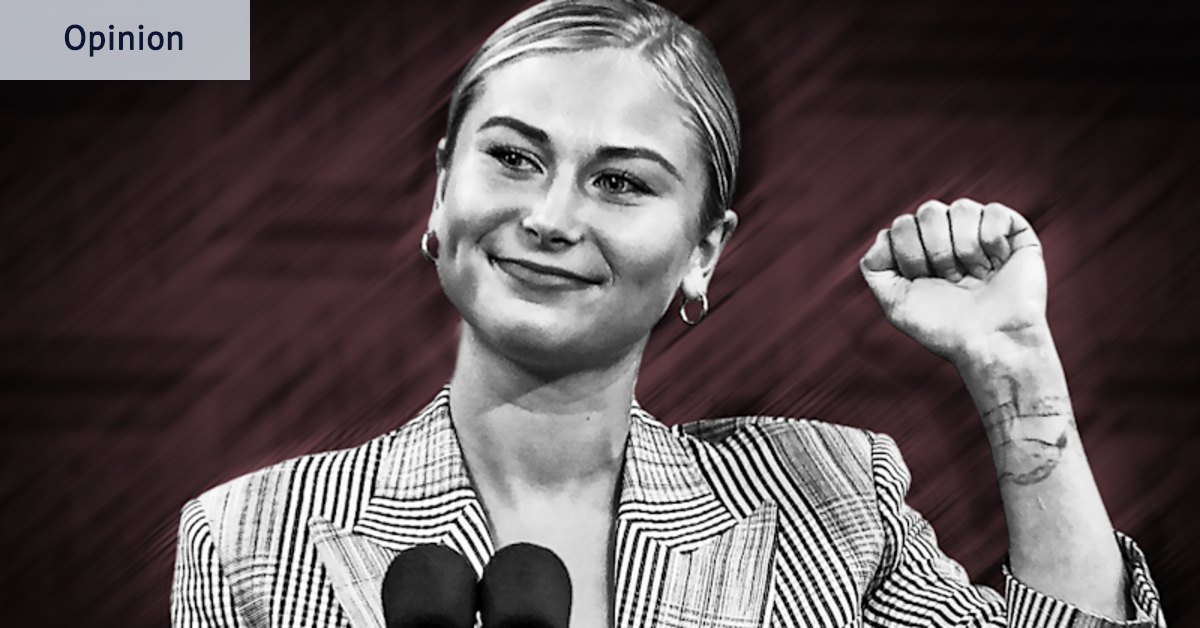
The PM’s biggest problem isn’t calling Grace Tame ‘difficult’. It’s that he can’t admit he’s wrong

Opinion

If an entire country misunderstands something you say, are the people at fault for not knowing your intentions, or are you at fault for being clumsy with your words?
And if your subsequent apology is ham-fisted and comes across as unaware and insincere, who cops the blame then?
After Prime Minister Anthony Albanese called Grace Tame “difficult” on Wednesday during an onstage game in which he was asked to describe people using just one word, this is the conundrum he now faces.
He says he was simply trying to convey that the former Australian of the Year and child sex abuse survivor has had a difficult life.
“Grace Tame has taken what is personal trauma and that awful experience that she had and channelled that into helping, in particular, other young women, being a strong and powerful advocate,” Albanese explained on Thursday morning as the furore began to erupt.
If you really meant that though, if that’s what you were really trying to say and what you really believe, why not use those words? Helping. Strong. Powerful. Advocate.
Probably because Albanese knew what he was saying and who he was saying it to. He chose to describe Tame – a long and vocal critic of News Corp – as “difficult” at the Herald Sun’s Future Victoria Summit. Many people in that audience would remember that a little over a year ago, Tame attended an event at the Lodge and stood next to Albanese and his now-wife Jodie Haydon wearing a T-shirt with the words “F— Murdoch” emblazoned on it in bold capital letters.
Does Albanese really expect anyone to believe that he was unaware the word “difficult” would land very differently in a room full of people who consume News Corp media than it would, say, in a room full of people at a writers’ festival event?
Of course not. Because he likely doesn’t believe it himself, either. Halfway through his non-apology apology, he provided further context for his word choice.
“Now there are other issues, such as the language that Grace Tame used that I disagree with at the demonstration that was held in Sydney. So that’s why it’s impossible to describe people in one word,” he said, referring to her use of a contentious slogan when addressing a pro-Palestine rally earlier this month during the visit of Israeli President Isaac Herzog.
As for Tame, she isn’t buying it. “Dude’s quoting Scott [Morrison] now!!! ‘She’s had a difficult life’… Spare me the condescension, old man. We all know what you meant. A badge of honour anyway. A confession that I’ve ruffled him,” she commented on social media.
The thing is, though, even if you are someone who finds Tame to be a difficult personality – or spiky or harsh or whatever other adjective you want to use to describe someone who refuses to submit and contort themselves into the shape you expect them to fit – that exact trait is the thing has gotten her where she is, that has helped changed laws around Australia to protect children, that has brought so much awareness to an endemic social issue, that has helped countless survivors feel less alone.
Describing any woman as difficult was always going to end badly. But saying, “If there was any misinterpretation, then I certainly apologise,” and thinking that actually qualifies as an apology makes it worse.
Add to this Albanese’s refusal to apologise to advocate Sarah Williams in 2024 after there was a dispute over his right to speak at the What Were You Wearing rally – she felt he had implied she was a liar – and it becomes apparent the prime minister has a real problem with admitting he’s in the wrong and saying sorry sincerely.
For a person who proudly declared that showing kindness isn’t weakness on the campaign trail, choosing the word “difficult” to describe someone who has survived and achieved what Tame has is incredibly difficult to understand.
Katy Hall is a senior editor and regular columnist.
The Opinion newsletter is a weekly wrap of views that will challenge, champion and inform your own. Sign up here.
 Katy Hall is deputy state topic editor. She was previously the deputy opinion editor for The Age.
From our partners