Ambassador urges looser visa restrictions amid debate over reliance


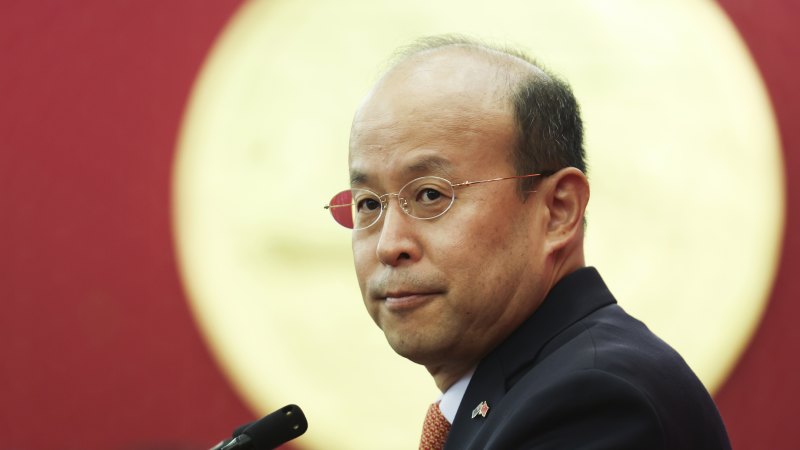
China’s ambassador to Australia has urged the Albanese government to consider loosening restrictions on international students from his country, opening a new front in the debate over a cohort that has proven lucrative and controversial for the university sector.
In his first remarks since Australia cracked down on visas for international students during a bitter pre-election debate about migration, Xiao Qian said that more short-term visas would enhance bilateral ties.
“I hope that the Australian federal government would consider providing more visa facilitation for Chinese students and scholars on short-term exchange programs to Australia, and offer policy support for the free flow of people between our two countries,” he said at an address at an Universities Australia conference on Wednesday.
“We should facilitate the mobility of young academics and researchers.”
Xiao appeared alongside Universities Australia chief executive Luke Sheehy, and his intervention comes as the number of Chinese international students rebound towards pre-pandemic levels.
“It’s fair to say in general terms that China-Australia education engagement is in good shape. And there is good momentum,” he said.
However, he noted Australia’s “continuous restrictions on research co-operation” in fields such as advanced technology and the uncertainty over visas continued to challenge the relationship.
Chinese students make up about 22 per cent of Australia’s $53 billion international student industry, the nation’s fourth-largest export commodity.
However, former Home Affairs secretary Michael Pezzullo warned at another session at the conference that the sector’s reliance on Chinese students was not without risk.
“China has a vociferous appetite and … we just have to face the fact that any relationship with Chinese scholars and Chinese institutions is going to have sitting behind it the Chinese state,” he said. “If we don’t accept that, we’re flying in the face of what we know … about the very tight controls that the Chinese state exerts over all facets of its society.”
Rachel Noble, a former director-general of the Australian Signals Directorate, echoed his concerns about foreign interference. “The threat is unprecedented,” she said.
In 2024, the Albanese government warned university bosses to end overreliance on students from China and India.
Labor failed to pass legislation to cap the nation’s international student intake that year. It pivoted to controlling the flow of students through the visa system instead, now forcing a “go slow” on visa applications after a university reaches 80 per cent of its allocation of students for the year.
Demand for Australian degrees remains high in China regardless, said a paper from the Department of Education issued in December, with a strong prognosis over the next seven to eight years.
More than 700,000 mainland Chinese students study internationally each year, and the number of high school graduates is expected to peak about 17.8 million in 2032.
Last year, the Herald revealed the eye-watering costs of an Australian education reached more than $750,000 for some degrees.
“An Australian degree continues to carry strong prestige for Chinese students when global rankings are considered,” said the paper.
The briefing warned that while Australia is likely to remain a popular choice for Chinese students, Asian nations are becoming increasingly serious competition.
“The relationship between governments can also influence Chinese student choices. Chinese student flows can decrease when relations with a destination country and China’s central government are strained, and increase when relations are stable or improving … Australian universities with branch campuses in South-East Asia may benefit, although competition will be high – especially as more Chinese institutions are building their footprint in the region,” the paper said.
Federal Assistant Minister for International Education Julian Hill, who is due to appear at the summit on Thursday, was contacted for comment.
Start the day with a summary of the day’s most important and interesting stories, analysis and insights. Sign up for our Morning Edition newsletter.
From our partners