Panel stacked with Trump loyalists approves his ‘beautiful’ White House ballroom


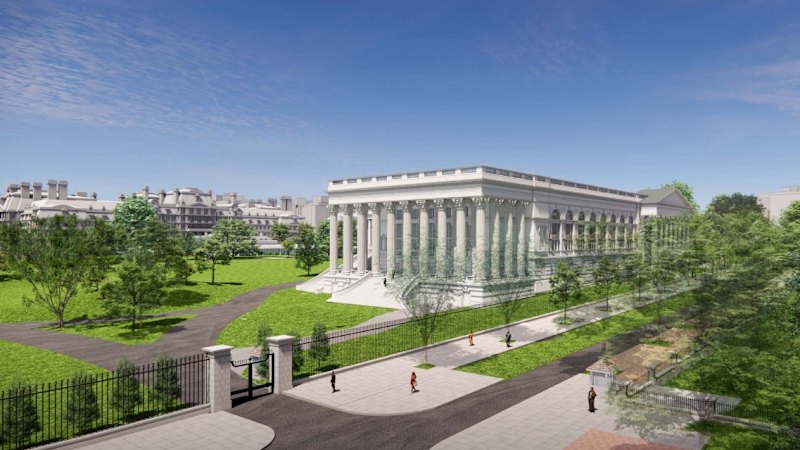
Washington: A design panel recently stacked with Donald Trump loyalists has approved the president’s White House ballroom, taking it a step closer to reality despite overwhelming opposition from the public submissions.
The Commission of Fine Arts voted 6-0, with one abstention, to approve the ballroom at a meeting on Thursday, Washington time, after reviewing updated plans and renders.
“This is a facility that is desperately needed for over 150 years, and it’s beautiful,” said chairman Rodney Mims Cook Jr, a former commissioner whom Trump returned to the agency last month.
Trump fired all six previous members of the CFA in October, then left the agency vacant until January, when he appointed seven new members – including his 26-year-old executive assistant Chamberlain Harris, who is not known to have any arts experience.
The panel approved the plans despite an avalanche of opposition from members of the public and concerned parties, including historic and conservation organisations.
Long-serving secretary Thomas Luebke said the commission received more than 2000 messages in just a week about the ballroom project. “The summary of it was overwhelmingly in opposition – over 99 per cent,” he said.
Those concerns largely involved the “illegal demolition” of the former White House East Wing in October, Luebke said, as well as the inappropriate scale of the new ballroom that would dwarf the White House.
People were also worried about the project ignoring historic preservation principles, the lack of transparency about who was funding the ballroom, and “a fundamental miscarriage of democratic principles”, he added.
Luebke also read out an unnamed letter of support, which said the White House’s current provisions for large ceremonies involving foreign heads of state were insufficient.
“We have a tent. Currently, people are omitted due to lack of space,” the person wrote. “The United States is on the world stage. Modernisation to have America be competitive in the eyes of world leaders is not a bad thing.”
Public condemnation did not stop the panel quickly proceeding to approve the designs following a presentation by architect Shalom Baranes and landscape architect Rick Parisi.
The 1000-person ballroom building is of similar height to the White House residence, although the footprint – 90,000 square feet – is considerably larger.
Harris, whose main job is formally the deputy director of Oval Office operations, said the building “isn’t that big by ballroom standards”, and the size was consistent with the residence.
“This is sort of like the greatest country in the world, it’s the greatest house in the world, and we want it to be the greatest ballroom in the world,” she said.
The CFA panel’s decision does not represent the end of the process. The ballroom must also clear the National Capital Planning Commission, which is due to meet in early March to vote on the project.
That commission has also been stacked with Trump loyalists. Its chairman is Will Scharf – formerly a Trump lawyer, now White House staff secretary, who is regularly pictured handing Trump executive orders.
Meanwhile, the National Trust for Historic Preservation filed a lawsuit in December to stop the ballroom. The judge in the case has so far refused to issue an injunction while the planning process is underway.
Cook Jr, the CFA chairman, said while he respected the National Trust, it had not stopped then president Harry Truman gutting the interior of the White House in the 1940s and 1950s. “Why the shouting now?” he said. “It seems unusual to me.”
Trump wants the ballroom to be finished before his term ends at the start of 2029. In a post on Truth Social, he thanked the panel for its decision. “Great accolades were paid to the building’s beauty and scale,” he said.
Even sceptics of the ballroom project have accepted the need for a bigger venue space for the president to host large, formal functions with visiting world leaders. Frequently – as was the case with a state dinner with then prime minister Scott Morrison in 2019 – guests are seated in outdoor tents on the White House grounds.
However, Trump’s ballroom has been tarred by accusations of improper process and lack of transparency. The cost – which is being covered by large corporate donations – has doubled to $US400 million, while the historic East Wing was bulldozed in October without any planning permits.
The White House has pointed out numerous presidents have modified or rebuilt the property. It says Trump’s ballroom is “a bold, necessary addition that echoes the storied history of improvements and additions from commanders-in-chief to keep the executive residence as a beacon of American excellence”.
Trump, a property developer before he entered politics, has also set in train a number of other Washington building projects, including the construction of a 250-foot triumphal arch nicknamed the “Arc de Trump”.
Get a note directly from our foreign correspondents on what’s making headlines around the world. Sign up for our weekly What in the World newsletter.
 Michael Koziol is the North America correspondent for The Age and Sydney Morning Herald. He is a former Sydney editor, Sun-Herald deputy editor and a federal political reporter in Canberra.Connect via X or email.
From our partners