Cyrano de Bergerac at fortyfivedownstairs; Somi at JazzLab; Ethel Cain at Palais Theatre; Geese at The Croxton; Cluedo at Comedy Theatre, Black Light at Malthouse, Never Are and Sync Well at Dancehouse

Updated ,first published
DANCE
Never Are and Sync Well ★★★★
Dancehouse, until February 21
There’s no straight line through this intriguing double bill at Dancehouse. One work finds its way by moving backward, the other pools and spreads in all directions. Both, however, have their own special fascinations.
Never Are is a solo created and performed by Emma Riches. In the upstairs studio at Dancehouse – where it’s hot and smoky – she begins with an extended practice of walking backwards, toes barely lifting, heels landing soft.
It’s disarmingly simple and yet immediately compelling. The backward circuit around the square stage area has an easy, calming effect. New elements gradually accumulate: little bits of dance, cells of movement, each with a single intention.
What is the proposition here? That sometimes backwards is the best way forwards? Perhaps. Riches arranges and rearranges her little segments, testing them in different orders, composing and decomposing.
She moves with a luxuriant, animal serenity – a little swing, a little swish, nothing too extravagant – and yet she also poses herself for the audience, acknowledging the act of being watched, savouring it.
Vocal elements are added. At first we get only single words: are, you, even, if, might, stuck, never. These verbal fragments lend themselves to repetition and reordering and become part of the choreography’s combinatory logic.
It’s a confident performance that rewards reflection. All that is lacking is the smallest touch more theatrical pressure in that eerie, half-formed relationship with the audience.
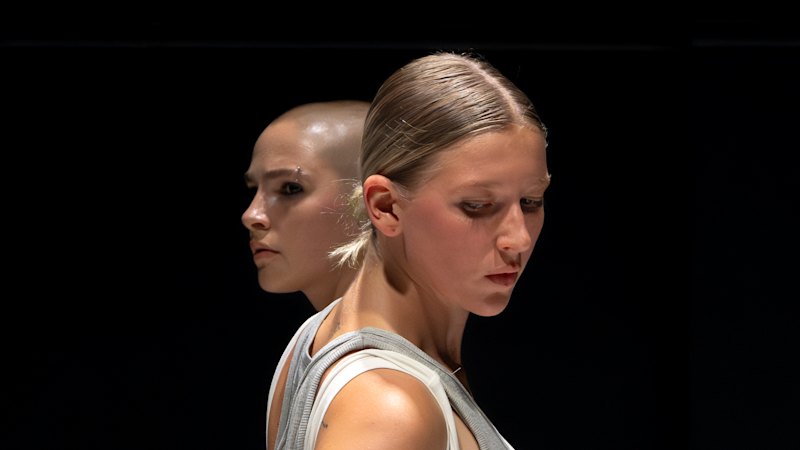
The second piece, Sync Well, created and performed by Gemma Sattler and Molly McKenzie, is a curious hybrid: a play of surprising connections and performative provocations. It’s serious and inwardly focused and weird in the best sense.
It develops around the theme of water bubbling up, pooling, soaking as if in a well. This is a show full of hissing and sputtering, pulsed wheezing and whistling, fizzing and gargling and gasping. A venting in which the body participates in various ways.
The performers work separately, then converge, often creating odd mirror effects, with long stretches of stillness and small movement in between. It’s controlled, intense, patient – even though it’s kind of about messiness and leakage.
Small objects are used to suggest unexpected relationships. A handful of stones. A metal chain. A small whistle. How are these things like each other? And how are they like the bubbles of water and earth?
It’s hard to say, but in the still, uncanny ambience Sattler and McKenzie create, the possible connections tantalise. This is a work that doesn’t force explanations – but the affinities it suggests feel real all the same.
Reviewed by Andrew Fuhrmann
THEATRE
Black Light ★★★
Malthouse Theatre, until March 7
Three generations of Larrakia women are drawn together in Jada Alberts’ Black Light, stranded at their remote home in the aftermath of an extreme weather event.
The play slides between domestic drama in a naturalistic mode and a more overtly poetic, existential style of theatre, layering an intimate vision of family conflict and solidarity into a broader vision that dreams of revolution against colonial legacies of dispossession and violence, and wields the power of traditional knowledge in that struggle.
As the playwright points out, revolution has a double meaning: it denotes circular motion, a cycle, as well as rebellion against an oppressive established order. Black Light takes inspiration from both senses of the word, and at the centre of its revolutionary impulse is the elderly Nan (Trisha Morton-Thomas).
A wheelchair-using Aboriginal great-grandmother might seem an unlikely revolutionary. Nan is losing her memory to dementia. Her chief ambitions are daily rituals: telling stories, sitting around drinking tea (Nan loves a cuppa), and getting her nails painted purple by one of her daughters.
And yet, like Winnie in Happy Days – the Beckett character who’s buried up to her waist in sand – there’s more to this woman than meets the eye.
A living link to Larrakia culture, Nan is a proud “saltwater woman”. Comic anecdotes and dotty ramblings brush against the accumulated wisdom of connection to Country, and one densely woven monologue has a seer-like quality, a vision that seems to rewrite the world with mad clarity (and follows in the footsteps of that poet laureate of Aboriginal literature, Alexis Wright).
Nan requires constant care. There’s never any question her two surviving daughters Mum (Lisa Maza) and Aunty (Rachael Maza) will provide it, but there’s spikiness and resentment and a nagging, unresolved grief between the sisters at the sacrifices they’ve made to raise Bub (Tahlee Fereday), the next generation of the family who now also has children, and to support their mother, too.
Shadows of domestic violence and addiction hang over this tight-knit family, and Black Light allows a potent moment of direct address, channelling one character’s rage against systems (in which we’re all complicit) which perpetuate inequality and trauma.
Escape into Larrakia Country (the area surrounding Darwin in the Northern Territory) is one response; retreat into the comfort of family is another. Dale Ferguson’s set design creates room for both – a spartan domestic space downstage, a tranquil expanse of rocky coastal spit in the background.
Although the theatrical elements don’t quite fuse into a unified whole, the performances are strong all round. They’re funny, poignant and true to life, with an effortless presence, even if design and occasionally text don’t always support them to best effect.
Black Light is writer-director Alberts’ tribute, among other things, to generations of women in their family, and I did wonder if this deeply personal story might have been more fully realised as drama had it been directed by fresh eyes. (Isaac Drandic leapt to mind.) Still, the play remains luminous, adding a small new star to the firmament of contemporary First Nations theatre.
Reviewed by Cameron Woodhead
THEATRE
Cyrano de Bergerac ★★★★
fortyfivedownstairs, until February 28
Edmond Rostand’s French tragicomedy Cyrano de Bergerac always seems ripe for reinvention. From Fred Schepisi’s 1987 romcom, Roxanne (starring Steve Martin and Daryl Hannah), to Virginia Gay’s cross-gendered queer Cyrano at the MTC in 2022, the story has a performance history as long as its hero’s nose.
This free adaptation from playwright Martin Crimp was staged on the West End and Broadway a few years back, with James McAvoy in the title role, and now comes to Melbourne in a bold indie production with a cast much larger than any of our main stages could afford to muster.
Those who felt that Gay’s version for the MTC shortchanged Rostand’s poetry may take heart at the obsessive centrality it assumes in Crimp’s – the retention of rhyming couplets; the vision of Cyrano as spoken-word maestro, bounding across the stage versifying, mic in hand; even a poem composed (after Emily Dickinson’s Because I could not stop for Death) on the field of battle.
Those who enjoyed the playfulness of a woman as Cyrano, on the other hand, and the undemanding romcom vibe Gay brought to the stage will be struck by the contrast here. The production has playful moments, but they’re locked within an epic dismantling of traditional masculine ideals. Mark Yeates leads a bare-chested, knife-wielding, testosterone-drenched deconstruction that hacks away at the very notion of the heroic and leaves an aftertaste more bitter than bittersweet.
Reviewed by Cameron Woodhead
JAZZ
Somi ★★★★★
The JazzLab, February 17
No matter how many recordings you listen to by Somi – and there are eight albums to choose from – nothing quite prepares you for the experience of seeing her live. Her voice is extraordinarily beautiful, conveying both fire and fragility with effortless agility. But it’s her physical presence that elevates her artistry to another level.
As she glides down the stairs and onto the stage at JazzLab, she is already singing, as though she is partway through a story she’d like to share with us. It’s the story of her life as an American-born singer of East African heritage: a singer steeped in jazz history, but also the history and lived experience of African communities around the world.
When she sings Kadiatou the Beautiful, she pauses between each half-whispered phrase to gaze quietly at the audience, then closes her eyes as her voice soars upwards and outwards in a wordless invocation.
Another original, Like Dakar, is a poignant love letter to West African immigrants in Harlem, New York, set to a loping 5/4 rhythm that she embodies with her torso and arms as she sings. Miriam Makeba’s classic Pata Pata is reimagined as a haunting, melancholy ballad, before a series of whooping calls propel the tune into a rhapsodic dance.
Whether the lyrics are pointed (as in The Gentry) or playful (Aiwah), Somi makes each word count and each phrase resonate with palpable conviction. The prayer-like Holy Room exudes such tenderness and vulnerability – aided by pianist Toru Dodo’s exquisite accompaniment – that it brings many in the room to tears.
Dodo and bassist Yunior Terry are supremely responsive to the music’s emotional shifts, moving from elegant understatement to buoyant grooves and imaginative improvisations with unerring sensitivity.
The aptly-named Last Song builds from a lyrical introduction to a joyful, polyrhythmic celebration, eliciting an ecstatic response from the audience as Somi clasps her hands to her heart, bids us a warm farewell and glides back up the stairs.
Reviewed by Jessica Nicholas
MUSIC
Ethel Cain ★★★★
Palais Theatre, February 16
First of all, Ethel Cain is not a person, but a band. She’s also a character, and in any case, she’s dead – Hayden Silas Anhedönia, singer and architect of Cain’s mythology, told the story of her life and grisly murder in her 2022 debut album, Preacher’s Daughter.
The band’s latest album, Willoughby Tucker, I’ll Always Love You, is intended as a prequel, delving into the character’s earlier life and charting the story of her first doomed love. The world Anhedönia has created with Ethel Cain is one of darkness, steeped in the language of the Bible and marked by the concerns of the Southern Gothic: the violence, the poverty, the grotesque underbelly of the American dream.
At the first of her four largely sold-out shows in Melbourne, Anhedönia arrives on a stage dominated by a wooden cross hung with tendrils of Spanish Moss and begins the show with Sunday Morning, a shoegazey track of twinkling acoustic guitar and washed out lyrics from her 2019 EP, Golden Age.
From there, the band offers a set that showcases the breadth of the Ethel Cain universe: from pop-inflected, singalong tracks like American Teenager and Thoroughfare, to the lush and melancholy strains of Janie and Dust Bowl, to the dark seductions of Gibson Girl (though fans may have been disappointed by the omission of F— Me Eyes, the intoxicating breakout single from the latest album). Ptolemaea shows the band at its heaviest and Anhedönia’s performance at its most magnetic: she screams like a woman possessed.
These are songs of sex and sin, purity and ruin, cinematic in scope and subversive in execution (see, for example, a song like Strangers, which reads as a sweetly aching love song but is, in fact, about cannibalism).
David Lynch is one of Anhedönia’s influences and his touch is everywhere: in her preoccupation with a young woman doomed by the abuses of men, in her vision of a surreal Americana populated by great beauty and terrible evil, in her love of dreamworld storytelling that unsettles even as it captivates.
Anhedönia has said that Willoughby Tucker, I’ll Always Love You is the last album she’ll write from the perspective of Ethel Cain. If that’s true, then this show acted as an appropriate eulogy. Underneath the shifting lights on a sweltering summer evening, Ethel Cain had never felt more alive.
Reviewed by Nadia Bailey
MUSIC
Geese ★★★★★
The Croxton, February 12
An hour and a half before buzzy New York four-piece Geese are due on stage, there’s two lines of people on the footpath outside: one waiting to get in, the other sheepishly holding up signs for tickets: “Friend didn’t show up? I’ll buy your ticket,” reads one. Another: “This Goose has no tix”.
Gooses they were. Ever since 23-year-old frontman Cameron Winter’s wonky, astonishing solo LP Heavy Metal grew from late-2024 curiosity into revered modern classic, the cult of Cameron has turbocharged Geese’s trajectory. When Winter’s Tuesday night solo piano show at The Forum went on sale in August 2025, it sold out instantly. In September, Geese released their third LP, the knotty Getting Killed, to rapturous reception. It means here now, on their debut Australian tour for Laneway Festival, both Winter and Geese could have played at venues three times the size, many times over. For one night only in High Street in Thornbury, it feels like being at the molten centre of the music universe.
Shockingly, Geese live up to the hype. Augmented by keyboard player Sam Revaz, Geese demonstrate they’re far more than their famous frontman’s backing band, with a dissonant clinic of sizzling indie rock, laced with prog, blues, punk, folk and anything else ever made with guitars. Somehow, nothing’s ornamental, no one slacks off.
From the opening slow burn of Husbands, the rammed crowd yell every word of Winter’s knack for self-flagellation: “I’m falling apart”, “I’ve been hit by the bus of life”, “Baby, you can change and still choose me”. They blast through all of Getting Killed and a couple of songs from 3D Country (2023), including an unhinged 2122, inspiring the first circle pit of the night.
There’s a wild vibrancy to Geese live that just isn’t present on the airtight audio of their records. New chordal passages emerge as guitarist Emily Green and drummer Max Bassin lead odd, telekinetic choices – where Winter was his own wry agent of chaos at Tuesday’s intimate solo show, tonight he’s the steely, charismatic fulcrum around which Geese expands and contracts.
Cobra, Au Pays du Cocaine and Taxes are gorgeous, given a spectral heft in this quasi-religious setting, while 100 Horses and the set-closing barnstormers, Long Island City Here I Come and Trinidad put the crowd on spin cycle.
The rumours are true: Geese are the most exciting new band, and a damn marvel to see. You’re a goose if you missed it.
Reviewed by Marcus Teague
THEATRE
Cluedo ★★★
Comedy Theatre, until March 15
Every generation from the Boomers down knows Cluedo. Editions of the game have been around since 1949, and kids tend to learn what a murder mystery is by playing it – well before they’re introduced to Agatha Christie.
Childhood nostalgia for the franchise undergirds this commercial comedy. It adapts Jonathan Lynn’s 1985 film Clue (a box office flop that developed a cult following) and a talented cast embraces the zaniness of a show that’s feather-light on suspense and plot but slathered with mildly diverting drollery.
Six usual suspects are invited to an English country house under the assumed names of characters from the game – Professor Plum (David James), Miss Scarlett (Olivia Deeble), Mrs Peacock (Genevieve Lemon), Colonel Mustard (Adam Murphy), Mrs White (Rachael Beck) and Reverend Green (Laurence Boxhall).
They’re greeted by the butler Wadsworth (Grant Piro), French maid Yvette (Lib Campbell) and a dour knife-wielding Cook (Octavia Barron-Martin). When their elusive host Mr Boddy (Joshua Monaghan) appears, it’s only for long enough to reveal sinister designs before adding to the body count.
What follows is a chaotic hunt for the killer(s) that gets serially interrupted by yet more potential victims, and features a blend of ridiculous sight gags, exaggerated caricature, inane banter and comforting in-jokes, and tightly choreographed physical humour with strong elements of revolving-door farce.
Each actor confects moments in the spotlight. They all have fun playing with genre stereotype, though it’s Piro’s butler who acts as a kind of MC and gives the most versatile (and ludicrous) performance, with Boxhall’s neurotic, jelly-limbed slapstick not far behind.
Production values are high, the set and costume design on par with the style of murder mystery theatre – think The Mousetrap – that Cluedo merrily lampoons.
I’d like to see a push towards more diverse casting in shows of this ilk. The play’s nominal setting in 1940s England hardly calls for historical accuracy or naturalism when it’s based on a game played by everyone, and the familiarity Cluedo trades on might have even broader appeal if it better reflected contemporary Australian audiences.
That said, Cluedo isn’t envelope-pushing stuff. Nor is it “a killer night out” as billboards claim. No, it’s undemanding comedy – a cosy, well-turned commercial entertainment that doesn’t outstay its welcome.
Reviewed by Cameron Woodhead
The Booklist is a weekly newsletter for book lovers from Jason Steger. Get it delivered every Friday.
 Jessica Nicholas is an arts and music writer, specialising in contemporary jazz and world music.
 Nadia Bailey is a writer, editor, and critic from Melbourne.
From our partners