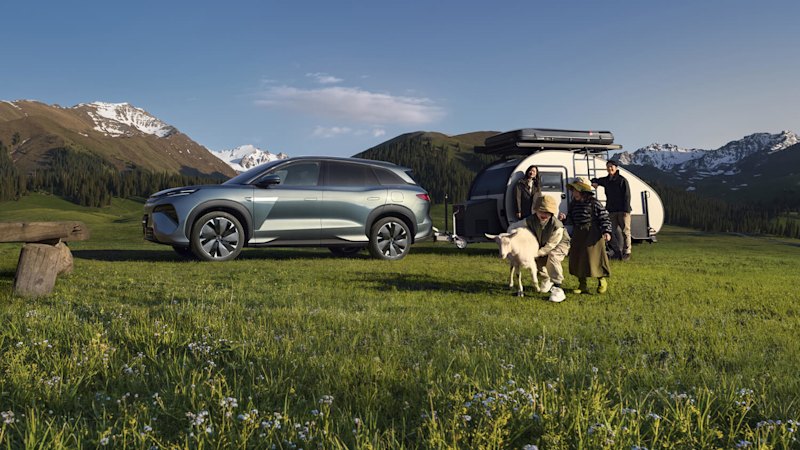
Looking to upgrade the family car? Your 2026 checklist for the new era of SUVs

Sponsored by BYD
Simon Webster
Nothing’s straightforward these days, is it? And choosing a family car is no exception. Finding the right balance between space, safety, affordability and environmental performance can be harder than helping the kids with their maths homework.
If you’re trying to make sense of it all, here are a few things to consider:
Seats
Let’s be honest: you’re going to want seven. Even if you’re not planning to fill a car with your own kids, there is little doubt that you will be constantly asked to ferry your offspring and a gaggle of their friends to concerts, football matches and all-night raves (depending on their ages, obviously). You’ll want a car that can handle the load.
Storage
For the modern Australian family, there’s no such thing as “too much space”, especially in a competitive SUV market where generous boot capacity is a primary consideration for buyers.
Safety
This one’s easy. Modern safety is no longer about the frame of the car; it’s about the smart technology watching over your precious cargo. When choosing a family SUV in 2026, look for advanced features that protect every row of your vehicle, such as comprehensive airbag coverage that extends to the very back. It’s also worth considering smart systems like Child Presence Detection (CPD), which uses millimetre-wave radar to detect movement inside the cabin, ensuring no child gets accidentally left behind.
Fuel and other ownership costs
The planet, and your bank account, will thank you for filling up at the bowser as little as possible. As well as comparing manufacturers’ fuel-consumption figures (you can also use the government’s Green Vehicle Guide), take a dive into other ownership costs, such as insurance and servicing, to see how they stack up, too. If you’re buying a new car, you might also want to compare warranties.
Driveability
It’s all well and good buying a big, safe, green, efficient car for the family, but let’s not be martyrs. Pick something that’s exciting to drive, too. Even mums and dads deserve to have a bit of fun now and then.
The complete package?
What car could possibly tick all these boxes? It’s a tough ask, but the latest super hybrids are giving it a good go.
Super hybrids are essentially plug-in hybrids (PHEVs) with higher performance capabilities. They can run on electric batteries — which you charge just as you would in a fully electric car — but also include a petrol engine. This is ideal for families that want the best of both worlds: silent, spacious EV commuting for the daily school run, along with petrol-backed security for the great Australian road trip.
Super hybrids can be more fuel-efficient than older-generation PHEVs (because their bigger batteries offer longer electric range), and they can be a lot more fun, too, thanks to big motors offering that electric wow factor.
Chinese carmakers are leading the way in the super-hybrid bracket, and it should come as no surprise that super-disruptor BYD is right in the mix. The Sealion 8 super hybrid is BYD’s first seven-seat SUV, and it hopes to offer families the complete package.
Ticking boxes
This super hybrid stacks up well against our checklist. First of all, it’s big, with seven seats offering plenty of legroom, even in the back row. It also offers plenty of storage: even with all seven seats in play, you get 270 litres of volume in the rear, which ramps up to 960L with the third row folded down.
The vehicle also delivers with an impressive family-first safety range that prioritises the protection of all seven passengers. It features nine airbags including full-length side curtains that offer peace of mind for those in the rear, while for discerning parents, the inclusion of third-row ISOFIX anchor points is a game-changer, allowing child seats to be securely fastened in the back. This is also paired with the millimetre-wave radar CPD system to monitor the cabin, front and rear cross-traffic alerts with automatic braking and constant driver fatigue and distraction monitoring.
As for fuel, the vehicle comes equipped with a 1.5-litre turbo-petrol four-cylinder engine, plus a 19kWh battery on the Dynamic FWD version of the car, and a 35.6kWh battery on the Dynamic AWD and Premium AWD versions.
This translates to a claimed 103 kilometres of electric range on the smaller battery, and 152 kilometres on the bigger battery. That’s enough to cover most trips, and BYD claims fuel-consumption figures of a paltry 1 litre per 100 kilometres when the battery is over 25 per cent full.
Performance is another factor. The electric motors (one on the FWD, and two on the AWD versions) offer serious power, with the AWDs going from 0-100km/h in a rapid 4.9 seconds – perfect for when you’ve got a weekend off with your partner and you just can’t get away quick enough.
It seems the ultimate family checklist finally has an answer that doesn’t require a single compromise.
The BYD Sealion 8 is rewriting the checklist for the modern Australian family. As BYD’s first seven-seat SUV, it balances high-end tech with genuine value, starting from just $56,990*. Whether you choose the efficient Dynamic FWD or the powerhouse Premium AWD, you’ll enjoy up to 152km of pure-electric range for the daily commute and a massive 1040km total range for the weekend getaway. With a focus on safety and a 2000kg towing capacity, it’s the complete package for 2026.
Check every box for your family at https://bydautomotive.com.au/sealion-8
*Excludes on-road costs. Performance figures based on Premium AWD model.
From our partners