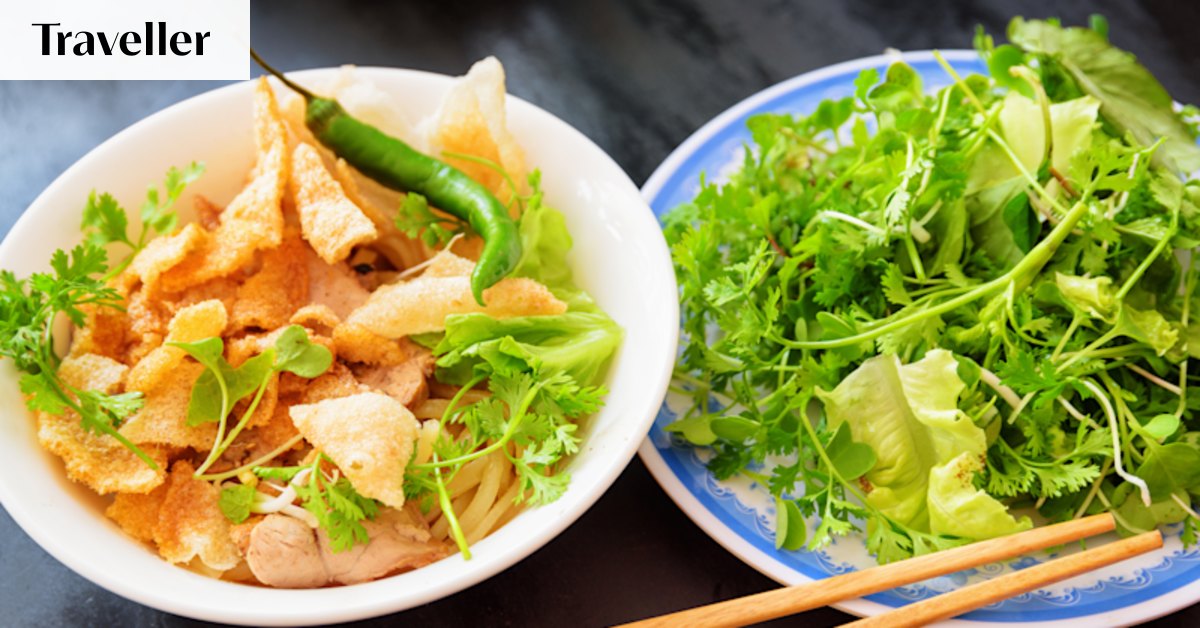


The dish: Cao lau
Plate up
You may think it’s tricky finding specialist ingredients to cook authentic Vietnamese food at home. If you don’t live near a good Vietnamese grocer you probably struggle to source, say, sawtooth coriander or banh xeo flour. Just wait until you try making cao lau, a noodle dish unique to Hoi An in central Vietnam.
To make noodles for proper cao lau, you will need to mix rice flour with water drawn from the Ba Le well, a source in Hoi An renowned for its calcium-rich purity. Use any other water, and you’re not making cao lau. Hmm. Tricky.
The only thing for it, then, is to travel to Hoi An and sample this truly excellent dish that has a hero component of thick rice noodles made chewy with the addition of an alkaline solution (supposedly using wood ash from the nearby Cham Islands). Those noodles are tossed with pork char sui and crisp crackling, plus bean sprouts and several herbs. With a small amount of broth to bring the dish together, you have a unique, delicious icon of Hoi An.
Sign up for the Traveller Deals newsletter
Get exclusive travel deals delivered straight to your inbox. Sign up now.
First serve
Hoi An is a historic river port with a long history of influence from China and Japan, among others, which is likely to have contributed to the creation of cao lau. Some theorise that the noodles were introduced by Chinese traders in the 17th century, while others claim the Japanese – whose udon and soba noodles bear some resemblance to those used in cao lau – were responsible about 100 years later. The finished dish doesn’t resemble anything from either of those nations, and so probably developed organically around that same period.
Order there
You’ll only find this dish in Hoi An, and one of the best is served at Cao Lau Thanh (no website, 26 Thai Phien, Hoi An).
Order here
Sadly, you can’t order cao lau in Australia. You can, however, enjoy excellent Vietnamese cuisine at An Restaurant in Bankstown (anrestaurant.com.au) and Pho Chu The in Footscray (unclethes.com).
One more thing
The name cao lau translates to “high floor”, and is assumed to be a reference to the raised platforms where Hoi An shop owners would traditionally eat their lunch.
 Ben Groundwater is a Sydney-based travel writer, columnist, broadcaster, author and occasional tour guide with more than 25 years’ experience in media, and a lifetime of experience traversing the globe. He specialises in food and wine – writing about it, as well as consuming it – and at any given moment in time Ben is probably thinking about either ramen in Tokyo, pintxos in San Sebastian, or carbonara in Rome. Follow him on Instagram @bengroundwaterConnect via email.
Traveller Guides
From our partners