Rubio gives Europe a Valentine’s bouquet, but the roses still have thorns


What a difference a year makes. Or does it?
Twelve months ago, US Vice President JD Vance stormed into the Munich Security Conference, warning Europe that it was destroying democracy with its restrictions on free speech, censorship of social media and embrace of unvetted immigrants who didn’t share its way of life.
His dark speech, just weeks after his ascension to power, alarmed his European audience and put them on notice that under President Donald Trump, “there is a new sheriff in town”.
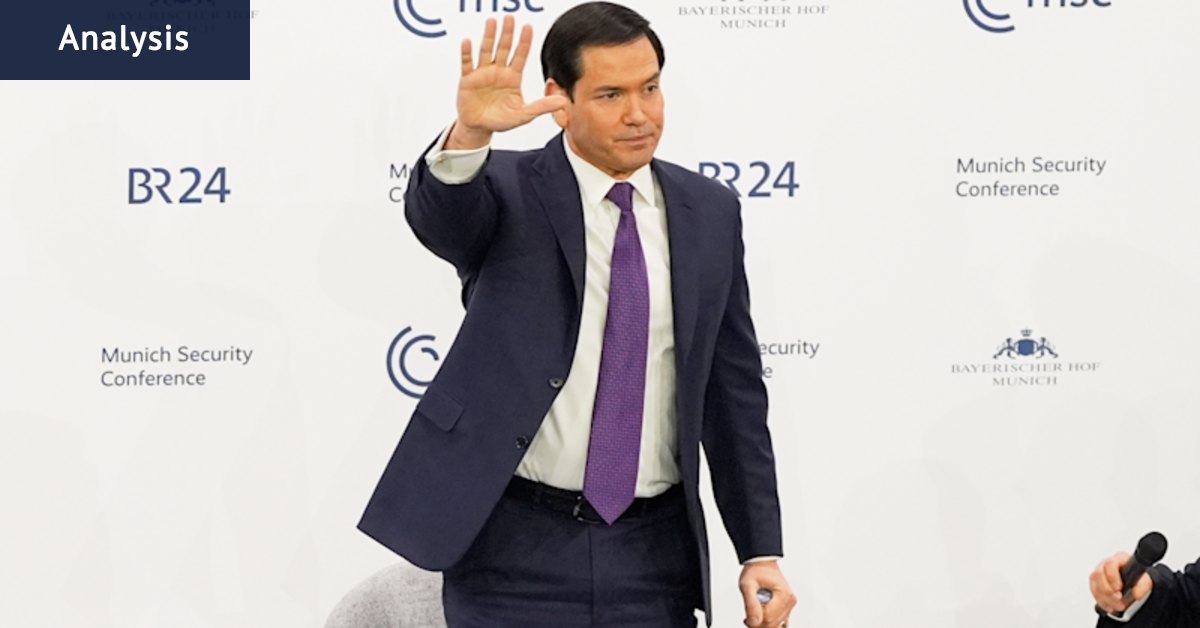
This year, the messenger was different – Secretary of State Marco Rubio – and so was the rhetoric. “The United States and Europe, we belong together,” Rubio said. “Ultimately, our destiny is, and will always be, intertwined with yours. We know that the fate of Europe will never be irrelevant to our own.”
Rubio directly repudiated what he said were headlines suggesting that the US sought to end the transatlantic alliance. “This is neither our goal nor our wish,” he said. “For us Americans, our home may be in the Western Hemisphere, but we will always be a child of Europe.”
MSC chairman Wolfgang Ischinger, a former German ambassador to Europe, told Rubio there was an audible “sigh of relief” running through the room during his speech, characterising it as a “message of reassurance”.
That might be a case of hearing what you want to hear.
Rubio’s language may have been more conciliatory than Vance’s, but he hit upon much the same themes and priorities.
If Americans could sometimes seem “a little direct and urgent in our counsel”, Rubio said, it was only because they were so profoundly concerned about Europe’s direction.
Most pressing was the scourge of mass migration, which was not a fringe concern of little consequence but “a crisis which is destabilising societies all across the West”.
Controlling migration was not hateful or xenophobic, Rubio said. Rather, “the failure to do is not just an abdication of one of our most basic duties owed to our people, it is an urgent threat to the fabric of our societies and the survival of our civilisation itself”.
It was not dissimilar to what we heard from Opposition Leader Angus Taylor in his first pitch to the Australian public on Friday, vowing to shut the door to migrants who “hate our way of life”.
Rubio was scathing about what he described as a western civilisation that was racked by guilt and shame, rather than being proud of its history, ancestry, language, Christian faith and shared sacrifices.
The West was also too fearful, he said: fearful of war, fearful of technology and fearful of climate change – which he described as a “cult”, echoing the language of his boss.
The so-called rules-based global order, which prioritises a set of international laws and norms above the use of raw power, was an “overused term”, Rubio said. The notion of a world without borders, where everybody was a global citizen, was “a foolish idea [that] has cost us dearly”. And the notion of free and unfettered trade was a delusion that had been exploited by the West’s adversaries.
Where Rubio differed slightly from Trump and Vance was the extent to which he conceded the same errors had been made by the United States.
“We made these mistakes together,” he said. “And now together we owe it to our people to face those facts, to move forward and to rebuild.”
Rubio’s remarks came hot on the heels of arguably the most consequential recent speech on the world stage – Canadian Prime Minister Mark Carney’s declaration at Davos last month that there had been a “rupture in the world order”, and that middle powers like Canada or Australia had to forge a new path.
Although Carney didn’t mention Trump by name, he was clearly taking aim at the US president’s upheaval of global norms and institutions.
Rubio said those old institutions did not need to be dismantled, but they needed to be reformed and rebuilt. He pointed to the impotency of the United Nations, arguing it played “virtually no role” in forging the ceasefire in Gaza, pursuing peace between Russia and Ukraine, constraining Iran’s nuclear ambitions or ending the tyranny of Venezuela’s Nicolás Maduro – all of which were led by the US.
“In a perfect world all of these problems would be solved by diplomats and strongly worded resolutions. But we do not live in a perfect world,” Rubio said.
One might quibble with how the US has gone about its actions – especially its handling of Russia and Vladimir Putin – but Rubio has a point when he says Washington is the one horse that’s always trying.
Appearing on a later panel in Munich, Australian Deputy Prime Minister Richard Marles was asked about the apparent death throes of the rules-based world order.
He said it was never the case that rules, and the enforcement of them, could be separated from pure power. But he seized on Rubio’s remarks as a happy middle ground.
“What Secretary Rubio said today was that there is an order which we should not be removing – repairing, but not removing – and I think it is well to remember that,” Marles said. “We should not easily cede the idea of what rules can do.”
Neither Europe nor the rest of the world should think they are off the hook. Rubio speaks with more diplomatic graces than Vance, but the substance is the same.
He may have handed Europe a Valentine’s Day bouquet, but the roses were still full of thorns.
Get a note directly from our foreign correspondents on what’s making headlines around the world. Sign up for our weekly What in the World newsletter.
 Michael Koziol is the North America correspondent for The Age and Sydney Morning Herald. He is a former Sydney editor, Sun-Herald deputy editor and a federal political reporter in Canberra.Connect via X or email.
From our partners