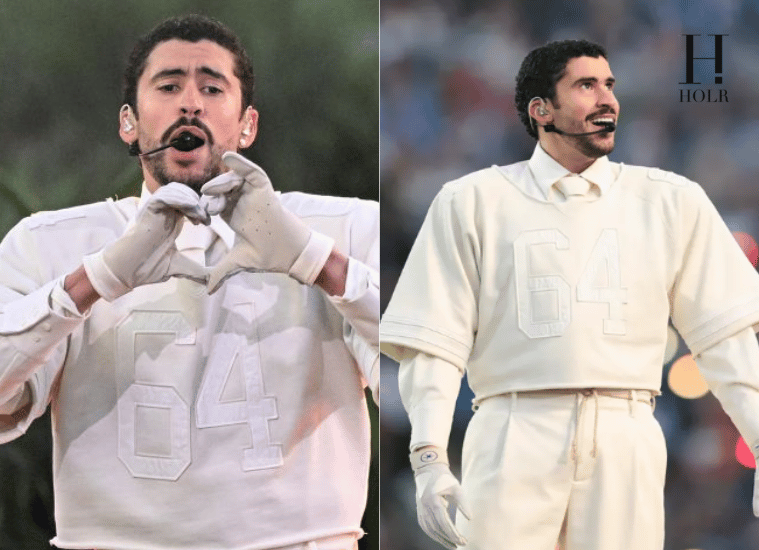
The Countries He Named and Why It Shook America –

God Bless America” — And Then He Named the Countries: How Bad Bunny Redefined America at the Super Bowl
February 9, 2026: When Bad Bunny stepped onto the world’s biggest stage during the Super Bowl LX halftime show, he didn’t just perform music — he delivered a cultural moment that instantly divided, inspired, and ignited debate.
After nearly an hour of Spanish-language performance rooted deeply in Puerto Rican culture, Bad Bunny ended his set with just four English words: “God bless America.” What followed was unexpected, deliberate, and impossible to ignore. Instead of stopping there, he began naming countries across the Americas, turning a phrase traditionally associated with U.S. nationalism into a continental declaration of identity.
For some viewers, it was powerful.
For others, it was controversial.
For millions of Latino Americans, it felt deeply personal.
:max_bytes(150000):strip_icc():focal(749x0:751x2)/bad-bunny-superbowl-halftime-show-020926-3-12826e96460343bb94a55b693dfaf95e.jpg)
Image Credit: CHRIS TORRES/EPA/Shutterstock
A Halftime Show That Refused to Translate Itself
From the very beginning, Bad Bunny made one thing clear: this performance would not be watered down, translated, or adjusted for comfort. Nearly every song, transition, and spoken word moment was delivered in Puerto Rican Spanish, complete with regional slang, cadence, and cultural references.
This choice was not accidental.
In the context of the Super Bowl — an event historically centered on English-language performances and mainstream American aesthetics — Bad Bunny’s refusal to switch languages was a bold assertion of cultural ownership. He didn’t ask for space. He took it.
That decision alone sparked backlash before he even stepped on stage.
Image Credit: USA Today
The Pre-Show Backlash: “Too Spanish for the Super Bowl?”
In the days leading up to the game, criticism emerged from conservative commentators who questioned why the NFL would book an artist who doesn’t primarily perform in English. Some labeled the decision “divisive,” while others framed it as a rejection of “traditional American values.”
Counterprogramming events were organized. Political rhetoric crept into sports commentary. Even security presence at the game became part of the larger narrative surrounding immigration, identity, and nationalism.
Against that backdrop, Bad Bunny’s final message landed with even more force.

Image Credit: Forbes
The Moment That Changed Everything: Naming the Countries
After saying “God bless America,” Bad Bunny didn’t pause for applause. Instead, he began listing countries — one by one — across Latin America, the Caribbean, and North America.
Among the nations he referenced were:
- Puerto Rico, his homeland
- Mexico
- Colombia
- Venezuela
- Dominican Republic
- Cuba
- Additional Latin American and Caribbean nations
- United States of America
- Canada
As each country was named, flags appeared, dancers moved in unison, and the visual language reinforced the message: America is bigger than one border.
This was not a geography lesson. It was a statement.
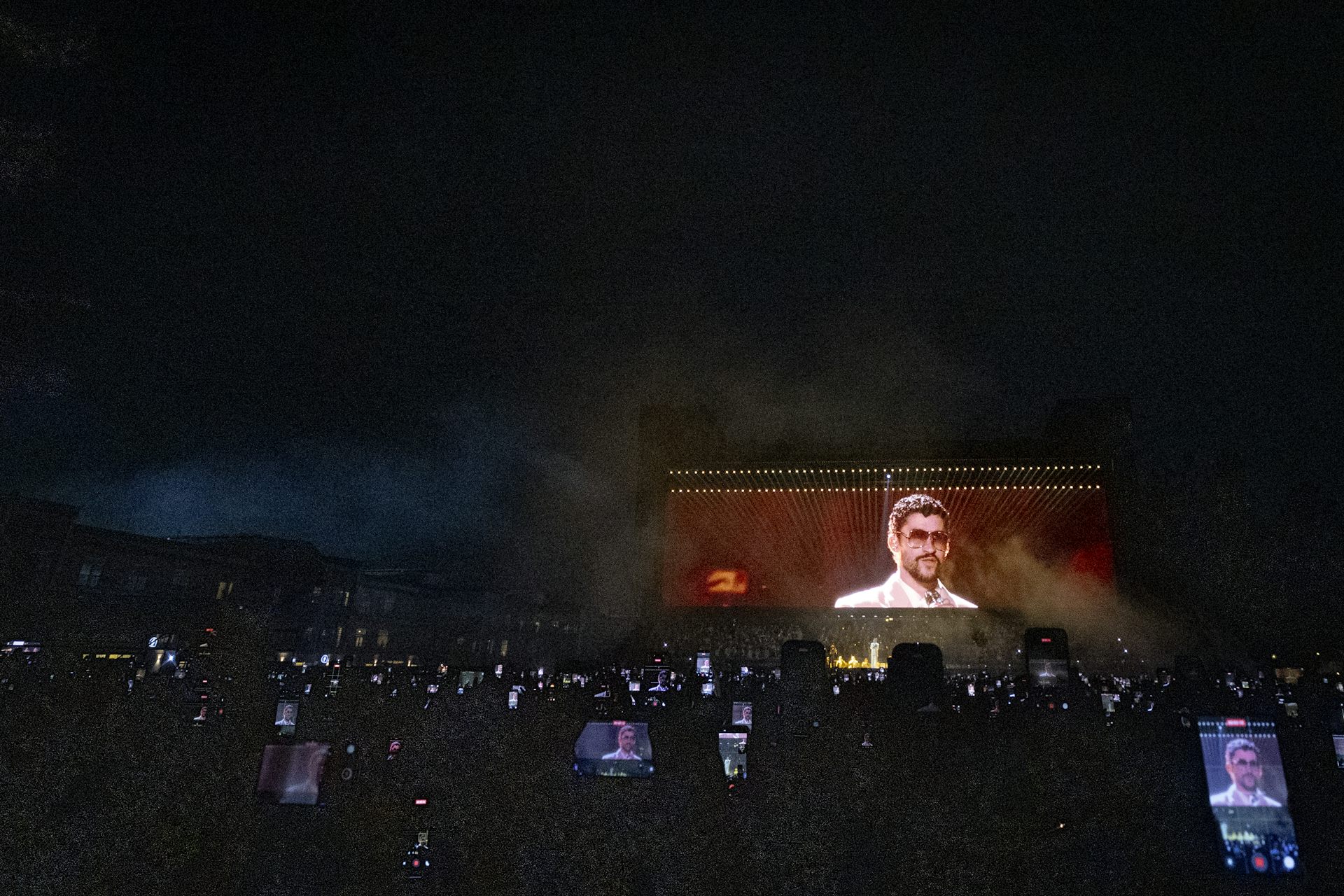
Image Credit: The Conversation
Redefining “America” — Not as a Country, but a Continent
In U.S. culture, the word America is often used interchangeably with the United States. Bad Bunny challenged that assumption in real time, on live television, in front of millions.
By naming countries across the hemisphere, he reclaimed the word America in its broader, original sense — a collection of nations, cultures, and peoples connected by shared history, migration, and struggle.
To some viewers, this felt like a correction.
To others, it felt like a provocation.
Why the Countries Matter More Than the Phrase
Plenty of artists have said “God bless America” at sporting events. What made this moment different was what came next.
Bad Bunny didn’t sing the patriotic anthem. He spoke the phrase plainly, almost casually — after performing almost entirely in Spanish — and then immediately expanded it beyond U.S. borders.
That sequencing mattered.
It reframed the blessing not as a nationalist slogan, but as a shared hope for all the Americas. In doing so, he shifted the emotional ownership of the phrase.
Image Credit: King 5 News
For Latino Americans, a Rare Moment of Recognition
For millions of Latino Americans watching — many of whom move fluidly between languages, cultures, and national identities — the moment resonated on a deeply emotional level.
It acknowledged a lived reality:
- Being American without being monolingual
- Loving the U.S. while honoring ancestral homelands
- Existing in multiple cultures at once
By naming countries, Bad Bunny publicly recognized identities that are often marginalized or politicized in mainstream American discourse.
Image Credit: CBS News
Language as Power, Not a Barrier
One of the most striking aspects of the performance was its refusal to explain itself. Bad Bunny did not translate. He did not justify. He did not soften his message.
By doing so, he flipped a long-standing expectation — that non-English speakers must adapt to be accepted — and instead placed the responsibility of understanding on the audience.
In that silence, the message became louder.
A Cultural Line in the Sand
This wasn’t just about music. It was about who gets to define America on one of its most visible stages.
Bad Bunny’s roll call of countries drew a clear line:
- America is multilingual
- America is multicultural
- America includes people whose roots stretch far beyond one flag
Whether viewers applauded or protested, they were forced to confront that reality.
The message on the screen — “The only thing stronger than hate is love” — reframed the entire performance, transforming what some saw as defiance into an offering: not a rejection of America, but a call for a more inclusive vision of what the country can be at its best, one that makes room for everyone.
Image Credit: Business Insider
Why This Halftime Show Will Be Remembered
Long after the scores fade and the season ends, this Super Bowl halftime show will be remembered for one reason: it changed the conversation.
By naming countries, Bad Bunny didn’t divide America — he exposed how divided the definition already was.
Some saw pride.
Some saw protest.
Some saw themselves for the first time.
Final Thoughts: More Than a Performance
Bad Bunny didn’t just perform at the Super Bowl — he claimed space.
By ending his set with “God bless America” and then naming the countries of the Americas, he transformed a familiar phrase into a radical act of inclusion. It was uncomfortable for some, affirming for others, and unforgettable for everyone watching.
Love it or hate it, the message was clear:
America isn’t one story — it’s many. And every one of them deserves to be named.
Published by HOLR Magazine
Image Credit: David TulisUPIShutterstock, Getty Images