Historic defence properties in Sydney, Melbourne and Brisbane set for sale and public access


Some of the nation’s most historic defence properties – including Victoria Barracks in Sydney, Melbourne and Brisbane – are poised to be sold and opened up to the public, with staff shifted to expensive and recently renovated nearby offices that regularly sit half empty.
After a wait of more than two years, the federal government is preparing to imminently release its response to a sweeping audit of the 3 million-hectare defence estate portfolio that could free up billions of dollars for the budget, expand public access to the nation’s military history and create more housing in inner-city areas.
Sources familiar with the audit, handed to the government in December 2023, said it had identified a series of examples where the use of historic sites as defence facilities was becoming increasingly impractical and expensive to maintain.
A subsequent analysis conducted for the government found many defence sites were underutilised and shut off from public access, meaning there is “significant scope for consolidation” in the defence estate.
The government has determined there is “little benefit for the defence force or the public as these sites are currently utilised”, the sources said.
Divesting the Victoria Barracks sites in Sydney, Melbourne and Brisbane could save taxpayers hundreds of millions of dollars over the next decade, highlighting the scope for major savings if dozens of other defence sites are also sold as expected.
The resale value of the three sites has been estimated at $1.3 billion, although heritage listings would limit the scope for redevelopment.
Any sale of the defence force’s prized possessions would inevitably arouse resistance from residents and veterans who want the status quo maintained, explaining why the government has taken so long to respond to the audit.
The government’s analysis found that Victoria Barracks Sydney, in Paddington, is a third empty on an average day while the recently refurbished Defence Plaza office complex in the CBD is 60 per cent empty. About 700 staff work across both sites.
Maintaining Victoria Barracks Sydney, which was built between 1841 and 1849, in its current form would be expected to cost taxpayers nearly $195 million over the next 10 years in infrastructure and sustainment costs.
The 15-hectare site houses the Army Museum of NSW, but it is only open one day a week for four hours and on the third Sunday of every month, limiting public access to military history.
The City of Sydney has embraced the idea of converting the site into public green space, cultural facilities and apartments to ease the shortage of inner-city homes.
“The perimeter walls, once built for defence, act as a barrier between this significant heritage site and the surrounding neighbourhood,” the council found in a blueprint released last year.
“With limited public access, the precinct remains largely unknown.”
Councillor Zann Maxwell said: “If Defence decides Victoria Barracks is no longer required for Australia’s contemporary strategic posture, we must be ready to transform it into something extraordinary that meets the needs of today while preserving the legacy of the past.”
The government has previously indicated it is interested in selling Spectacle Island in Sydney Harbour, which is vacant and has cost more than $4 million to maintain since 2023.
The heritage-listed island, near Drummoyne in Sydney’s inner west, was used to store munitions during World War I and World War II.
Experts have also singled out HMAS Penguin in Balmoral, which houses the defence force’s diving school and navy medical school, as a prime candidate for sale.
Victoria Barracks Melbourne, in Southbank, has a 56 per cent utilisation rate, meaning it is nearly half empty most days.
Meanwhile, Defence Plaza Melbourne, in the CBD, has just a 46 per cent usage rate.
This means the modern office facility is more than half empty most days despite $130 million being spent on leasing, fitting out and upkeep over the past five years.
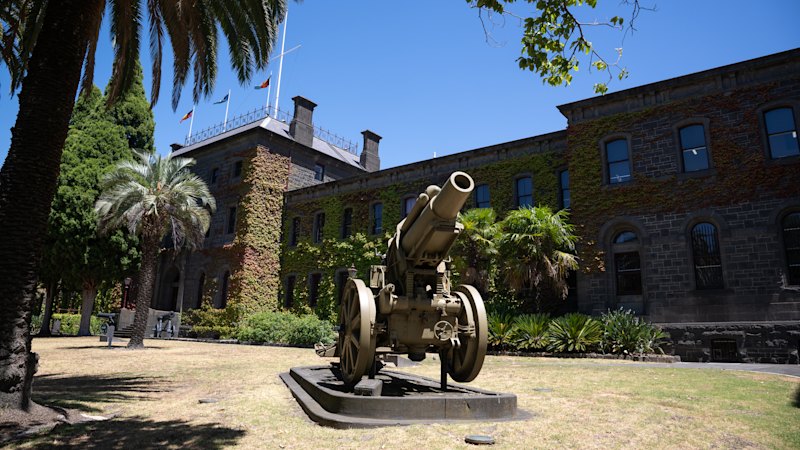
Melbourne’s Victoria Barracks, completed in 1872, once served as Defence’s main headquarters and housed the special war cabinet during World War II.
The war cabinet room is not currently open to the public, despite its crucial historical role.
Assistant Defence Minister Peter Khalil, who has responsibility for the defence estate, said: “There are strong protections in place for many buildings with heritage overlays, but right now, many of them are not open for the community to see or use.
“We want to ensure as many Australians as possible can access and appreciate our military history.”
Victoria Barracks Brisbane is nearly half empty, while there is ample capacity at Gallipoli Barracks, a 12-minute drive away.
Maintaining Victoria Barracks, in Petrie Terrace, in its current form is expected to cost $105 million over the next decade.
Cut through the noise of federal politics with news, views and expert analysis. Subscribers can sign up to our weekly Inside Politics newsletter.

From our partners