Elon Musk’s space junk blazes across Victorian skies


A satellite believed to be owned by Elon Musk lit up Victorian skies and dazzled early risers when it reentered the Earth’s atmosphere as space junk on Tuesday morning.
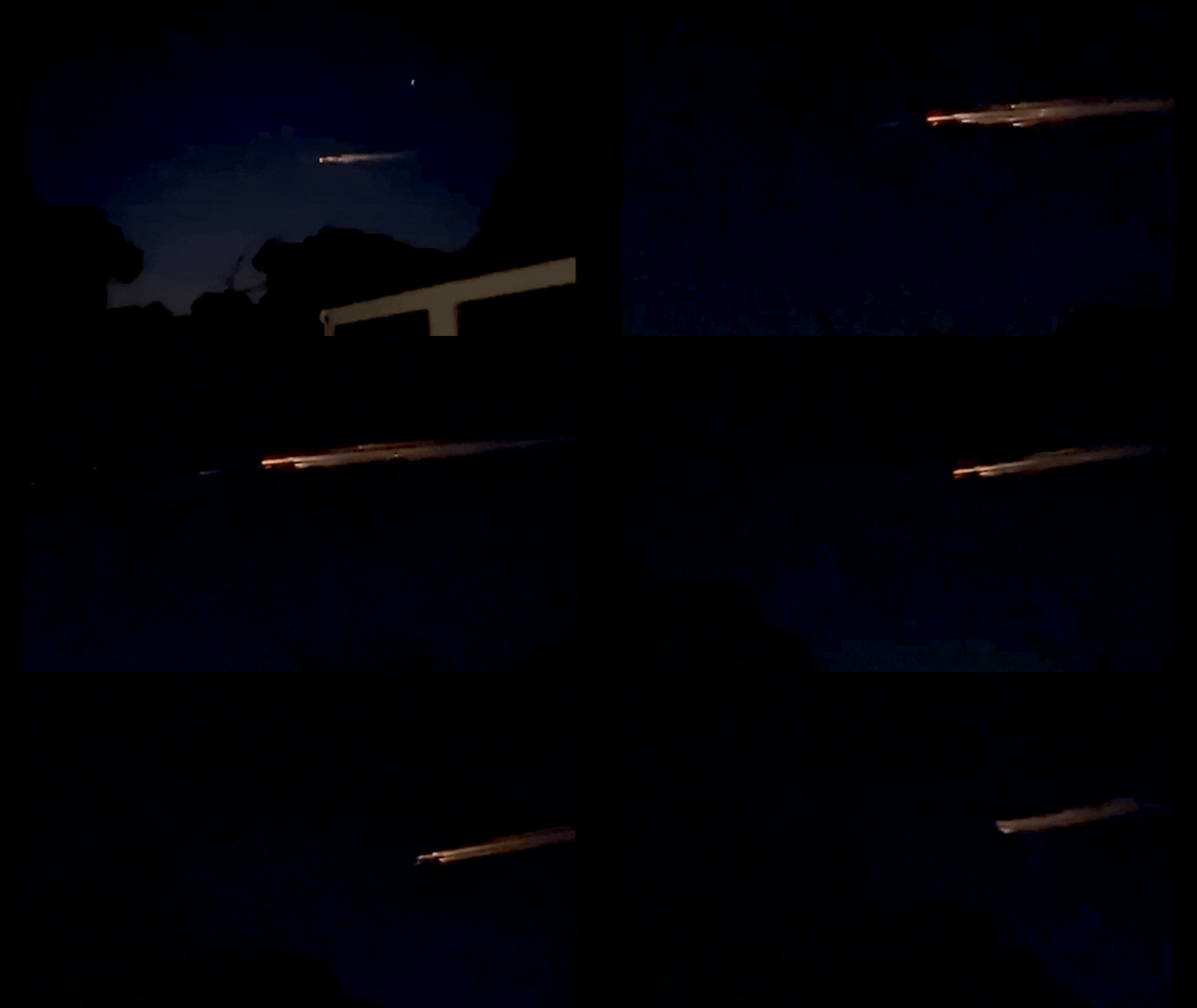
The space junk, which early indications suggest is one of Musk’s SpaceX Starlink satellites, blazed across the sky about 5.27am, leaving behind a flaming orange trail flecked with green. Many Melburnians thought they had witnessed a slow-motion meteor.
However, Associate Professor Michael Brown, of Monash University’s school of physics and astronomy, said there were telltale signs it was a space junk reentry instead.
“It was coming in almost horizontally, and coming in pretty slowly compared to, say, a meteor, which gave people plenty of time to get their mobile phone out and get some footage and perhaps say as profanities as the thing came in,” he said.
Starlink satellites, which provide internet connections, orbit in space at a relatively low altitude of 500 kilometres and therefore experience strong atmospheric drag. When the satellites’ engines give out, they are dragged back into the atmosphere over the course of months or years, where the friction of reentry causes them to burst into flames spectacularly.
“These are internet satellites that [Musk’s company] SpaceX has been launching many thousands of in recent years, and the first ones that they launched a few years ago are now past their prime and are starting to come down in increasing numbers,” Brown said.
“So these satellites reenter somewhere over the globe, pretty much every day, and we had one of them reenter over Victoria early this morning.”
Astronomer at Swinburne University Alan Duffy said space junk travels at about seven kilometres per second during reentry, which is three to four times slower than a meteor. In video on social media, the satellite can be seen leaving behind multiple molten trails which contained a greenish tinge, both also clear indicators that it is space junk, not a meteor.
“When you see the piece breaking up into multiple fireballs and trails, that tells you this is a large object, so much so that it can break up and still have visible separate components burning.”
“The different material types – metals and plastic, typically you find in a satellite or in a rocket housing – burn and give different colours, that’s quite literally the chemical constituents burning up in the atmosphere.”
Space junk is usually entirely burnt up in the atmosphere and rarely poses a risk to people on Earth.
Satellite reentries are becoming increasingly common – particularly Musk’s StarLinks – due to a large increase in the number of launches in recent years.
Duffy said this meant low-orbit areas of space were becoming crowded and there is a risk of space junk colliding while in orbit, which would create a knock-on effect of breaking up other objects in orbit.
“We have that challenge already in some orbits where we’re very close to that tipping point,” he said.
“And once that happens it means you can’t use those orbits for years, decades, perhaps even centuries, depending on where they are, unless you actively clean them up.
“The other challenge is … we use it for a range of different needs, from communication to Earth observation, weather monitoring and human habitation in terms of the space station. So it’s a very crowded, very prized patch of real estate, and with all of those satellites operating up there, contesting for those orbits, it’s becoming quite a challenge to literally navigate.”
Duffy said private companies should be strictly regulated to ensue they conducted business responsibly.
The Morning Edition newsletter is our guide to the day’s most important and interesting stories, analysis and insights. Sign up here.
 Angus Delaney is a reporter at The Age. Email him at angus.delaney@theage.com.au or contact him securely on Signal at angusdelaney.31Connect via email.
From our partners