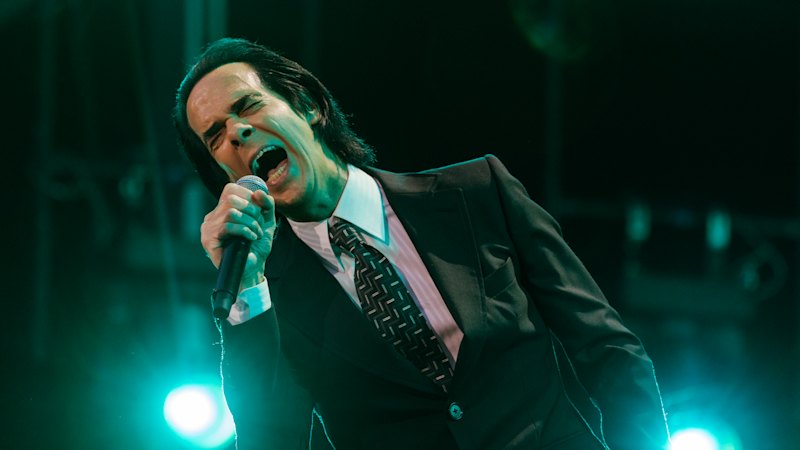
Nick Cave and the Bad Seeds at Alexandra Gardens; The Placeholder at fortyfivedownstairs;

Updated ,first published
MUSIC
Nick Cave and the Bad Seeds ★★★★★
Alexandra Gardens, January 30
Across his decades-long career, Nick Cave’s work has always courted darkness: his lyrics reverberate with images of biblical violence, with the ache of loneliness and grief, with the kind of love that goes hand in hand with death. Yet equally, he is attuned to beauty and salvation; to the distant, longed-for possibility of redemption. It is in the tension between these two impulses, never quite reconciled, that the strength of his artistry lies.
This artistry was on full display at Melbourne’s Alexandra Gardens, where an electrifying 2½-hour set somehow doesn’t seem long enough. It’s been nine years since Cave last toured with the full complement of the Bad Seeds, and the band seems determined to make up for lost time. Every person on stage comes to the performance with absolute conviction: from Warren Ellis working his unruly magic with the violin, to the gorgeous textures of the gospel-inflected backing choir, and the magnetic, visceral energy of Cave himself.
“It seems like we’ve been on a great odyssey across this country to get to Melbourne,” he says, to roars of approval. This is a show for the home crowd.
The set deftly balances work from the band’s 2024 album, Wild God, with cherry-picked tracks from its extensive back catalogue. An early highlight is a searching performance of O Children from the 2004 album, Abattoir Blues/The Lyre of Orpheus, while Cave’s darker impulses are on full display in the seductively menacing groove of Red Right Hand and the apocalyptic bombast of The Mercy Seat.
While the show contains its moments of pain, rage and despair, these days, perhaps joy is Cave’s primary register. It’s there in the naïve lyrics of Frogs, in his open-hearted tribute to former bandmate and collaborator Anita Lane in O Wow O Wow (How Wonderful She Is), and most defiantly in Joy, in which Cave conjures up a ghostly child visitor with a message of hope amid the tragedy of the everyday: “We’ve all had too much sorrow, now is the time for joy.”
A generous, six-song encore showcases some of the band’s best work: from an elemental rendition of The Weeping Song to a sensitive cover of Young Charlatans’ Shiver (perhaps the world’s most accomplished love song ever to have been written by a 16-year-old). A luminous performance of Into My Arms brings the evening to a close: tender, plainspoken, the darkness tempered always by light.
Reviewed by Nadia Bailey
THEATRE
The Placeholder ★★★
fortyfivedownstairs, until February 8
The shared experience of grief has culminated in many an incisive theatre piece centred on chosen families navigating existential questions of loss, friendship and mortality – Domenica Feraud’s off-Broadway play Someone Spectacular and, closer to home, Ash Flanders’ Malthouse production This Is Living among them.
Ben MacEllen’s The Placeholder is the latest play to wade into thorny territory. We’re plunged headfirst into 2017, notably the year queer communities were subjected to a plebiscite on marriage equality. It’s a devastating time, illustrated by clips of real-life interviews and news segments showcasing the bigotry that was allowed to flourish.
United by virtue of Barb’s Bosom Buddies – a fundraising collective dedicated to honouring the memory of namesake Barb, who died of breast cancer – five disparate people in the fictional rural town of South Bend find themselves meeting monthly to brainstorm badges, banners, cookies and muffins.
Matriarch Pat (Meredith Rogers) is a soft-spoken retiree whose kitchen becomes the focal point of the play, brilliantly materialised by Bethany J. Fellows’s set design. Helen (Michelle Perera) is a widow with a heart of gold and a penchant for baking. A proud lesbian, Keira (Rebecca Bower) self-medicates with alcohol to withstand living in a cloistered town. Barb’s niece Jo (Brigid Gallacher) is the conservative black sheep of the group. And sporty Nic (Oliver Ayres) used to go by Nicole, until they announce they’re transitioning into a man.
The reprisal is swift. The elder members of the group, Pat and Helen, paradoxically take it in their stride, but Keira is incensed by the perceived loss of a lesbian peer, and Jo insists it’s all but a phase. The remainder of the play details the fallout of Nic continuously insisting on his personhood against bad-faith arguments and a gulf of miscomprehensions.
As the kindest, most level-headed character, Helen is who most audiences will project themselves onto. But Perera, so brilliant in This Is Living, is also the strongest of the ensemble. Her comedic timing is impeccable as she expertly oscillates between empathetic displays of allyship and perfectly executed moments of humour that imbue the play with levity at key junctures.
Functioning like a time capsule by virtue of being set nearly a decade in the past, The Placeholder provides a stage for various expressions of acceptance and opposition as the group muddles through supporting Nic. A cookie-cutter bigot, Jo’s views cover well-trodden, odious ground. But it’s Keira’s see-sawing between solidarity and gender essentialism and a self-victimisation that’s impervious to the marginalisation of others that’s harder to stomach – and altogether more interesting.
MacEllen presents thought-provoking contrasts between desired gender-affirming care and unwanted life-saving surgery, gender and sexuality, mental deterioration and newly prized lucidity. But at close to three hours, The Placeholder is simply too long. MacEllen’s script retreads familiar ground in the play’s second act, which drags lugubriously to its emotional climax(es).
The tenuous connecting thread of a makeshift charity doesn’t explain why these characters are so invested in one another, and why they tolerate unconscionable behaviour – particularly from Jo. As a result, the emotional payoffs are muted, hampered further by unnatural, dialogue-heavy exposition and uneven acting during key dramatic reveals.
Much is left unresolved by close. Keira’s alcohol addiction continues to be the butt of jokes, Pat’s clear descent into dementia is unremarked upon. String-heavy interludes between scenes are peppered with a greatest hits compilation of what happened in the intervening years – good, bad, ridiculous. But the cacophony, so effective initially in illustrating the overwhelm of the plebiscite, overpowers the play by the end.
Reviewed by Sonia Nair
The Booklist is a weekly newsletter for book lovers from Jason Steger. Get it delivered every Friday.
 Nadia Bailey is a writer, editor, and critic from Melbourne.
 Sonia Nair is a contributor to The Age and Good Food.
From our partners