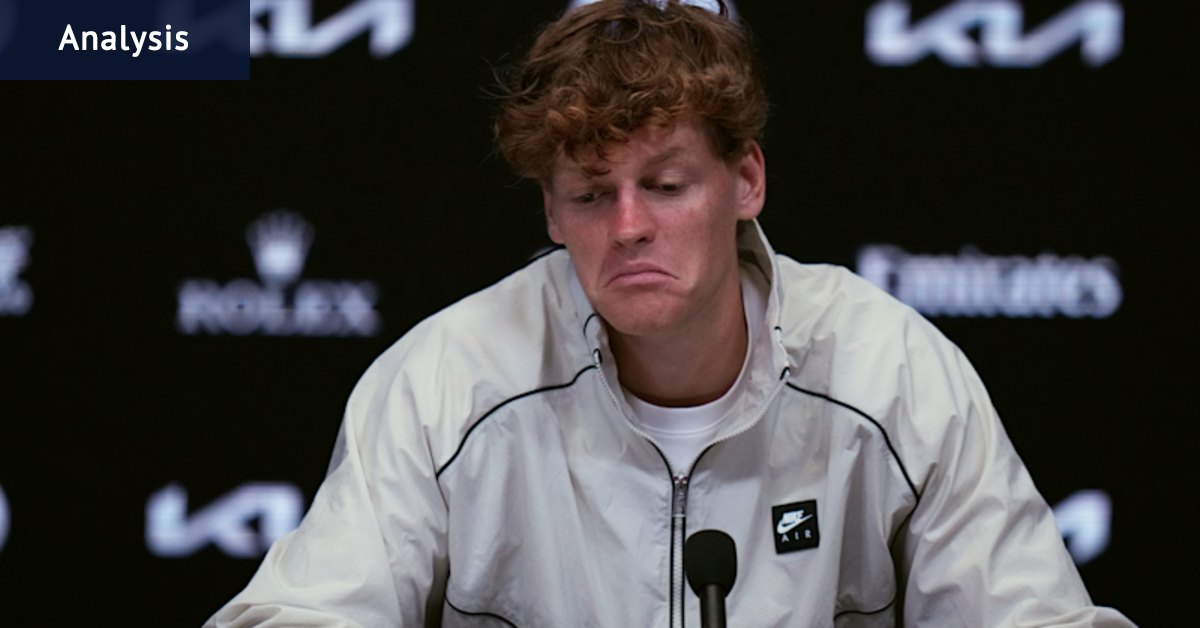
Extreme heat policy sparks debate over athleticism vs safety after Sinner-Spizzirri match

Sinner has a right to operate in a workplace which safeguards his wellbeing; it is the responsibility of a tennis tournament to ensure that, for players who often push themselves past the brink in drastic conditions, there is a point at which their safety is taken out of their hands. The same rights should be applied to ball kids, umpires, staff and spectators.
Equally, Spizzirri has a right to exercise whatever athletic advantage he can over an opponent, because athletic superiority is ultimately the crux of many sports. This little-known American played well above his world No.82 ranking against the cream of the crop, and a key point of strength was his capacity to play at full steam in the heat in a way Sinner definitely cannot.

Eliot Spizzirri was in his element in Saturday’s difficult conditions.Credit: Getty Images
“I thought that it was an opportunity to showcase my physicality,” a magnanimous Spizzirri said after the match. “I was talking to a couple of people in the locker room that I did my pre-season with, and this heat’s nothing compared to what we deal with in Florida, and what I went and trained in in Austin. Even New York in the summers with the humidity.
“I played a match in China last year. I think it was 123F (50C) on-court temp. I don’t think it was even ballpark close to that today. So, yeah, I felt pretty fresh, to be honest, and felt like I could have gone a lot longer.”
Operating for long periods in intense heat and humidity was Spizzirri’s trump card, because it is Sinner’s glaring frailty, as has been demonstrated on numerous occasions. It feels uncomfortable to say that the tournament’s heat rules may have stripped Spizzirri of a match-winning physical advantage. It feels uncomfortable because it feels similar to suggesting you should put lives at risk for the sake of good sport, and that is absolutely not the right course of action.
And herein lies the fraught nature of this issue. A spectrum, if you like, on which a balance must somehow be struck. One that appropriately mitigates risk while also allowing for the Darwinist element of sport to play out so that somebody wins and somebody loses in a setting with minimal external interference. As a side note, being scheduled in the hottest part of the day and not the cooler evening also qualifies as external interference.

Jim Courier takes a victory dip in the Yarra after winning the Australian Open in 1993.Credit: Stuart Hannagan
A fascinating offshoot study is the ongoing research into whether a person is born with the athletic prowess of, say, a professional tennis player, or whether it is learned through thousands of hours of training. Is Spizzirri’s anatomy biological, or the result of years of acclimatisation while coming through the US college system? Conversely – and also similarly – is Sinner’s weakness in this area genetic, or is there a flaw in his approach to training in heat?
It’s the old nature-or-nurture debate, and it won’t come as a shock that the answer appears to be a combination. Sinner, for his part, revealed his own competitive edge via his ability to recover from dire cramping just enough to take control of a match he’d never had in his grasp from the start.
Loading
None of this provides an answer to the conundrum at hand, but Jim Courier – a saluter of the sun during his playing days – offered some valuable context when recalling his Australian Open final win over Swede Stefan Edberg in 1993, when there were no heat rules and their “bodies were just in shock”.
“I woke up in the morning of the final … it was going to be 102 degrees [Fahrenheit] and 150 on the court,” Courier told the Tennis Channel in the aftermath of the Sinner-Spizzirri meeting.
“I knew I had a physical advantage against Edberg, who had been doing his training in London in the winter, and I had been in Palm Springs. The tournament director at the time came to me and said, ‘We’re going to shut the roof’ and I said, ‘Good luck with that because you won’t have two players on the court, because those aren’t the rules’.
“Now I applaud the tournament, given how much more physical the game is today than what it was back then. I think it is sensible.”