Coalition split as Nationals leave Liberals; David Littleproud blames Sussan Ley for rift


Updated ,first published
The entire leadership of the Coalition could be junked after Nationals leader David Littleproud sparked one of the worst crises in conservative politics in Australian history by blowing up the Liberal-National agreement, infuriating the Liberals.
Fearing a decade of Labor dominance if the Coalition permanently split, Liberal MPs were privately withering in their criticism of Littleproud even as they acknowledged that Ley’s leadership was probably terminally damaged and were discussing options for her replacement.
Some Nationals were canvassing long-shot options with the Liberals to keep the Coalition together via unorthodox arrangements such as allowing some of the five Nationals who did not resign on Wednesday to serve in the shadow cabinet, demonstrating the level of desperation in both parties.
“Can we override the stupidity here?” one senior MP said of the last-ditch talks, claiming there remained about a 20 per cent chance of reviving the Coalition because so many MPs disagreed with Littleproud’s move.
Some MPs backgrounded media outlets that Nationals defector Barnaby Joyce had been right in his recent attacks on Littleproud’s leadership, and even Littleproud’s backers in his own party acknowledged that by tearing up the Coalition and blaming Ley, it meant he would most likely have to depart as leader if any patch-up was to occur in coming weeks or months.
Most MPs spoken to by this masthead said they did not expect a petition to call a special party room meeting to roll Ley before parliament returns in February, so the soonest Ley’s leadership could be challenged would be early next month.
“It feels inevitable that she will be replaced, but the timelines aren’t clear,” said one right-wing MP, who spoke on the condition of anonymity.
Leadership rival Angus Taylor is returning from a European holiday as planned later this week. He has been in touch with colleagues to assess whether it is the right time to strike, but one of his supporters said it could create even more chaos if a Liberal leadership challenge followed a Coalition split in quick succession.
Andrew Hastie, another likely leadership contender, has defended himself on social media for voting for the hate speech bill along with other Liberals, saying “you often only get the choice between multiple bad options” and telling the thousands of right-wing commenters furious with him that “purity is for keyboard warriors and paid influencers”.
Liberal MPs said there were two prevailing narratives emerging about the Coalition split. One was that Ley had mishandled the saga and her leadership was terminal; the other held that the Nationals had acted recklessly and should not dictate the Liberal leadership.
One source said that both held true: MPs believed Ley’s leadership was badly wounded, but that Littleproud’s actions meant there was a strong appetite not to reward the Nationals, which might buy time for Ley.
Many MPs spent Thursday on the phone canvassing options, but the conversations were disorganised, numbers were not being counted, and key backers of Hastie and Taylor did not want to publicly cut down Ley, instead preferring that she see the writing on the wall herself, making it hard to predict how the next few weeks will play out.
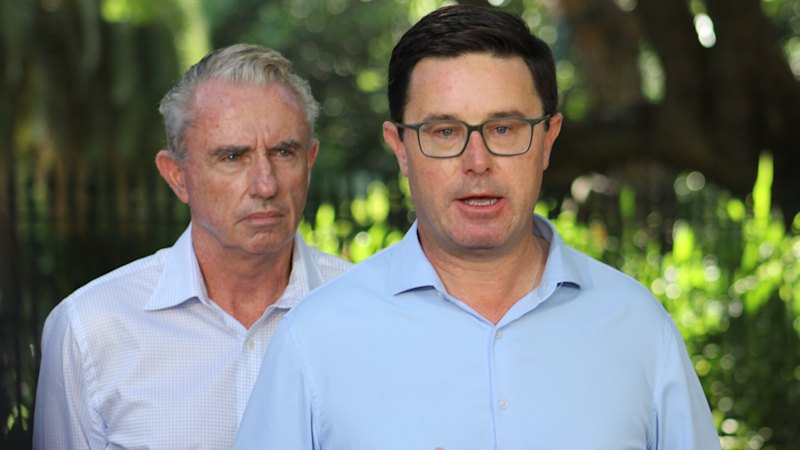
In a press conference in Brisbane on Thursday morning, Littleproud blamed Ley for forcing his hand, as he explained his decision to blow up the Coalition by quitting the joint frontbench along with 10 other Nationals MPs.
The Nationals leader claimed it was Ley’s actions that led to the rupture because she should not have accepted the resignations of three Nationals senators who broke shadow cabinet convention when they voted against the Coalition’s position to support Labor’s hate crimes laws on Tuesday.
“She has forced the Coalition into an untenable position,” Littleproud said, adding “we sit by ourselves.”
“We cannot be part of a shadow ministry under Sussan Ley.”
Ley had asked Littleproud not to speak publicly about politics on Thursday because it was the day of mourning for the Bondi massacre. One Liberal MP who did not vote for Ley said it was “disgusting” that Littleproud made the comments on the day of mourning.
Ley made no public comments except those in a short statement released as Littleproud was speaking, saying: “Today the focus must be on Jewish Australians, indeed all Australians, as we mourn the victims of the Bondi terrorist attack.”
It is the second time the Coalition parties have split since the last election after an eight-day split last May.
Former prime minister John Howard backed Ley’s decision-making on Wednesday and former foreign minister Alexander Downer was critical of Littleproud.
“David Littleproud should have understood the huge responsibility he has to make the Coalition work, not force yet another break-up. [Doug] Anthony, [Tim] Fischer, [John] Anderson would never have allowed this to happen,” Downer said, referring to previous Nationals leaders.
Ley will need to start making arrangements for a new Liberal-only opposition. Some Liberals, particularly moderates, hope the party will be able to be regenerated without the presence of their conservative junior partner.
The crux of Littleproud’s argument is that the Coalition’s internal decision-making process on Labor’s hate crimes laws, which make visa cancellations easier and ban hate groups, was flawed.
Ley and senior Liberals argue that the shadow cabinet, which includes senior Nationals, agreed on Sunday to back Prime Minister Anthony Albanese’s watered-down bill if he agreed to Coalition amendments.
Over the next two days, Coalition shadow ministers secured a series of concessions from Labor, executing the will of the shadow cabinet.
But over Monday and Tuesday, the Nationals-only party room held a flurry of meetings to discuss the bill, as right-wing backbencher Matt Canavan raised objections.
After several of these meetings, the junior Coalition partner made amendment requests, some of which the government could not accept. Canavan believed the sweeping new powers to ban hate groups – aimed at neo-Nazi organisations and radical Islamist groups like Hizb ut-Tahrir – could be used to crack down on mainstream political and religious groups, a view shared by the Greens.
Littleproud said his party room – which has often been pushed to its positions by Canavan, a leadership threat to Littleproud – was still working through its processes until late on Tuesday when the Senate started to vote.
Therefore, his MPs felt compelled to vote against the laws, he said, even though the shadow cabinet agreed in principle on Sunday to back the bill with amendments.
Three Nationals frontbench senators – Bridget McKenzie, Ross Cadell and Susan McDonald – had offered their resignations out of respect for shadow cabinet convention, Littleproud said. But, he argued, Ley should not have accepted them and should instead have acknowledged the unique circumstances caused by Labor’s flawed emergency process.
Cut through the noise of federal politics with news, views and expert analysis. Subscribers can sign up to our weekly Inside Politics newsletter.
 Paul Sakkal is chief political correspondent. He previously covered Victorian politics and has won Walkley and Quill awards. Reach him securely on Signal @paulsakkal.14Connect via Twitter or email.
From our partners