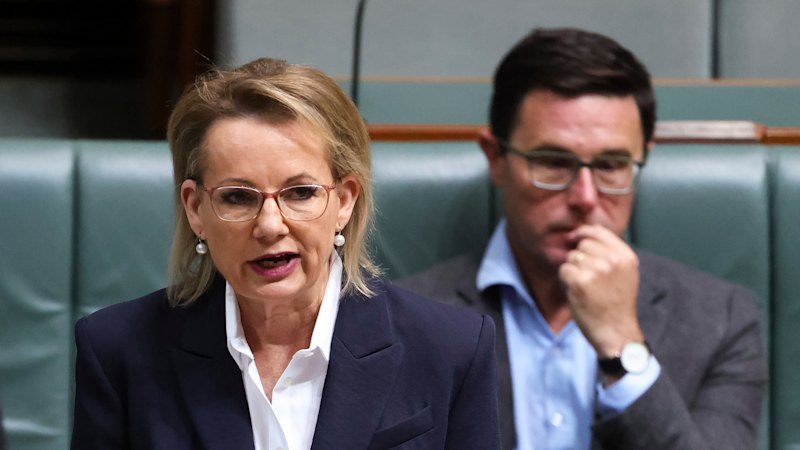
Nationals Bridget McKenzie, Ross Cadell, Susan McDonald set to resign from frontbench after hate speech law split with Coalition


Updated ,first published
The Coalition is in tatters after Nationals leader David Littleproud and all of the party’s frontbenchers joined three rebel MPs in quitting their positions after they broke shadow cabinet solidarity, following through with a bombshell threat he made to Ley on a day of high drama.
Triggering one of the biggest crises in conservative politics for a generation, Littleproud and eight Nationals frontbenchers quit Ley’s frontbench on Wednesday evening after the opposition leader had earlier accepted the resignations of three rebel Nationals earlier in the day. It is the second time since the May election the parties split.
This masthead obtained a letter sent by Littleproud to Ley on Wednesday morning saying that Ley had the right to sack frontbenchers Bridget McKenzie, Susan McDonald and Ross Cadell after they broke from the Liberals to vote against the government’s bill to crack down on hate groups.
But, Littleproud argued in the letter, Ley should avoid doing so because the legislative process was so rushed and the shadow cabinet never signed off on a final bill – a claim heavily contested by the Liberals.
“If these resignations are accepted, the entire National Party ministry will resign to take collective responsibility,” Littleproud wrote in a hand-signed letter sent to Ley.
“Opposing this bill was a party room decision. The entire National Party shadow ministry is equally bound”.
Hours after Littleproud’s letter, Ley accepted the resignations with the full backing of right-wing Liberal powerbrokers such as Michaelia Cash, James Paterson and Jonno Duniam.
Nationals MPs then met at a 6pm on Wednesday and decided to follow through with the threat, leading Littleproud and deputy Kevin Hogan and others to also depart the frontbench.
The stunning move will almost inevitably lead to the Coalition dissolving, likely for a longer period than the brief split after the May election.
After spending weeks piling pressure on Labor over its flat-footed response to the Bondi massacre, a tortuous few days of sparring over hate speech laws pulled apart the Coalition and plunged it into a fresh crisis as polls showed One Nation pulling support from the opposition’s right flank.
The joint Liberal-Nationals shadow cabinet on Sunday made an in-principle agreement to back Labor’s crackdown on hate groups so long as they were amended in line with Coalition demands, which they were.
That agreement started to fall apart on Monday when Nationals backbencher Matt Canavan, who has often set the agenda inside the junior Coalition partner, started to campaign against the bill over concerns it would target mainstream religious and political groups.
After the frontbenchers voted against the hate speech laws, they sent resignation letters to Ley on Wednesday morning, as first reported by this masthead, in acknowledgement that they had breached convention as shadow ministers to toe the party line.
Ley repeatedly told Littleproud about the need for his MPs to stick with the agreed position before the vote, Liberal sources speaking on the condition of anonymity said.
But Ley, under pressure to prove that she could enforce discipline, said she had accepted the resignations hours later on Wednesday afternoon, saying, “Shadow cabinet solidarity is not optional.”
“It is the foundation of serious opposition and credible government.”
“I made it clear to David Littleproud that members of the shadow cabinet could not vote against the shadow cabinet position. The shadow cabinet was unanimous in its endorsement to support this bill subject to several amendments that we did then secure.”
One top Liberal said: “Littleproud is threatening to pull the Nationals out of the frontbench at the same time as saying in private that he hopes the Coalition can stay together. It’s a nonsensical position.”
Flailing in the polls, Ley took the decision to let the frontbenchers go with the full backing of right-wing Liberal powerbrokers such as Michaelia Cash, James Paterson and Jonno Duniam. Duniam and Ley convinced right-wing Liberals such as Andrew Hastie to back the hate crimes bill that made visa cancellations easier and allowed for the prohibition of hate groups such as neo-Nazis and radical Islamists.
Even Ley’s critics in the Liberal Party backed her stance against the Nationals on Wednesday as they expressed private fury at Littleproud for failing to bring his party into a coherent position on the laws.
But the long-run implication for Ley might still be devastating if the wounds caused by the resignations, or an even more damaging Coalition split, erode Ley’s standing further and fuel a leadership challenge from Hastie or Angus Taylor, who missed the parliamentary week as he was on holiday in Europe.
One Liberal made the point that several inner-city Liberal frontbenchers wanted to vote for Labor’s gun restrictions but voted against the laws in line with Coalition policy, an example the Nationals could not emulate against the backdrop of a backlash among online free speech advocates.
The scale of the libertarian/far-right discontent towards Labor’s policies was evident on the social media feed of right-wing darling Andrew Hastie, whose posts were flooded with messages urging a vote for One Nation, which opposed the laws.
Nationals frontbencher Anne Webster said of a split on Wednesday: “We are not afraid to do it again.”
Foreign Minister Penny Wong seized on the tension to create a leadership test for Ley.
“A very important question now is there for Sussan Ley. The shadow cabinet made a decision to support this legislation, but shadow cabinet members have voted against it. Will she enforce the convention that people, shadow cabinet members, who vote against the shadow cabinet position have to resign, or will she squib it?” Wong said.
Cut through the noise of federal politics with news, views and expert analysis. Subscribers can sign up to our weekly Inside Politics newsletter.
 Paul Sakkal is chief political correspondent. He previously covered Victorian politics and has won Walkley and Quill awards. Reach him securely on Signal @paulsakkal.14Connect via Twitter or email.
From our partners