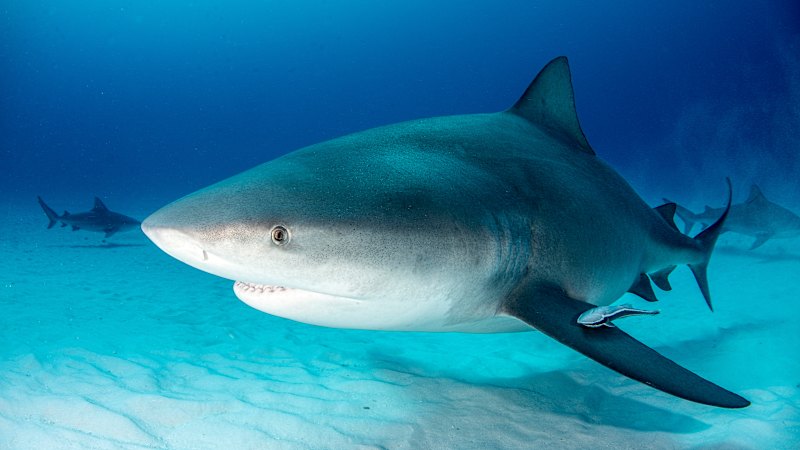
Is it dangerous to swim in Sydney?

It’s the perfect time of year for bull shark activity. The sharks prefer temperatures above 22 degrees and their activity around Sydney peaks in January and February.
Lauren O’Neill survived a bull shark attack in Elizabeth Bay at the same time of year.
The only slightly unusual factor behind the attacks was the time of day. Bull sharks are crepuscular, meaning they usually hunt in the low light of dawn and dusk. The low-light conditions also favoured by tiger and white sharks, but all three species can attack at any time.
Bites are more likely after big rains or floods and within a kilometre of a river. Schools of baitfish and diving birds are also a sign of greater risk.
Are bull sharks common in Sydney?
Sydney Harbour is an important habitat for bull sharks, which migrate from Queensland to NSW in summer, from as far north as the Great Barrier Reef.
The sharks live and hunt throughout the harbour, from Parramatta and Lane Cove Rivers to Middle and North Harbour, and off Sydney’s coastal beaches.
They hunt in shallower water at night; hotspots for bull sharks include areas less than 5 metres deep close to steep drop-offs. They swim into estuaries and rivers, including the Hawkesbury, to give birth.
Are they aggressive and do they attack humans?
All but eight of the 48 shark bites recorded in Sydney Harbour since 1807 were inflicted by bull sharks, according to the Australian Shark-Incident Database.
Some describe the species as aggressive and territorial, although NSW Department of Primary Industries scientist Dr Amy Smoothey – who has led much of the research on the harbour’s sharks – told the ABC they’re not naturally predisposed to attack humans.
“Bull sharks have this really bad reputation that they are the most aggressive species and there’s actually no scientific evidence to suggest that,” she said.
The species’ liking for shallow water also makes them more likely to encounter people.
Are shark populations off NSW increasing?
There is no evidence that populations of the three most dangerous sharks to humans – bulls, tigers and whites – are on the rise.
Tiger shark numbers are declining, while a DNA study estimated there could be fewer than 500 adult breeding great white sharks along the entire Australian coastline.
For bull sharks, however, there may not be more of them but the predators are spending more time in Sydney.
The sharks migrate northward towards Queensland each year when water temperatures drop below 20 degrees, usually between April or May.
Bull sharks spend an extra 15 days in and around Sydney compared to 2009 due to warming waters, a study published last year concluded.
“It’s just something to be aware of – that one of the top three shark species that are considered potentially dangerous for people is spending more time in this area,” warned lead author of the study Dr Nicolas Lubitz from James Cook University.
Unlike white and tiger sharks, bull sharks are not a protected species in NSW.
Why are shark bites on the rise?
The four-fold increase in shark bites along the NSW coast since 2000 is mostly driven by white sharks, according to a study led by Flinders University shark expert Professor Charlie Huveneers.
There were 14 fatal shark attacks in Australia between 2000 and 2009, 21 in the next decade from 2010 to 2019, and already 23 in the half-decade from 2019 to now. Non-fatal bites are also more frequent.

A bull shark being tagged in Sydney Harbour by the NSW Department of Primary Industries.
But the factors underpinning the uptick are many and varied. Shark attacks remain so rare that it’s difficult to tease out trends or tie the uptick in attacks to any one factor.
Huveneers’ review identified 40 factors that may be driving the rise in attacks.
“Human population growth, habitat modification and destruction, declining water quality, climate change and anomalous weather patterns, and changes to the distribution and abundance of sharks and their prey are all often proposed to explain the recent increases in shark bites,” he said.
“However, the infrequent occurrence of such events reduces our ability to determine which of these factors explain the increase in shark bites the most. It is likely to be due to a combination of these factors.”
The increase in bites since the 1990s was mostly driven by attacks on surfers on NSW’s mid and far-north coasts, and “does not necessarily reflect an increase in the risk of shark bites,” Huveneers and his colleagues wrote.
What mitigation factors work?
The NSW government says it has the largest shark management program of its kind in the world.
Loading
The program involves seasonal nets, drone surveillance during school holidays, and more than 300 SMART (Shark Management Alert in Real Time) drumlines.
The SMART system works by catching the three target shark species (white, tiger and bull sharks) using baited hooks, tagging the sharks and re-releasing them a kilometre offshore.
Listening stations near popular beaches can then detect the presence of the shark within 500 metres and trigger alerts.
Proving which mitigation efforts work the best is difficult because shark attacks themselves are so rare and unpredictable.
But the analysis by Huveneers and his colleagues found no statistical difference between the number of shark bites and netted versus non-netted beaches since 2000.
There were no shark bites at beaches where SMART drumlines or drones were in use, but 19 attacks at the same beaches before their implementation, which “might indicate that SMART drumlines and drones could potentially reduce shark-human interactions” the researchers wrote.
What’s the advice for staying safe?
To reduce the risk of a shark bite, people should swim, dive or surf with other people, stay out of the water with bleeding cuts and avoid swimming in murky water, according to the NSW government’s SharkSmart advice.
SharkSmart advice for swimmers and surfers
- Tell an on-duty lifesaver or lifeguard if you see a shark.
- Stay close to shore when swimming.
- Stay out of the water with bleeding cuts or wounds.
- It’s best to swim, dive or surf with other people.
- Avoid swimming and surfing at dawn, dusk and night – sharks can see you but you can’t see them.
- Keep away from murky, dirty water, and waters with known effluents or sewage.
- Avoid areas used by recreational or commercial fishers.
- Avoid areas with signs of bait fish or fish feeding activity; diving seabirds are a good indicator of fish activity.
- Dolphins do not indicate the absence of sharks; both often feed together on the same food, and sharks are known to eat dolphins.
- Be aware that sharks may be present between sandbars or near steep drop offs.
- Steer clear of swimming in canals and swimming or surfing in river/harbour mouths.
- Avoid having pets in the water with you.
- Keep away from shark nets and other shark mitigation measures.
- Consider using a personal deterrent.
What’s behind Shark Beach’s name?
Swimming was discouraged at Shark Beach when it opened for public use in the early 1900s due to the risk of shark attacks, which may be behind the name.
The area was known as Shark Bay in colonial times, and the beach’s neighbouring Steele Point was also once known as Shark Point.
The point looks out at Shark Island, which is said to resemble a fin.