Relentless campaign of criticism was bound to take a toll on PM

Were Basil Fawlty to have read the front-page headline of Monday’s Herald (“Support for PM plunges post-Bondi”, January 19), he would undoubtedly have uttered his famous response: “Well, that’s stating the bleeding obvious.” Given the relentless negativity towards everything the PM does or attempts to do by all arms of the media, the opposition, One Nation, the Greens and groups of all persuasions, what else would you expect? Sadly, the debates have not been all that civil, and one can only hope that the result will not be a decline into a Trumpian-style society. The idea that one man can, without co-operation and civil support from all others involved, solve the thorny issues of religious hatred and gun control, is ludicrous. We, the public, look to our media and our representatives to offer us clear and respectful information. Without it, trust in our institutions will be lost. Reporter Rob Harris warns the PM “trust, once lost, is hard to regain”. He might well have directed that to the media and all politicians as well. Peter Robertson, Stanmore

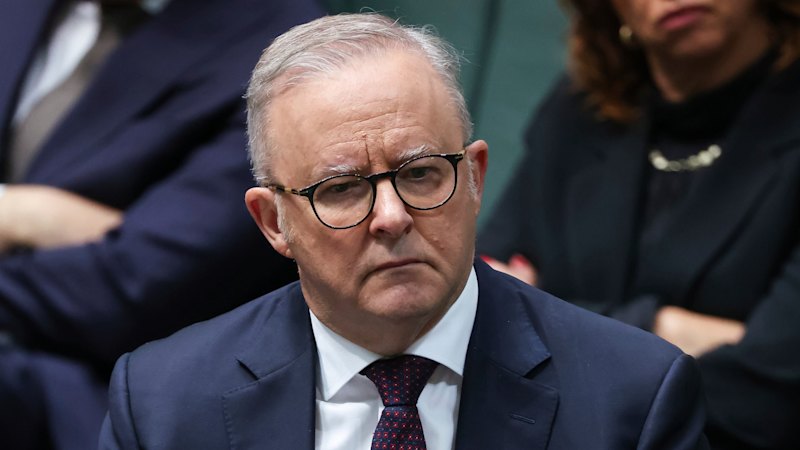
PM Anthony Albanese during a condolence motion at Parliament House on Monday in relation to the victims of the Bondi terror attack.Credit: Alex Ellinghausen
It’s interesting that a lot of your readers are so devoted to the PM that they are blind to his many faults, including indecisiveness. When he takes a position on a national issue, they applaud him, even if it is out of sync with the best interest of Australians. Then the inevitable backdown happens and they applaud him for this, and he becomes a great leader for the backdown. Either you agreed with him in the first place or you didn’t. Only in politics can this level of incompetence be interpreted as a strength. Peter Phizacklea, Sydney
Correspondent Paul Sakkal writes that Albanese is “addicted to winning after last May’s election” (“Albanese’s capitulation is embarrassing, but at least it avoids moment of national shame”, January 18). What a thing to say about a man who has shown Australians what good government looks like since taking over from the disastrous waste of space that was the Morrison picture show. He has managed one of the greatest media pile-ons in recent memory and done so without ever descending into histrionics. Look again, Mr Sakkal, what you are observing is a serious person intent on delivering the best government for all Australians. Stella de Vulder, Pymble
True colours
Poor Sussan Ley doesn’t understand what a condolence motion is (“Ley slams government response to antisemitism”, January 19). Instead of giving a sincere and full condolence motion to those affected by the tragedy of Bondi, she embarked on a political attack on the government. Sussan made herself the subject. What a desperate act in the midst of unspeakable grief and suffering. Mark Leary, Annandale

Opposition Leader Sussan Ley criticised the PM during the condolence motion.Credit: Alex Ellinghausen
Good law takes time
The current difficulties around national hate-speech laws should be a warning (“Labor backs down on post-Bondi changes as political support collapses”, January 18). They show what happens when complex social regulation is developed under pressure and with too narrow a consultation base, producing law that is contested and hard to sustain. As this is happening, many West Australians will be barely aware that a WA Multicultural Act is being developed to prevent racism and strengthen social cohesion. This work is not headline-grabbing. It is complex, careful and does not generate easy clicks, yet it is precisely this kind of legislation that shapes how our society holds together over time. Better consultation is not just a courtesy – it’s an absolute necessity. Carl Gopalkrishnan, Morley (WA)
Throw offer overboard
Prime Minister Anthony Albanese should think thrice before even considering, let alone accepting, the invitation to the “Board of Peace” for Gaza (“Albanese will ‘respectfully’ consider Trump’s invitation to join Gaza peace board”, January 19). Does he need to be tainted by the voracious ambition of some participants? Let the people who have caused this immense catastrophe sit on the board: they must accept the blame for their rapacious greed. Vanna Gallassi, Marsfield
Mr Albanese says he will respectfully consider Trump’s invitation to join the Gaza peace board. If there was a Guinness world record category for this, it would be hard to beat the five seconds it should take to turn down this invitation. Jane Welman, Earlwood
The offer to give us a three-year free trial membership of the Gaza board of peace, then a fee of a billion dollars, presumably requires us to run our credit card first and then face a near-impossible process to cancel. Been there, done that. Alan Phillips, Mosman
Cold ground
It would be wonderful if one of Trump’s sycophants would point out to him that access or ownership of rare earth minerals is not the issue – the processing of these is. China commands about 90 per cent of the world’s processing capacity, developed for more than a decade with a lot of state investment. Australia sends its lithium to China for processing, for example. There are many countries in the world, including Australia, willing to sell America all variety of minerals without him buying or invading Greenland. Mining it in their extreme temperatures would be no joke, just as extracting the tar-like oil from Venezuela. In typical Trump fashion, the headlines might sound good to his supporters, but the underlying detail undermines his ideas. Bill Johnstone, Blackheath

Credit: Megan Herbert
If the USA puts 10 per cent tariffs on EU countries, they must retaliate (“Europe lashes out at Trump over latest move to get Greenland”, January 17). All competitors from the USA should receive a 10 per cent time penalty added to their Winter Olympics results. Missing out on medals upsets Trump enormously, as has been shown in the past. Neil Duncan, Balmain
Credit card abuse
Maybe interest rates on credit cards are too high (“Trump’s crackdown won’t solve credit cards’ many problems”, January 19), but capping them in the way Donald Trump proposed is surely not the answer. When interest rates rise generally (as they might legitimately do), then the difference between the capped rate on credit cards and the general rate will shrink. Cards will then become cheap relative to other sources of credit, distorting the market and subverting the role of interest rates in the economy generally. As the article suggests, better regulation might be a solution. It has worked in Australia. But it would be anathema to those who resist any imposition on the free market – even something that prevents abuse and exploitation. David Rush, Lawson
Reject theocrats
The Australian Federation of Islamic Councils (AFIC) is going against one of its basic principles in its defence of Hizb ut-Tahrir (“Peak Muslim body comes out in defence of radical Islamist group” January 19). The fundamentalist organisation rejects democracy completely as a man-made construct and instead endorses theocracy as the only form of government, a system that is seen to be tearing Iran apart. Since AFIC rightly encourages all Muslims to engage in the democratic process, they should be unequivocal in condemning any organisation that does not accept the fundamental principles by which Australians live. Andrew Thornley, Ashfield
To start the year on a positive note, I would like to see a march across Sydney Harbour Bridge in solidarity with the good people of Iran, who are desperately trying to throw off the shackles of the repressive Islamic regime headed by the despotic Ayatollah Khamenei. Ironically, at the so-called “peace” march across the bridge last year, some protesters were holding up portraits of the Ayatollah in support. Was this because the Islamic regime of Iran supported Hamas in Gaza? Go figure. Melvyn Tuckey, Mandurah (WA)
E-bike hoons
I am not a grump. Kids break the rules – it’s part of growing up. I still routinely ignore the “please keep to the designated path” signs on bushwalks to find the best views. But when kids endanger themselves and others, there should be consequences (“‘E-bike cowboys’ swarm Sydney northern beaches golf club” January 19). If they are driving unlicensed on an unregistered motor vehicle, such conveyance being anything that can go without being pushed or pedalled, the ranger or police should disable and/or impound the vehicle. The ringleaders should be arrested and charged, with the irresponsible parent being called to the police station to learn why their child was acting dangerously, pay the fine and victims’ compensation, take the bike to the tip and explain to the child on the way home why they will now be walking until hell freezes over. David Neilson, Uralla

An e-bike rider ‘pops a wheelie’.Credit: Renee Nowytarger
While I agree that e-bikes can be a hazard in the cities, consider how we use them in the country. Some delineation must be drawn between city and bush riders. In our town, the majority of the e-bikes are used for ascending the mountains and beautiful bush tracks in our surrounding countryside. Any laws to restrict the usage of these fantastic inventions need to consider these differences. Damian Roebuck, Lithgow
Low road taken
On the subject of housing developments, correspondent Alex Jones points out the “low-hanging fruit” of Parramatta Road and wonders why it is not being considered (Letters, January 19). I think I have the answer. The government is far too busy planning the ruin of the Pyrmont Peninsula with the addition of massive towers from near the shore to the heights with nary an affordable dwelling in the housing mix. Indeed, the government is targeting existing public/affordable housing developments which have been identified as “sites capable of change”. We only have to look at Waterloo and Glebe to know what that means. Elizabeth Elenius, Pyrmont
Yes, yes, let’s line Parramatta Road with “six-storey blocks” as suggested by your Kirribilli correspondent – all 23 kilometres of it should do. That way the views and amenities in suburbs such as Kirribilli or Mosman won’t be affected. Marie Del Monte, Ashfield
Unsafe arrangement
Absent from the debate around gun controls are the details of gun storage. Gun owners tell me a $70 cordless angle grinder can open a standard gun safe in less than a minute. Not long ago, I lived in a rural area where such methods were used in several farms nearby over a three-month period. Rumour had it bikie gangs were restocking for sale into the illegal arms trade. Given it is proposed that each farm could hold 10 weapons, this would be a lucrative trade. It’s hard to see why each farm needs that many. In the case of urban gun owners, a requirement to store weapons in a hardened gun club facility would do a lot for reducing theft. And what use beyond murder and sport are handguns? Over to you, Chris Minns. Ronald Watts, Newcastle
Trickle charge
Of course the energy retailers want to delay the roll-out of a three-hour period of free electricity (“Three hours of free power scheme could favour well-off: energy giants”, January 19). Today, depending on your retail plan, they receive solar exported either for a few cents, free or even charge you for the privilege, and then sell that same energy to your neighbour at peak rates. Why would they want to give that up? Tim Douglas, Hurlstone Park

Retailers pay low rates for solar-generated power fed back into the grid.Credit: Getty
Retailers push back on free power because it’s too hard to implement. What a surprise. Surely it’s just a few rows in the spreadsheet to credit back what was used. Tim Schroder, Gordon
Hands off the Bard
Productions and study of the Bard’s plays would indeed suffer if political and cultural considerations were to rule (Letters, January 19). Consider some of the potential misinterpretations. Mixed marriages don’t work, as black people kill their white wives, demonstrated in Othello. Italian politics are run by vain, power-hungry despots who need to be taken out by the mob in Julius Caesar. Mind you, Italians can also be accused of inter-family hatred and under-age sex in Romeo and Juliet. The Greek aristocracy spends an inordinate amount of time running around the forest hallucinating in a drug-induced state, as in A Midsummer Night’s Dream. We all know that Egyptian women are femme fatales, thanks to Antony and Cleopatra. Hamlet has shown us that the Danes can be very vengeful, suicidal procrastinators. Apart from being a superstitious, murderous lot, the Scots believe in witches and apparitions in Macbeth. Need I go on? Irrational interpretations, if left unchallenged, have the potential to kill off most of the world’s greatest literary works. Robert Hickey, Green Point
I don’t agree with correspondent Sharon Everson’s depiction of Fagin in Oliver (Letters, January 19). The character is, in fact, a lovable rogue who, despite the habits he teaches them, provides homeless kids with shelter and food. He is also a funny and entertaining character who, at the end of the road, reflects on his principles and promises to “turn a leaf over” in the beautiful song Reviewing the Situation. When I saw the play as a child, it was the birth of an enduring love for the theatre. Justin Fleming, North Sydney
Greg Lewin says the Bard could be seen as culturally insensitive in “The Scottish Play”, which paints the Scots as a “conniving, murderous lot” (Letters, January 19). Perhaps so, but of the 36 Scots monarchs who ruled before he wrote Macbeth, 15 died of natural causes, 11 in battle and 10 were assassinated or executed. Just like their English and Irish neighbours, they were hardly peaceful or gentle folk. Remember also that Shakespeare was writing for an English audience. Lance Rainey, Rushforth
- To submit a letter to the Sydney Morning Herald, email letters@smh.com.au. Click here for tips on how to submit letters.
- The Opinion newsletter is a weekly wrap of views that will challenge, champion and inform. Sign up here.