At 1200 pages, this monumental collection is a masterpiece

In the long and largely progressive arc from the bloodshed of the ’70s to the Good Friday Agreement of 1998, Heaney established himself as the foremost poet in Ireland since Yeats. If Yeats was shamanic, visionary, preternatural, Heaney was artisanal, glottal, natural, in the sense that he found his numinous moments not through occult cosmologies but through the things he could touch and feel with his body as well as his mind.

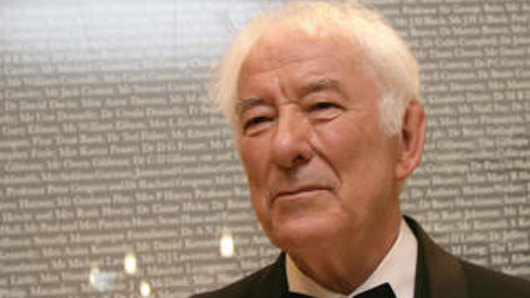
Heaney in Venice in 2008. Credit: Getty
The constellations of his hyperlocal influences are well charted here, as is his progress as a wordsmith. It’s instructive to see in the early and previously uncollected poems how his eventually unobtrusive lineation and the sluice and burr of his unmistakable cadence have yet to consolidate. There are glimpses, but the music of a poem like October Thought, or the very first in the collection, Reaping In Heat, still have the aerial whiff of something pretentiously pastoral, and also an enthusiasm of alliterative feeling reminiscent of Hopkins. In the case of Reaping In Heat this is partly because he describes an almost Virgilian scene, mowing, by hand with a scythe, and thus, unlike the poet’s father digging for potatoes, the poem seems more local somehow to “literature” rather than to the actual Derry ground he came from.
In the end, with it all laid out in front of us and properly contextualised by this edition, Heaney’s poetry seems all about that ground, its deep psychic grip, its familial texture and endemic sound. Bitten at first by the pleasure of language, he found himself gradually enlisted by time and place into an ancient trade requiring all his moral fibre and thus his sense of imaginative independence too.
In a late poem, from his last collection, Human Chain, he riffs on the Bretagne poet Eugene Guillevic’s paean to the herbs of his region. With his ear for Celtic commonality, Heaney transports Guillevic’s continental original to his own patch, has some fun with it, but also seizes on the herbal as a way of telling us what is so profound about his approach.
Loading
That he looked as hard and conscientiously at the world around him as he did into himself is perhaps the most admirable thing about his art. That he tuned his voice to balance the two was his great achievement. Unity of being was also Yeats’ ambition but for Heaney, the ongoing music of a poem was in the squelch of lough margins as much as it was in the singing bird on the golden bough.
The Booklist is a weekly newsletter for book lovers from Jason Steger. Get it delivered every Friday.