Why batting is so difficult in this Test series heading into SCG match

The wobble seam is bowled with the fingers wide of the seam and held loosely, rather than in a conventional upright position. This delivery wobbles in the air. After pitching, the delivery moves in one of three directions: away from the batsman, into the batsman, or it remains along its previous path, without deviating.
Bowlers themselves are not even sure about how the ball will move. “No one really knows whether it’s going to nip or not, and which way it’s going to nip,” former England fast bowler Chris Woakes said earlier this year. “If you don’t know, the batter doesn’t.” The uncertainty over which way the ball will move makes the wobble seam venomous.
Consider two of Boland’s wickets this series. On the third evening in Brisbane, Harry Brook shaped to defend, assuming that the ball would hold its line. Instead, the delivery moved away a scintilla, and kissed the outside edge.
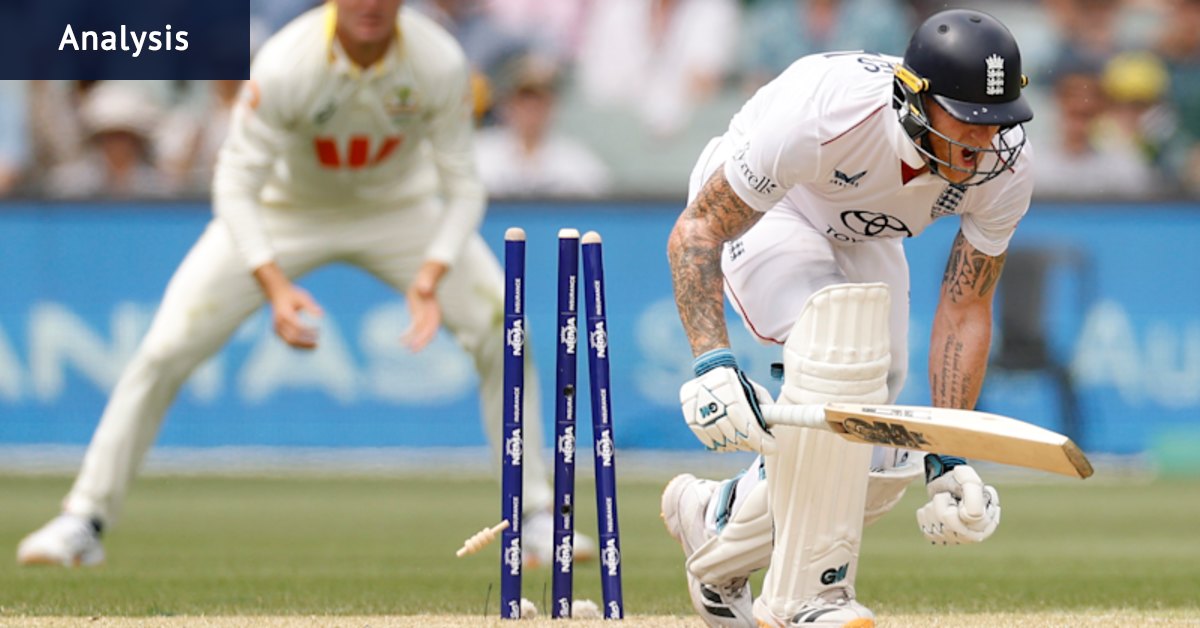
On the first evening in Melbourne, Jamie Smith pushed forward to defend, just as Brook had done. This time, the batsman was deceived by a delivery that curved in to uproot his middle stump.

Like many of his fellow batters, Marnus Labuschagne has endured some Ashes pain.Credit: Getty Images
Like many supposed modern inventions, the wobble seam is really a reinvention. In the 1990s, Curtly Ambrose, Courtney Walsh and Allan Donald all bowled what would now be known as the wobble seam, using the delivery to try and nullify Sachin Tendulkar.
The modern incarnation of the wobble seam was popularised by Australia’s Stuart Clark and Pakistan’s Mohammad Asif in the late 2000s. Observing Asif in 2010 led James Anderson to develop the ball – to great effect – in time for the 2010-11 Ashes. In the 15 years since, the delivery has increasingly become the default for leading quick bowlers around the world.
Batting ‘blind’
Physics explains why the wobble seam is so lethal. Facing 130km/h bowling, a batsman has about 0.55 seconds between the ball being delivered and reaching them. This decreases further, to 0.4 seconds, when speeds reach 145km/h.
Batsmen must commit to their shot 0.15 seconds before the ball reaches them, as demonstrated by research by David Mann, who has worked with Australian Test batsmen. During the last 150 milliseconds of a ball’s trajectory, a batsman is effectively blind. In this period, batsmen cannot make any further adjustments to their strokes.
With wobble seam, all the deviation occurs in these 0.15 seconds, when it is too late for batsmen to change their shots. This is why Brook and Smith were both dismissed by Boland’s wobble seam, but by deliveries that moved in the opposite direction.
While Mitchell Starc has used swing devastatingly this series, even he now uses wobble seam regularly. Though swing is more alluring than seam, it gives batsmen more visual cues about what to expect, based on how the ball is delivered, and more time to adjust, as the ball movement happens before pitching.

Scott Boland’s accuracy has troubled England.Credit: Getty Images
From 2017-24, balls that swung more than 1.5 degrees in Tests averaged 23 runs per wicket. Balls that seamed more than 0.75 degrees averaged just 17. Half as much seam, then, is more dangerous than twice as much swing.
Unrelenting accuracy
While progress is hard to measure precisely in such a multifaceted game such as Test cricket, there is strong reason to think that today’s Test seamers are more accurate than ever before. This observation is not to disparage past greats, but recognise the greater depth of today’s Test attacks, and how they are better equipped to absorb injuries.
Even in the absence of two of their three leading seam bowlers, Australia have demonstrated remarkable accuracy: the ability to pound out a good line and length relentlessly, thereby maximising all assistance offered.
One finding by CricViz, the data-tracking company, emphasises Boland’s skill. Based on a player’s ability to bowl on both a good line and length, Boland is the most accurate seamer in history, since ball-tracking data was introduced in 2005. This makes Boland more accurate even than Glenn McGrath, when he was recorded at the end of his career.
Green pitches
Three millimetres of grass: that was all it took to cause national uproar down under. These three millimetres at the MCG were the difference between the 7mm of grass for last year’s MCG Test against India, a classic that finished in the last throes on day five, and the 10mm for this year’s two-day affair.
The MCG’s curator – to use the nomenclature beloved in Australia – Matt Page said that he was in a “state of shock”. The pitch was officially graded “unsatisfactory” by match officials. The opening Test, at Perth, also offered appreciable seam movement to go with bounce.
Yet either side of these Tests, batsmen have thrived. Across Brisbane and Adelaide, the teams averaged a combined 34.9 per wicket – the equivalent of a very healthy 349 being scored in all four innings of the match. The difference between these two Tests and the games in Perth and Melbourne illustrates how greater deviation transforms the dynamics of matches.
Batters’ responses
Aspects of batting technique this series can justifiably be criticised: at Melbourne, Smith was bowled through an inviting gate between bat and pad. Modern batsmen have far less experience in defending than players of previous generations, before the short-formats mushroomed.
Brook’s response to walking out at eight for three in England’s first innings at Melbourne showed the very different approach that is today’s zeitgeist. Facing Starc with the new ball, Brook charged down the pitch and attempted a huge swipe that met only thin air. “Oh what has he done? Oh dear me,” exclaimed Jonathan Agnew live on Test Match Special, speaking for thousands of English cricket fans.
Loading
Yet there was method in Brook’s audacity. On a pitch offering such lavish seam movement, his approach aimed to meet the ball before it could deviate off the pitch, and score runs before he encountered a fatal delivery. Remarkably, the English batsman advanced down the wicket to five of his first 15 balls. For all the mocking, Brook’s plan worked. He scored more runs than anyone on either side in the Test, making a total of 59 for only once out.
Joe Root adopted a far more orthodox approach, the sort that would be free from criticism if it failed. Yet he still only lasted 53 balls in the Test and made a duck and 15 across the two innings.
Perhaps batting techniques have indeed declined. But to see such a high-class technician as Root flounder at the MCG was to be reminded that when bowling is this accurate, on a pitch offering abundant movement, batsmen’s agency in their fate is limited.