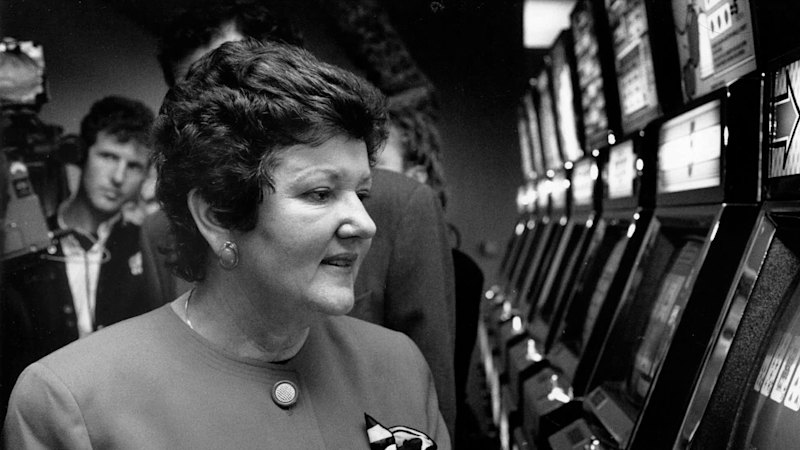
First-ever release of Victorian cabinet documents reveals pokies warning

Ministers were also warned of the risk of a run on the bank as the financial situation became publicly known. The bank was eventually sold amid much controversy to Commonwealth Bank.
As cabinet tried to rescue its own finances and the state economy, Kirner oversaw the rollout of poker machines, an idea canvassed by Cain’s team in 1982 but which he strongly opposed.
Then attorney-general Jim Kennan headed their Gambling Review Committee which pushed for the machine limit as well as a maximum bet limit of $100.
But a recommendation from within the Department of Premier and Cabinet argued against this, saying there should be no limit and machine numbers should be determined by the open market.
“If part of the government’s strategy is to enhance community facilities at clubs, and possibly pubs, this activity will not be financed by only 30 machines,” it says.
“This restriction will be very strongly opposed by all large clubs, pubs, the TAB and racing interests.”
Kirner’s cabinet was also warned that no maximum machine limits would risk pokies being concentrated in just a few venues, which pushed them towards a “compromise number” large enough to justify spending money on the machines.
It was recommended that machines have a $2 limit if located in places of “unrestricted entry” that did not have age limits or dress code restrictions, a policy that was adopted and remained until machines were restricted to adult-only zones years later.
Kennan advised cabinet that these policies would cater for gamblers in search of a casual “flutter”.
“The bet limits in ‘uncontrolled’ venues will inhibit a ‘flutter’ from becoming heavy gambling unless the person concerned has made such a conscious decision,” he wrote.
Cabinet was also advised to adopt laws that ensured at least 88 per cent of turnover from machines made its way back to players, with 7 per cent going towards government, 2 per cent to the operator and 3 per cent to licensed clubs.
The legislation that eventually passed parliament laid down a turnover rate of 87 per cent. This ratio was reduced to at least 85 per cent in 2014.
The reforms introduced under Kirner led to 10,000 machines being installed across Victoria. The Kennett government allowed further expansion of pokies until 1999, when a 30,000-machine limit was imposed amid growing community concern.
Since then, governments have routinely tried to wind back the impact of these decisions with trading-hour restrictions, maximum bet reductions and the still-pending introduction of carded play.
Kirner, who died in 2015, expressed regret about the rollout to The Age in 2004 and backed a review of what “Jeffrey’s government and my own government decided”.
“Restricting them to the casino alone is a remarkably good idea,” she said at the time.
“It is time for tighter controls – but that’s a matter for the government.”
The cabinet papers from 1982-1992 also reveal one of the biggest issues that dogged the Cain and Kirner years was the state’s increasingly perilous financial situation.
Interest rates as high as 17.5 per cent contributed to the downfall of merchant bank Tricontinental and with it the overarching State Bank of Victoria.
Tricontinental was essentially allowed to run up hundreds of millions in bad debts, leaving the state bank and the Victorian taxpayer on the hook.
The cabinet papers reveal Roper wrote a “letter of comfort” to the state bank in July 1990 promising that the government would protect its financial position.
The documents show this meant going even further than covering the $795 million in bad debts they had already expected from the Tricontinental saga.

Tom Roper provided a ‘letter of comfort’ to the State Bank.Credit: Geoff Ampt
Both banks’ debts had grown so significantly between February and July that the cabinet was told they would need to cover liabilities and interest costs of about $2.3 billion. This was expected to cost the state budget $120 million in 1990 alone, growing to $340 million a year by 1994.
The alternative presented to Cain’s cabinet was to do nothing until the financial figures of the state bank were finalised. However, they were warned in that scenario any market rumours or leaks could lead to the bank’s collapse and require a federal bailout.
“A substantial run on the State Bank would be beyond the financial resources of the state and would depend on the Reserve Bank for a cure,” they said.
By August 10 that year, Cain had been replaced by Kirner as premier and records from 10 days later show the government canvassed massive asset sales to save its own financial position.
Under its debt management strategy, the cabinet was asked to consider selling off the state bank, the Loy Yang B power station, its softwood plantations, the State Insurance Office, the Rural Finance Corporation and half of the Gas and Fuel Corporation.
The State Bank of Victoria was sold for $2 billion and the State Insurance Office sold for $227 million in 1992.
A 51 per cent share of Loy Yang B was sold in 1992, but it wasn’t fully privatised until 1995, alongside much of the State Electricity Commission’s assets.
The Gas and Fuel Corporation was broken up into three entities by the Kennett government in 1997 and privatised.
Although Kirner’s asset sales did not go as far as Kennett later would, they attracted significant criticism from within the Labor Party.
In her first week in office, the newly released documents show cabinet received a submission from the ALP calling for a reduction in the number of lower house MPs from 88 to 85 and upper house seats to 17 to show the government was sympathetic to the challenges of the time.
“The adoption of this proposal would enable the premier on budget night to announce to the Victorian people that the severe cutbacks they are being asked to take are being shared by the parliamentarians,” the submission said.
“Headlines of ‘horror budget: welfare recipients slugged’, could be replaced by ‘MPs slashed: Government shares the pain’.”
These were the first cracks in the Labor factional coalition that had been built after decades in the political wilderness.
By March 1991, further signs of strain emerged as two ministers were scolded in official submissions from the same cabinet meeting.
Agriculture minister Ian Baker was accused of not consulting his colleagues before telling the NSW and Commonwealth governments the state did not support the release of treated effluent into the Murray River.
The premier’s department advised against supporting Baker’s submission on the matter and recommended that they ask him to consult other ministers before briefing on cabinet submissions.
“Mr Baker has chosen to convey a Victorian Government position without consulting all relevant ministers,” the documents say.
In the same meeting, a briefing note from the premier’s department criticised finance minister Tony Sheehan for bringing a submission to support a housing development project in Footscray known as Quay West.
“You should be aware that while the submission indicates that the Department of Premier and Cabinet was consulted, we were not advised by either the Ministry of Finance or Treasury that a submission was under preparation, and we do not support the minister’s recommendations,” they said.
Baker was later criticised for public comments he made about cabinet’s decision-making abilities which he said were taken out of context.
Sheehan, who went on to be named treasurer from January 1992 until Labor lost the election in October, accused Kirner after the defeat of walking away from their plan to balance the budget by 1994.
Despite the scandals and infighting that consumed its third term in office, the Labor government achieved significant reforms.
Monash University emeritus professor of politics Paul Strangio said it could be argued that Cain was the most transformative Victorian premier of the last 50 years, modernising government processes and taking Labor from nine successive election losses to becoming the regular party of government in the state.
Voting was reformed to enshrine the “one person, one vote” principle and an independent electoral commission created, a policy mimicked by the federal Hawke government.
“Cain himself spearheaded legal or electoral reforms underpinned by the principles of transparency, accountability and independence from political interference,” he said.
“The government was pioneering in Australia in creating a Director of Public Prosecutions and enacting Freedom of Information laws. Cain used to regularly ring me up to decry what had happened to Freedom of Information later in his life.”
WorkCare, the forerunner to WorkSafe, and the Transport Accident Commission were established alongside VicHealth, which it was recently announced would be absorbed into the Department of Health next year after decades of independence as part of budget cuts by the current state government.
Cain also oversaw brothels being legalised, liquor licensing laws liberalised, firearm controls tightened, tenancy laws overhauled and shop trading hours extended, Strangio said.
Loading
Nighttime lighting at the MCG and the decision to make Melbourne Park the home of the Australian Open were both significant contributions to Victoria’s sporting landscape.
Kirner, as education minister, oversaw the establishment of the Victorian Certificate of Education that we know today and as conservation minister brought farmers and communities together to create the LandCare movement.
In its final term, the government was devastated by factional conflict, financial calamities and public sector industrial disputes.
Strangio said that by the time Kirner took over from a “broken” Cain, the government was doomed.
“Her two years in office largely comprised crisis management as she tried to stabilise Victoria’s ailing economy, hold together a restive party and parry the trade union movement,” he said.
“Her chief legacy as premier was selling the debt-laden State Bank of Victoria to the Commonwealth Bank, following negotiations with the federal treasurer Paul Keating.”
Strangio said there was also an element of the “glass cliff” for Kirner, in which a female leader inherits office in impossible circumstances.
He said it was a tragedy that the reputation of Cain’s government was sullied in its final years, given the premier was a stickler for probity who would pay his own postage, return gifts and decline first-class flights.
“The end of his premiership had echoes of what had befallen his father [former premier John Cain snr], a government devoured by its own,” Strangio said.
“But despite its unhappy end, in my view, there’s no question that the Cain government changed Victoria overwhelmingly for the better, and it did so with a seriousness of purpose, clarity of principle and decency which were the hallmark of its premier.”
Start the day with a summary of the day’s most important and interesting stories, analysis and insights. Sign up for our Morning Edition newsletter.