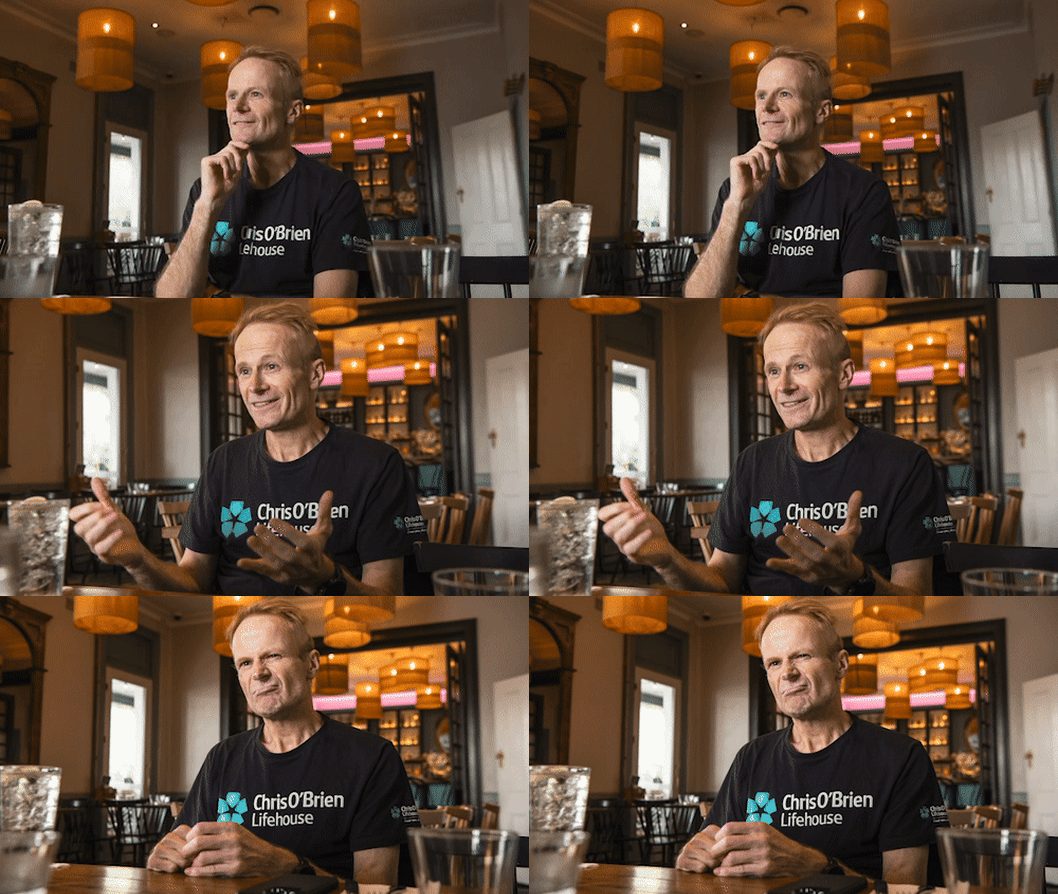
Richard Scolyer contemplates the future

It’s drizzling as Professor Richard Scolyer arrives on his bike for lunch. We hug a greeting outside The Royal Hotel in Leichhardt, a short ride from his home in Sydney’s inner west, then the former Australian of the Year chains it to a pole.
More than 2½ years after being diagnosed with a lethal brain tumour, Scolyer is still cycling, still running his local five-kilometre Parkrun just about every Saturday and still confounding expectations.
Since taking on a world-first treatment that could have killed him at any time – a combination of three immunotherapy drugs and a personalised cancer vaccine – the internationally renowned pathologist and cancer researcher has shown amazing resilience, lasting well past the median survival for his savage glioblastoma of 14 months.
The outlook was grim when an operation last March confirmed the tumour that had been largely excised during what’s called debulking surgery was aggressively growing back. But he has exceeded expectations again that he had just a few months to live.
And even though Scolyer now believes he is slowly declining, he is delighted to have reached more milestones: his 59th birthday in December, another Christmas, and another summer holiday with his family – wife Katie and children Emily, 21, Matthew, 20, and Lucy, 17.
“Now we’re 2½ years out and we can have a chat like this, I’m astounded and very, very happy,” he says at our table upstairs. “I keep getting told that – not in these words – ‘you don’t have much time left, and you’re gunna die within a month most likely’ and, for whatever reason, I still keep going.
“I really hope that’s because of this treatment. That it can make a difference for other people, but it could be luck.”
Prime Minister Anthony Albanese, who announced $5.9 million in funding to establish the Richard Scolyer Chair in Brain Cancer Research at Chris O’Brien Lifehouse in September, called him “inspiring to millions”.
That reflects the courage Scolyer has shown in trying to reinvent brain cancer treatment with joint 2024 Australian of the Year Professor Georgina Long. The then co-medical directors of Melanoma Institute Australia – he has since stepped down – ignored the standard treatment of surgery, chemotherapy and radiotherapy to tackle his cancer and instead trialled what they had learnt successfully treating patients with advanced melanoma.

“I’m not at the capacity that I was some time ago”: Richard Scolyer.Credit: Steven Siewert
Scolyer has also been inspirational for his openness and positivity in chronicling the ups and downs of his treatment, including in the bestselling memoir that we wrote together, Brainstorm, and with regular posts on social media.
He has been hard to pin down for a Lunch With interview, though. Months earlier he chose The Royal, a favourite place for family dinners, but had to cancel twice when he wasn’t well. After some difficult weeks, particularly during an experimental drug treatment, then the devastation of the tumour’s return, Scolyer is back to his usual upbeat self.
But he admits to short-term memory problems that include struggles with words. “I forget people’s names, which is probably the worst thing that I do,” he says. “It’s not just people who aren’t real close to me. Sometimes I get one of the kids’ names wrong or people I know really well.”
Scolyer says he was mortified when he recorded a video for a Tasmanian Aussie Rules team that he is the No.1 ticketholder for, the Bridgenorth Parrots, and realised when he watched it days later that he had not only got the town’s name wrong but had called his treatment centre “Chris O’Brien Landscaping” instead of “Lifehouse”. The players reportedly found the video inspirational anyway.
Loading
When he learnt from a scan that the tumour had crossed to the other hemisphere of his brain, it was a blow late in the year.
“The two sides of your brain are only connected [in a few places], and for it to go to the other side, that ain’t good news,” he says. “I’m not at the capacity that I was some time ago, and the X-rays correlate with it getting worse, showing more disease.”
How does he react to setbacks now? “It pisses me off, but I’m more accepting of changes,” Scolyer says. “The fact I’ve spent so much time with my kids, which I didn’t expect, that’s been good.”
Despite what he says, he looks healthier than when we’d caught up for an impromptu pizza a few weeks earlier. While a couple of extra kilograms has made him less drawn in the face, recent radiotherapy has left him with a ring-barked hairstyle that, to his credit, he doesn’t cover up with a hat.
Not wanting his medical team (or readers) to think he is letting himself go, Scolyer contemplates a burger then orders a fattoush salad with avocado. I go for a sweet potato salad with chicken and, to round out a healthy lunch, we’re both drinking mineral water.

Fattoush salad with avocado at The Royal Hotel.Credit: Steven Siewert
Keeping fit has continued to be important to Scolyer during treatment. Having now passed 270 Parkruns, the longtime triathlete’s next sporting goal is cycling the Tasmanian stages of the Tour de Cure cancer research fundraising ride with Matthew in March. (He grew up in Launceston and still visits his father, 90, and mother, 89, when he can.)
“I’m happy to take risks now,” Scolyer says of the new challenge. “The writing’s on the wall. I’ve been here for much longer than was expected and want to do those things with my mates, getting out there and enjoying life. One thing that’s really come home for me is the importance of doing things that you like doing.”
While still not entirely comfortable being a public figure, Scolyer tries to use his profile to push for more funding for research into brain tumours.
“The biggest thing is to try and make a difference in this field of cancer,” he says. “It’s not funded well enough to push things along. It’s a difficult tumour to get into – it’s inside your brain, it’s got big bones, skull, around it. The brain itself doesn’t have spare cells that are not so vital there. The way some of the tumours grow is through subtle, peripheral, infiltrative growth.

Sweet potato salad with chicken.Credit: Steven Siewert
“Basically, you can’t see it on radiology, you can’t see it [during surgery]. The pathologist can see more, but you’re still struggling to find the end of it. So it’s a tough disease to do something about. We’ve got to find ways to do it better.”
The food arrives and proves to be as tasty as it looks. What does he do now when he feels especially low? “Different things at different times,” Scolyer says. “Just lately, my threshold for being disappointed about small things is different. That’s partly the effect of the tumour, but it’s only with close family members. They’ve copped it more than others.
“But I feel like I’ve come out of a hole. A lot of things are changing. My sleep isn’t what it used to be [during much of his treatment] – 10 or 12 hours. I’m back to seven hours.”
One of Scolyer’s treatment centres is Chris O’Brien Landscaping – sorry, Lifehouse. When he was a junior doctor at Sydney’s Royal Prince Alfred Hospital, O’Brien mentored him, and they worked on research projects together. So it’s a cruel irony that Scolyer now has the same type of cancer that killed the famous head and neck surgeon around the same age, 57, in 2009.
Has he ever wondered whether there is something about their work or the hospital environment that caused both their glioblastomas?

The bill for lunch at The Royal Hotel in Leichhardt.Credit:
“That’s a great question,” Scolyer says. “We don’t know is the bottom line. I’ve certainly wondered that. Is there some association? But it doesn’t add up. People in different fields get this sort of cancer.”
How long does he think he can last? “Excuse me while I chew away,” he says. “But who knows? There are world experts in brain cancer working at some of the best institutions around the country, seeing more patients than anyone else, and they don’t get it right.
“It’s not easy to predict how long you’re going to be here for. Often there are clues for particular tumours – how they’re growing, where they are, how big they are, their proliferative activity, the tissues that they’re invading. They can [indicate] how long you’re likely to be here for, but it’s not 100 per cent.”
After our plates have been cleared away, Scolyer orders an Earl Grey tea. I go for a skim cappuccino. Lunch has gone quickly in such engaging company.
Like everyone else who knows him or has even just watched him on Australian Story or A Current Affair, I’m hoping Scolyer can keep going for years.
Loading
As our tea and coffee arrive, I fumble around to ask a difficult question for someone so full of life, so enthusiastic about reaching new milestones and so determined to improve the outlook for future brain cancer patients: how much has Scolyer thought about what will happen as the end nears?
“It’s going to happen,” he says thoughtfully. “It’ll be sad. I think it will be harder on my family, particularly my wife Katie, than it will be on me.”
He pauses. “If you can’t function properly, it’s hard for people to continue to look after you. Everyone might have a different idea, but I’m comfortable with it being quicker rather than slower. And I hope my family is able to get on with life and keep being such wonderful people and doing good things for society.”
Get the day’s breaking news, entertainment ideas and a long read to enjoy. Sign up to receive our Evening Edition newsletter here.