2026 prediction amid countdown to the next apocalypse

Loading
Then the Cold War began thawing. In 1988, the clock went back to six minutes, after the US and the Soviet Union signed the first treaty ever to ban an entire category of nuclear weapons (those mounted on intermediate-range missiles). In 1990, it hit 10 minutes, after the Berlin Wall crumbled, and with it the Iron Curtain.
In 1991, the clock touched 17 minutes, the farthest from midnight it has ever been. Intellectuals celebrated the “end of history” and the apparent dawn of pacific and liberal democracy for all humanity. At long last, the superpowers junked thousands of their nukes, as they had implicitly promised in the NPT. And they stopped all explosive testing of nukes, even underground.
The era of good feelings didn’t last long, though. By the late 1990s, both India and Pakistan tested fission bombs. The terrorist attacks of September 11, 2001, caused anxiety that “loose nukes” might fall into the hands of non-state actors with nothing to lose. North Korea tested its first warhead, becoming the ninth nuclear power.
And climate change joined the board’s and world’s worry list. It threatens catastrophe first gradually, then suddenly: by damaging ecosystems, causing floods, storms and droughts (and thus famines), and seeding more pestilence as species come into contact with new organisms and the thawing permafrost burps out pathogens frozen for millennia. By 2007, the clock was at five minutes to midnight; in 2015, at three.
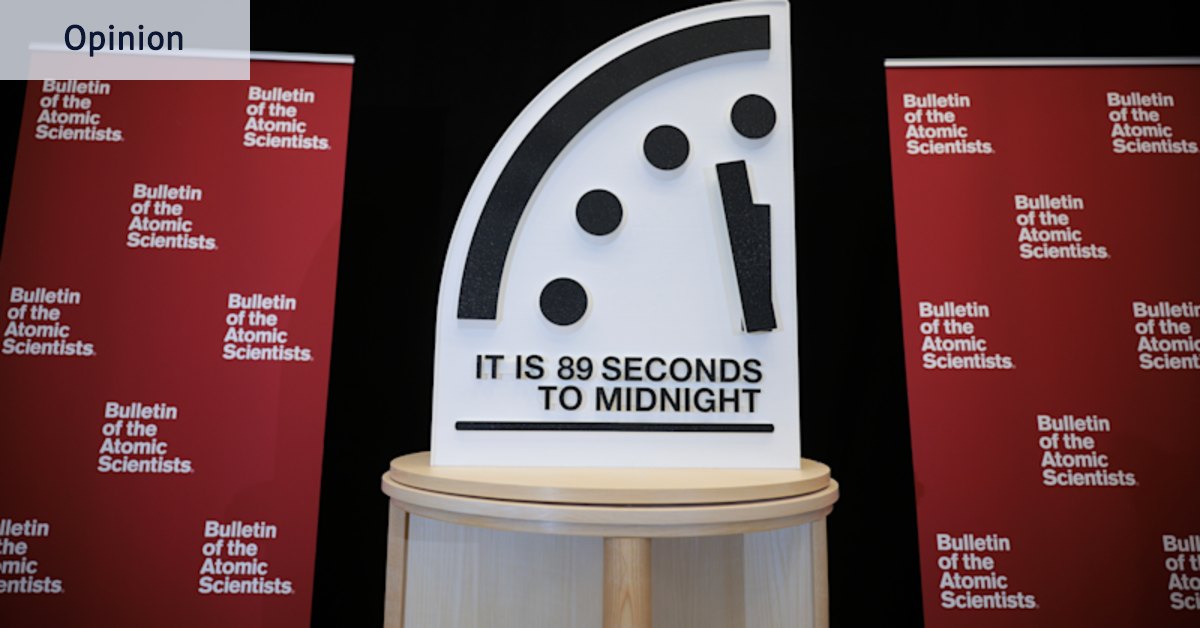
In 2020, during the first administration of Donald Trump and a pandemic, the board switched to quoting the time in seconds: 100 to midnight. It identified yet another threat in the form of “cyber-enabled information warfare”. Memes, disinformation and conspiracy theories now spread like viruses, confusing, distracting and polarising societies and making them “unable to respond” to the existential challenges posed by nukes and the climate.
In 2023, the clock moved to 90 seconds to midnight after Russian President Vladimir Putin invaded Ukraine and broke the ultimate taboo of the nuclear age by threatening to use nukes.

Trump’s erratic second stint in the White House has added a lot of risk. Credit: AP
And this year, it ticked forward another second. Trump was not the reason — he was inaugurated only a week before the announcement. It was instead the urgency of all the existing threats, and the spectre of hidden feedback loops and possible “cascades” associated with our emerging “polycrisis”.
And now, one year on? It seems to me that every threat the Bulletin described in 2025 has gotten more dire.
Nuclear risk, which was relatively easy to comprehend during the Cold War, is now diffuse. The last arms-control treaty between the US and Russia expires in February, and both countries are “modernising” their arsenals, with new warheads, bombers, missiles and submarines.
China is adding to its stockpile to catch up with the big two. North Korea is arming; Pakistan and India are always close to fighting, and sometimes at it. Worse yet, artificial intelligence threatens to make many kinds of weapons “autonomous” and shrink decision times in a nuclear crisis to minutes — the insanity of the resulting psychological stresses has even made it to Hollywood.

The Bulletin and its clock started with Albert Einstein (pictured), Robert Oppenheimer and the other scientists who were genius enough to invent nuclear weapons and wise enough to regret their invention.Credit: Getty Images
Trump has probably made one part of the problem better, if only temporarily: He bombed Iran’s nuclear facilities, setting back its efforts to build a bomb. But he has also increased the risk of general proliferation (and of the NPT’s slow death), by disdaining America’s traditional allies and making them doubt the US “nuclear umbrella” that allegedly protects them. From Europe to Asia and the Middle East, more countries are now considering going nuclear, just as experts are advising them.
Trump also appears close to breaking another nuclear taboo, the moratorium on explosive testing. If the US were to detonate nukes again, China, Russia and other countries would follow suit. And all major nuclear powers are designing new, more manoeuvrable and faster missiles to deliver death on earth, while looking to outer space as the next domain of warfare.
Meanwhile, greenhouse gas emissions keep increasing and the weather is getting more destructive. And yet America, the world’s largest emitter historically – and the second-largest (after China) currently – has officially lost interest.
Loading
As the new National Security Strategy puts it: “We reject the disastrous ‘climate change’ and ‘Net Zero’ ideologies.” The Trump administration boycotted the 30th climate conference of the United Nations in 2025 and will formally exit the Paris Agreement, a treaty to control global warming, on January 27, 2026 — the very day when the Doomsday Clock will be reset.
Also in January, the US will formally quit the World Health Organisation, whose role is in part to look out for and save us from the next pandemic. At home, Trump has put antivaxxers and quacks in charge of public health.
That segues to the other threat the Bulletin worried about last time: misinformation and disinformation. They are “potent threat multipliers,” John Mecklin, the editor, wrote, because they “blur the line between truth and falsehood”.
Since he said that, the blurring seems to have made us all but blind. The board will make its own decision about the clock. If you ask me, it feels like one minute to midnight — or less.
Bloomberg
Get a note directly from our foreign correspondents on what’s making headlines around the world. Sign up for our weekly What in the World newsletter.