Meet the Saudi sisters wielding $75 billion in a man’s world

A US-based representative for the Olayan Group didn’t comment and directed all requests to a Saudi-based spokesperson, who didn’t respond to a detailed list of questions.
Most global executives are reluctant to speak about the family for fear of offending the sisters, who are known to fiercely guard their privacy. This story is based on an analysis of the family’s investments, operating companies and filings of family-owned entities, as well as interviews with more than half a dozen people familiar with the group, who asked not to be named discussing information that isn’t public.
Wall Street bosses
Hutham and Lubna, both in their early seventies, were born in Saudi Arabia to Suliman Olayan. The patriarch was orphaned at a young age and started out working as a dispatcher for the predecessor company of Saudi Aramco, leveraging his fluent English. He mortgaged his house for $US8000 to win a pipeline contract, according to a profile in Time magazine, eventually launching the Olayan Group in 1947.
From there, Suliman diversified aggressively, and the group went on to strike partnerships to sell Colgate toothpaste, Oreos and Coca-Cola in the kingdom. He bought US equities to use as credit with American banks and by 1980, his conglomerate brought in more than $US300 million in annual revenue, according to the Time profile.
Loading
His globalist bent created a uniquely bi-national empire that the daughters were immersed in early. Both studied in the US and were given significant jobs in the family business on their return. After Suliman’s death in 2002, his son Khaled was named chairman of Olayan Group, but Lubna and Hutham helped run much of the family’s vast operations.
Lubna led the Mideast-focused division and Hutham took charge of Olayan America. The sisters married foreigners and took on prominent roles — Lubna was the first woman elected to the board of a public company in Saudi Arabia in 2004. Even then, women’s rights were severely limited in the kingdom. Only in 2018 were women finally given the right to drive.
Low profile
In an interview with NPR in 2018, Lubna recalled the difficulty finding a ladies room in factories and boardrooms because there were usually no women. She began approaching government officials and executives for help boosting the female workforce — all the while being reminded to tread carefully and attempting to avoid confrontation.
“So, you negotiate, you deal, you do this, you take and give,” she said in the interview about those early efforts.
Along the way, the sisters developed reputations for being steely negotiators. Their ascent was aided by an ability to keep a low profile and the duo ensured their business was seen as supportive of the government’s aims.
The group is now officially headquartered in Liechtenstein, with offices around the world, including in Athens, where Lubna’s lawyer husband has deep ties. Over the years, the family has gained a reputation for running a stringently professional organisation that’s sophisticated in its dealmaking at a level not typically seen at family offices.

The Olayans are deemed richer than Prince Alwaleed bin Talal, the royal known as Saudi Arabia’s Warren Buffett.Credit: AP
“The family was very conscious of incorporating corporate governance frameworks into their business, and they did it with a high level of professionalism,” said Josiane Fahed-Sreih, director of the Institute of Family and Entrepreneurial Business at Lebanese American University.
In one sign of their influence, the Olayan family was untouched in 2017 when dozens of Saudi royals, former officials and businessmen, including Alwaleed, were detained at the Ritz-Carlton in Riyadh as the crown prince consolidated power and conducted an unprecedented national shakeup.
Investing misstep
Alwaleed, worth about $US17 billion these days, has made a comeback of sorts in recent years and his investment group has benefited from the kingdom’s construction frenzy. In the 1990s, the businessman was known for a flamboyant lifestyle, frequently pictured on a private yacht purchased from Donald Trump.
The Olayans do things differently.
“Normally we don’t seek the limelight…especially anything splashy,” Hutham said about the Olayan family in a speech to the Arab Bankers Association of North America in 2013. “We avoid excess, and we are pretty frugal.”
Even so, there have been investing missteps. A longtime investor in Credit Suisse, they stuck by the bank even through its downturn, ultimately becoming one of the big losers in the turmoil that culminated with UBS Group’s discount purchase of the troubled lender.
The losses were at a scale that could roil large financial firms, but one international executive recalls the collapse being treated as a relative non-event within the Olayan Group. The conglomerate continued to execute transactions and payments as normal during the period, the person said.
Loading
Saudi National Bank, the Swiss lender’s top shareholder, was among firms that lost money on its investment and its chairman resigned in the aftermath. Meanwhile, the Olayans’ profile has only grown in the years since.
Key to that are their relationships on Wall Street and within the kingdom, particularly as Riyadh has started to intensify pressure on foreign firms to invest more locally and help diversify the economy.
Despite recent fiscal pressures, Saudi Arabia remains a lucrative market for the titans of global finance: Riyadh ranks as one of the biggest issuers of debt in recent years, while the kingdom’s wealth fund has shown an appetite for blockbuster deals like the recent $US55 billion transaction to take Electronic Arts Inc private.
Lubna has close connections to BlackRock co-founder Larry Fink, among others, and was recently named co-chair of the US-Saudi Business Council alongside Citi’s Fraser. Hutham sits on the board of Brookfield, which ranks as one of the biggest private equity investors in the Middle East.
Davos in the Desert
This year, during Saudi Arabia’s Future Investment Initiative conference, often called Davos in the Desert, Lubna hosted a party in Riyadh that had top global financial executives and officials mingling over canapés and rice and lamb, according to one attendee.
Their links run broader than just finance. The US equity investments their father started to amass in the 1960s have grown to $US12.7 billion. These days, the portfolio includes stakes in Microsoft, Alphabet and Amazon. By comparison, Saudi Arabia’s $US1 trillion wealth fund owns just over $US19 billion in US stocks.
The group’s private equity portfolio forms another large chunk, and is estimated to run into the tens of billions of dollars, according to people familiar with the matter. Compounded annual growth rate for direct investments has exceeded 30 per cent over a 10-year period, according to its website. The firm’s real-estate holdings span more than 40 million square feet and 40,000 apartments under management.
At home, the Olayans have backed the kingdom’s biggest efforts. When Saudi Aramco’s $US25 billion IPO struggled to attract international investors in 2019, the Olayan family was among those tapped locally by the administration of MBS — as the de facto ruler is called — to shore up demand.

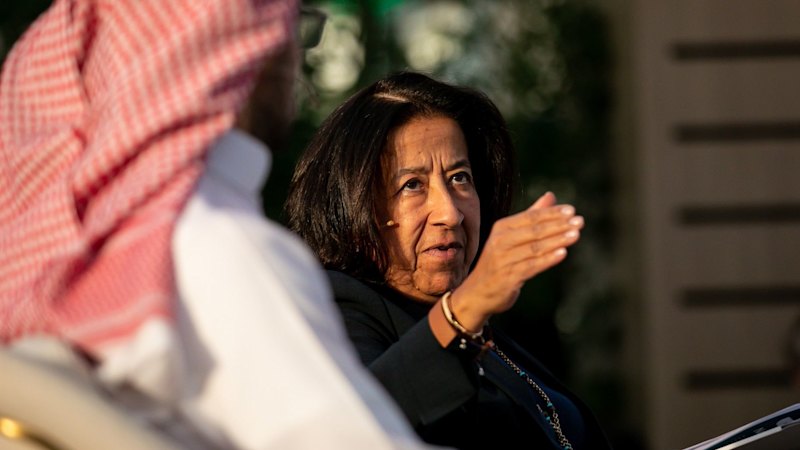
Lubna Olayan has successfully navigated the obstacles for women in the Saudi business world. “You negotiate, you deal, you do this, you take and give,” she says.Credit: Bloomberg
At the same time, the sisters have managed a careful balancing act with their public comments. In 2018, as much of Wall Street avoided the kingdom’s FII conference after Saudi agents murdered columnist Jamal Khashoggi, Lubna used the start of a panel discussion to mourn his death, saying that the act ran counter to Saudi values.
“We are very grateful that the terrible acts reported in recent weeks are alien to our culture and our DNA,” Lubna said in her address.
These days, Lubna is chair of the Olayan Group’s corporate board, according to a recent press release from the US-Saudi Business Council. Hutham chairs the shareholders’ board, the group’s website says.
Day-to-day operations are mostly managed by the likes of Chief Executive Officer Hani Lazkani and Chief Operating Officer Samer Yaghnam, people familiar with the matter said, though the sisters remain the public face of the group and helm broad strategy with family members.
Loading
Multiple people described Lubna as frank and outgoing, with a reputation for being deeply involved with her investments. Like her father, she’s worldly and warm but also incisive, said James Zogby, president of the Arab American Institute and a friend of the late Suliman. “If you talk with her about current events, it’s not just, ‘This happened.’ She understands why things are moving the way they are.”
Hutham, meanwhile, appears soft-spoken and grandmotherly in conversation, but her line of gentle questioning can elicit small details that can serve as fodder for the negotiating table, according to one international executive.
The sisters are among the few people who understand the true extent of their sprawling business in its entirety, and tightly control its financial details. There have been moments in past years when a listing of an operating business seemed imminent, but deals haven’t materialised.
Meanwhile, much has changed for Saudi women in the workforce. In the past seven years, the kingdom has announced reforms allowing women to set up businesses without male consent and travel independently, and many now run private equity funds, trade stocks and work in factories.
“We look for opportunities, even in adversity,” said Hutham in her 2013 speech about her family. “We see silver linings.”
Bloomberg
The Market Recap newsletter is a wrap of the day’s trading. Get it each weekday afternoon.