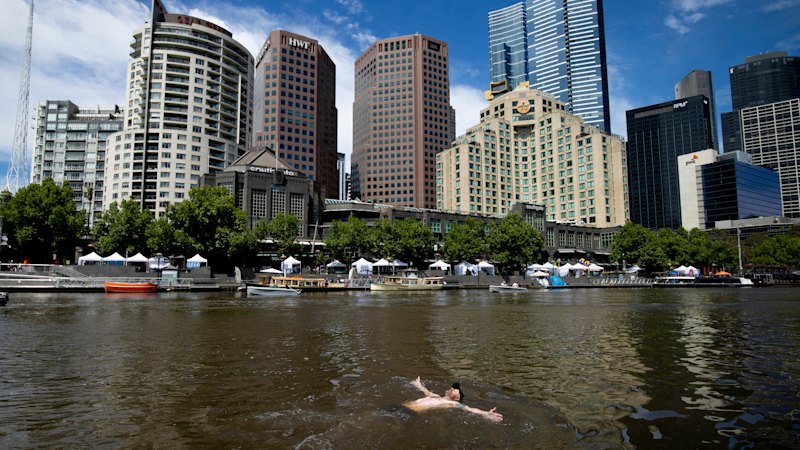
The push to make Melbourne’s waterway swimmable despite E.coli concerns

These days, the Yarra Riverkeeper Association describes the river as “polluted with litter and a cocktail of urban wastes”, noting the water quality in some stretches falls well below the accepted standards for safe swimming.
Riverkeeper Association president Janet Bolitho says it is “absolutely” possible for the more urban parts of the river to become as healthy as its upper reaches.
“Fifty years ago, the Yarra was thought of as a joke – people said it was brown and dirty,” she says.
“Well, it’s not like that any more. It’s much better than it was. We need the next generational shift, which is towards swimmability.”
The association is part of a growing worldwide movement to restore urban rivers to something approximating their pre-industrial state.
From the Seine in Paris, to the Thames in London, the Swimmable Cities movement – spearheaded by Melburnian Matt Sykes – has fought for the right to clean and healthy urban waterways, which can be enjoyed by everyone.
The Swimmable Cities Alliance – which incorporates about 200 organisations in 35 countries – grew after global attention turned to efforts to rehabilitate the Seine during the Paris Olympics.

It took 36 years and a Herculean clean-up operation costing €1.6 billion ($2.9 billion) to make the Seine swimmable.Credit: Getty Images
There is a Wurundjeri phrase, Burndap Birrarung burndap umarkoo, which translates to “what’s good for the Yarra is good for all”.
Sykes says: “It comes back to this [Wurundjeri] wisdom, which is: we know this stuff is connected. So the healthier the waterways become, the healthier that we will become.”
Two challenges confront policymakers and activists working towards improving the health of the Yarra, and they come from the same source: stormwater.
Without litter traps and “river gardens” (planted depressions that collect run-off and rubbish), rain that falls on city streets washes rubbish and pollution into creeks and rivers.
The Environment Protection Authority and Melbourne Water measure another turn-off to swimming in much of the Yarra: E.coli, the bacteria indicating the presence of faecal contamination (overwhelmingly from animal faeces washing into the river, rather than sewage contamination).
Analysis of water samples taken over 12 years shows E. coli levels in Kew are, on average, almost three times the recommended safe swimming threshold of 260 organisms per 100ml of water.
The agencies test at four stretches of water along the Yarra’s urban course: Warrandyte, Healesville, Launching Place and Kew. Of the four, Kew consistently measures the highest concentrations of E.coli.
But the levels are marked by ebbs and flows. E.coli readings are higher several days after heavy downpours, as rainwater washes the city’s muck into the Yarra’s tributaries and the river itself.
Analysis of the test results shows the highest average E.coli readings along the length of the river take place in the warmer months, when people are more likely to swim in the Yarra.
Over the 12 years of data, January recorded an average 781.09 organisms per 100ml – the highest average E.coli values – followed by December with 634.69 organisms per 100ml. Both readings were far higher than the safe swimming threshold of 260 organisms per 100ml.
The cleanest section of the river was at Warrandyte, where an average 283.43 organisms per 100ml of water was recorded (although these results were inflated by heavy rain pushing the average upwards during some weeks).
Two Monash University environmental scientists who have spent years studying microbial levels in the river have challenged the Yarra’s poor reputation and say that for an urban river, it is in relatively good health.

People cooling off in the Yarra River at Warrandyte.Credit: Justin McManus
Senior research fellow in planetary health Dr Rebekah Henry says the overall health of the river – as an urbanised system – has been fairly consistent over the years.
“We use these fecal indicators because they give us this idea of estimated risk. But they are a conservative estimation of public health risk … they’re the guidelines,” she says.
Loading
Henry says testing of Yarra River water during COVID-19 lockdowns showed microbial levels remained relatively stable – a result she described as “good news”.
“Nobody was going out … And the interesting thing was the quality of the river stayed about the same across that period, which means that what’s happening in that dynamic [river] system, whether we were out and about, or not, [there was] this consistency. I think that’s actually the good news here.”
Her colleague, Professor Perran Cook, who specialises in the biochemistry of aquatic environments, concurs.
“I’ll go out on a bit of a limb and say, when you consider the health of the Yarra given the size of the city, and also the geography of the way it sits on an estuary, I don’t think you’ll find many better examples of a river in a city in terms of its water quality,” he says.
“There’s agriculture. There’s urbanisation. [And yet] it’s swimmable in the upper reaches, apart from [after] high rainfall.”
The Morning Edition newsletter is our guide to the day’s most important and interesting stories, analysis and insights. Sign up here.