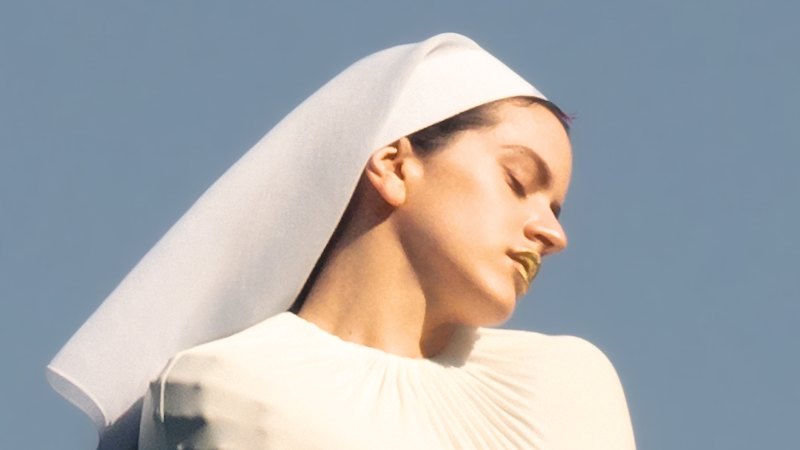
An audacious left turn from a pop auteur

What to make of this startling left turn? In part, it feels like an honouring of Rosalia’s classical pedigree; the now 33-year-old studied guitar from 9 and flamenco from 13 at Barcelona’s Catalonia College of Music, and has been accused of perverting the form ever since her breakthrough, 2018’s El Mal Querer. After Motomami, which earned acclaim but also cries of cultural appropriation for its engagement with Latin American club sounds, Lux leans into European traditions, its liturgical bent a pointed rejection of pop trends and its hedonistic spoils. At times, it plays like a post-breakup surge of Old Testament violence.

Rosalia at the 2023 Latin Grammy Awards, the cite of her crowning success with Motomami.Credit: Vianney Le Caer/Invision/AP
As ever, Rosalia’s at her most intoxicating when lines are blurred, when her classical foundation buffets against modern modes. On Reliquia, as she aligns herself with the saints whose remnants pepper cathedrals throughout Europe – “Me, who lost my hands in Jerez and my eyes in Rome, my heels in Milan,” she sings in Spanish – her melisma writhes over staccato strings and thudding beats, somehow finding the emotional nexus between Vivaldi and Yeezus.
On Divinize, the holy and the base overlap, like on Madonna’s Like a Prayer, FKA Twigs’ Mary Magdalene or Leonard Cohen’s Hallelujah; “Pray on my spine, it’s a rosary,” Rosalia sings, over rattling beats and ascending strings. The final stanza of La Yugular is expansive poetry, as she contemplates the devotion held in the weight of a soul (“a glass of milk occupies an army, and an army fits inside a golf ball, and a golf ball occupies the Titanic, and the Titanic fits inside a lipstick”).
On the waltzing La Perla, the album’s lightest moment, she’s engaging with modern pop’s key form – the barely veiled kiss-off – and taking tabloid-baiting jabs at “an emotional terrorist, the greatest disaster in the world” (it’s almost certainly aimed at Alejandro). It’s necessary because, at times, the solemnity on Lux is a lot to bear.
Loading
Memoria, a fado written by and performed with Portuguese artist Carminho, is so reverential you feel robbed. La Rumba del Perdon is Gipsy Kings for a new generation. And despite its outlandish vocals and closing wink, Mio Cristo Piange Diamanti, Rosalia’s attempt at an aria, just makes me think of Andrea Bocelli in stadium-mode. You can picture The Voice contestants wowing onlookers with it at Carols by Candlelight.
But the audacity is the point. Online, Lux has already sparked debates over whether it constitutes pop or not, or classical or not, or opera or not. You’d imagine Rosalia would embrace the discourse with a bow of her halo and a warm benediction. As any Catholic knows, saintin’ ain’t easy.
Rosalia’s Lux is out now.


