Do Liberals still identify as conservative? And what does that even mean any more?

In April, US right-wing broadcaster-turned-influencer Tucker Carlson invited onto his podcast Matt Walsh, a commentator and podcaster from the right-wing manosphere, whose particular focus is campaigning against trans rights. Chatting with Carlson, Walsh remarked that “the definition of conservatism … it has no definition, I think”.
Walsh said “conservatism” was a word that no longer meant anything because it had been “used and abused and overused”.
“When you tell me that someone is conservative, that doesn’t tell me a lot about them,” he told Carlson. “I don’t know what you mean.”
Carlson went a step further. He said that labelling someone conservative “generally means I’m not going to like them”. “They’re going to be some kind of fraud on the internet … that’s my gut reaction, so discredited has the word become.”
As a term, and as a tradition, conservatism has become confusing. In the United States, it is no longer associated with the Republican Party.
In the United Kingdom, support for the once-great Conservative Party has been hollowed out by the rampaging populists of Nigel Farage’s Reform UK, which commands 27 per cent voter support (according to the latest YouGov poll taken last week). The Tories (and Labour, which is in government) come a distant joint-second on 17 per cent of the vote.
Loading
In the Australian context, the Liberal Party – the traditional home of our conservatives – also seems confused about what conservatism means. Or perhaps it’s something slightly different – that members of the Liberal Party are fully comfortable with their conservative identity, but they are unable to communicate to the voting public what it means, and why we should support it in a contemporary context.
As Victorian Liberal Senator Jane Hume noted on the Herald and Age’s Inside Politics podcast this week, the Labor Party is good at celebrating its historical heroes, even those with a mixed legacy. The recent commemorations of the 1975 Dismissal are a good example.
In launching Troy Bramston’s biography of Gough Whitlam, Prime Minister Anthony Albanese was able to laud Whitlam’s legacy of reform without identifying the contemporary ALP too closely with numerous failures of Whitlam’s government.

Anthony Albanese signing copies of Troy Bramston’s biography of Gough Whitlam at the launch.Credit: Steven Siewert
The Liberals seem less comfortable enunciating what traditional Australian conservative values mean in the contemporary context. Homeownership, especially for young people, seems to be the lowest-hanging fruit. The importance of homeownership is a bedrock of conservatism. It brings financial and psychological security, which in turn provides the stability to start a family.
Loading
The issue is a direct link to Robert Menzies, a totemic part of the Australian Dream, and a problem which the Albanese government has not just failed to improve, but arguably made worse.
Just one idea that might capture voter attention: the Liberal Party could easily wedge Labor with a proposal to wind back negative gearing benefits for property investors who take advantage of it for multiple properties. But no one within the Liberal party room seems brave enough to attempt anything so sensible.
The Liberal party room seems set to topple leader Sussan Ley, later if not sooner. Again, no one within the party room has enough imagination, or enough team spirit, to borrow from one of conservatism’s greatest heroines to bolster Ley’s position.
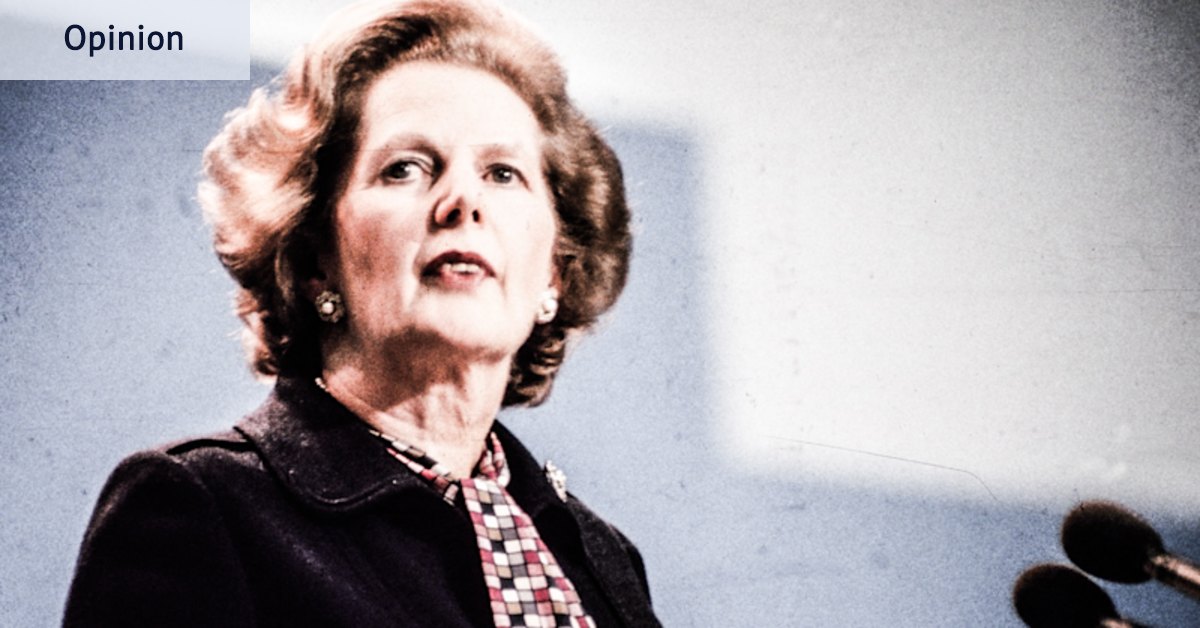
Margaret Thatcher stared down sexism and snobbery to become a Tory titan. She made a virtue of her gender, deliberately positioning herself as a sturdy, sensible and no-nonsense woman who was here to clean up the economic and social messes of Britain in the 1970s.

Margaret Thatcher.Credit: Hulton Archive
As her biographer Charles Moore notes: “She loved to say, The cocks may crow, but the hen lays the eggs; she being the hen.”
Thatcher allowed ageing industries – that is, coal mining – to fail (and largely dismissed the human suffering that ensued); she identified the threat of global warming and moved Britain towards plural energy sources, including renewables. She projected strength.
Just imagine how much President Trump would love to be called the “Iron Man”. By anyone.
Thatcher has many critics, and for just reasons. But she knew what she was, and so did voters.
Until the Liberal party room works out what conservatism means to it, and how to communicate that to the Australian public, it will struggle to do anything much more than haphazardly fight off populism.
Or worse, give over to it.
Jacqueline Maley is a columnist and author.