$1 billion project delayed until end of 2026 due to equipment failure


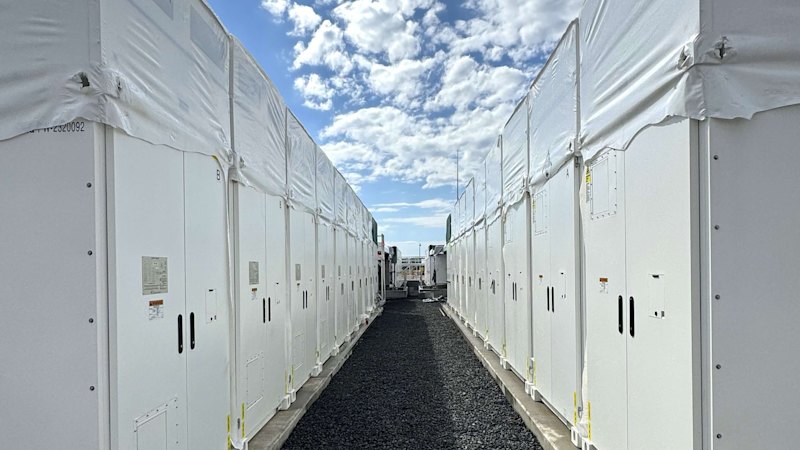
A $1 billion “super battery” designed to smooth Australia’s transition away from coal to cleaner energy sources is facing further delays due to a major equipment failure, pushing its full debut to the end of 2026.
The Waratah Super Battery, a sprawling complex the size of eight Australian Rules football fields on the site of a former coal-fired power plant north of Sydney, was originally scheduled to be fully online by the end of 2025. But a “significant internal fault” in one of its giant transformers during testing in October damaged vital equipment and delayed the scheduled launch of its remaining capacity until May 2026.
On Wednesday, that timeline for it to be fully operational slipped again, this time by up to seven months, marking the latest in a string of clean-energy project delays that have prolonged the need for NSW to rely on coal-fired power stations and put ambitious climate targets at risk.
Officials warn grid-scale batteries that can store renewable energy are essential components of a greener grid because of their ability to provide rapid discharges when it’s needed to plug urgent supply gaps and provide special services required to keep the system stable.
Earlier this year, Origin Energy agreed to delay the closure of Australia’s biggest coal-fired power station, the Eraring generator in NSW, citing the need to allow the state more time to progress new generation, storage and transmission projects amid warnings from authorities that the grid was under-prepared for the plant’s retirement.
The Waratah Super Battery is considered a flagship project of NSW’s energy transition strategy. When it reaches full swing, it will be the biggest grid-scale battery in Australia, and one of the world’s most powerful battery systems in the world, with 850 megawatts of capacity and 1680 megawatt hours of storage, allowing it to run at full power for almost two hours. The system has been designed to initially work like a “shock absorber” to buffer the network from disruptions caused by events such as lightning strikes or bushfires.
However, the battery’s owner, American asset giant BlackRock’s Akaysha Energy, said it was forced to delay its full ramp-up in October following the “significant” internal failure of one of its three transformers – the critical pieces of infrastructure that increase voltage levels so electricity can travel safely across transmission lines. The fault resulted in an “overpressure” event, which ruptured a tank wall and caused the transformer to drain into the surrounding area, the company said.
“Investigations into the cause of this fault are ongoing,” it said.
With just one of its three transformers presently in service, the battery is operating at 350 megawatts of capacity.
Akaysha told the market operator late last year that the fault would delay its full start-up until May 2026, but on Wednesday it said the battery’s full capacity would now not be online until the “end of 2026”.
“The Waratah Super Battery continues to operate with one transformer in service,” Akaysha said in an update on Wednesday. “As a precautionary measure, the second transformer remains offline.”
The project’s contractor, Consolidated Power Projects Australia, has been instructed to replace the failed transformer. Its manufacturer, Wilson Transformer Company, had started production and was due to deliver the replacement transformer to the site in the third quarter of 2026, Akaysha said.
“The remaining capacity of the battery is scheduled to come online by the end of 2026,” it said.
The Business Briefing newsletter delivers major stories, exclusive coverage and expert opinion. Sign up to get it every weekday morning.
 Nick Toscano is a business reporter for The Age and Sydney Morning Herald.Connect via X or email.
From our partners